







Spotlights
Biological Science Laboratory Technician (Biological Science Lab Tech), Biological Science Technician, Laboratory Technician, Marine Fisheries Technician, Research Assistant, Research Associate, Research Specialist, Research Technician, Wildlife Biology Technician, Biotechnology Technician, Environmental Technician, Microbiology Technician, Biotechnology Laboratory Assistant
Have you ever taken a laboratory class, or seen a lab environment in a movie or TV show? If so, you know that labs are tidy, organized places where experiments are conducted and results are observed.
There are many different lab types, but the medical research lab is one of the most common. Medical researchers – usually biologists and scientists – frequently need help from assistants known as Biological Technicians. These assistants run tests and experiments, capture data, study results, and report their findings.
They also keep labs clean and stocked with supplies, maintain equipment, protect samples from contamination, and utilize data analysis programs. Some work with lab animals or go out to collect biological specimens in the field. By managing these tasks, Biological Technicians directly contribute to scientific discoveries related to fields such as environmental research, genetic studies, and drug development.
Biological Technicians may work for universities, government agencies, or private industry employers. They must follow strict protocols, wear appropriate personal protective equipment, and safeguard the data and collections under their care.
- Contributing to groundbreaking scientific research
- Working in a hands-on, lab-based environment
- Supporting advancements in medical, agricultural, and environmental sciences
- Enjoying job stability with a growing demand for biological research
Working Schedule
Biological Technicians tend to work full-time, with overtime possible to meet deadlines. They usually work in laboratories but may also take trips to field sites.
Typical Duties
- Conduct and assist in various types of medical research.
- Assist in the design, preparation, and execution of lab experiments, following regulatory and safety protocols.
- Set up, adjust, calibrate, clean, and troubleshoot lab and field equipment.
- Order and maintain supplies and equipment.
- Ensure work areas are clean, organized, and prepared.
- Collect biological samples. Handle samples carefully to ensure their integrity and avoid contamination.
- Measure and prepare compounds, solutions, reagents, and animal feed for lab procedures.
- Prepare, isolate, and examine specimens to detect diseases or analyze biological properties.
- Run tests to determine the physical and chemical properties of substances.
- Feed and care for laboratory animals, if applicable.
- Monitor experiments and collect data. Use software to record, analyze, and interpret data.
- Create data-driven reports. Maintain records of activities. Input data into databases.
Additional Duties
- Provide technical support to researchers, as needed.
- Review articles or scientific literature to support ongoing projects and keep up to date on advancements.
- Train new lab assistants.
- Wear appropriate personal protective equipment at all times.
Biological Technicians help scientists understand living things by collecting samples, conducting experiments, and analyzing biological materials. Their work might involve studying bacteria that cause disease, testing water for pollution, examining plant cells, or helping researchers investigate how a new medicine affects the human body. They work in laboratories, hospitals, universities, pharmaceutical companies, government agencies, and research facilities. Some spend most of their time indoors using microscopes and laboratory equipment, while others collect samples outdoors from forests, farms, rivers, and other natural environments.
A typical day might begin with preparing laboratory materials, organizing samples, checking equipment, and reviewing instructions from a scientist or research supervisor. Biological Technicians may grow bacteria or cell cultures, prepare slides, extract DNA, measure chemical substances, or perform tests on blood, tissue, soil, and water samples. They carefully follow experimental procedures, record observations, enter results into computer databases, and help researchers interpret the findings. They also clean and sterilize equipment, maintain laboratory supplies, and make sure experiments follow safety guidelines.
Biological Technicians use microscopes, centrifuges, pipettes, test tubes, laboratory glassware, incubators, and specialized testing instruments. Depending on their field, they may also use computer software to organize data, analyze results, or create charts and reports. Accuracy is essential because even a small mistake in measuring, labeling, or handling a sample can affect an experiment. They often work as part of a research team alongside biologists, microbiologists, medical scientists, and other laboratory professionals. Their work helps advance scientific knowledge, improve healthcare, protect the environment, and develop new products and technologies.
Soft Skills
- Analytical thinking
- Attention to detail
- Communication
- Curiosity
- Focus
- Integrity
- Organizational skills
- Patience
- Problem-solving
- Teamwork
- Time management
Technical Skills
Biological Technicians need hard skills related to the following:
- Laboratory techniques and procedures (e.g., sterilization and sample preparation)
- Data analysis and statistical software (Excel, R, and laboratory management software)
- Data entry
- Field sample and specimen collection (spectrophotometers, microscopes, and PCR machines)
- Laboratory instruments and equipment
- Health, biological, and chemical safety protocols
- Microscope operation
- Technical writing and documentation
- Biological sample preparation and handling
- Animal caretaking
- Molecular Biology Technicians: Study biological materials at the molecular level, including DNA, RNA, and proteins. They may help researchers investigate genetic conditions, identify organisms, or understand how cells function.
- Microbiology Technicians: Work with microorganisms such as bacteria, viruses, fungi, and other tiny organisms. They grow cultures, perform tests, and help identify microbes that may cause disease or affect food, water, and the environment.
- Cell Biology Technicians: Study cells and how they grow, divide, and respond to different conditions. They prepare cell cultures, examine samples under microscopes, and assist with experiments involving living cells.
- Biotechnology Technicians: Help develop and test biological products and processes used in medicine, agriculture, food production, and industry. They may work with genetically engineered organisms, enzymes, vaccines, or other biotechnology products.
- Environmental Biology Technicians: Collect and examine samples from soil, water, plants, and wildlife to study environmental conditions. They may help researchers monitor pollution, investigate ecosystems, and assess the effects of human activities on the environment.
- Wildlife Biology Technicians: Assist wildlife researchers with studying animal populations, habitats, and behavior. They may collect field samples, track animals, record observations, and help monitor endangered or threatened species.
- Plant Biology Technicians: Support research involving plants, crops, and plant diseases. They may grow plants under controlled conditions, test soil and plant samples, study plant genetics, and help develop improved crop varieties.
- Marine Biology Technicians: Assist scientists who study marine organisms and ocean environments. They may collect water and organism samples, monitor aquatic conditions, and help investigate marine ecosystems.
- Clinical Laboratory Research Technicians: Assist with biological research involving human specimens such as blood, tissue, and other bodily fluids. They prepare samples, perform laboratory tests, and help researchers investigate diseases and potential treatments.
- Research institutions
- Pharmaceutical companies
- Colleges and universities
- Government agencies
- Environmental consulting firms
Biological Technicians are expected to perform their duties with precision, adhering to established protocols to ensure the reliability of their findings. This attention to detail demands focus and diligence because even small mistakes can destroy the validity of an experiment. Accuracy and quality assurance are therefore essential.
The work can be challenging and even frustrating sometimes because experiments don’t always produce the desired results. Biological Technicians have to be patient and resilient, often repeating procedures over and over to validate findings.
Safety is another critical aspect of the job since there is a risk of exposure to hazardous chemicals or biological specimens. Everyone in the lab has to prioritize safety, strictly follow protocols, wear appropriate protective gear, and avoid making mistakes that could have harmful consequences. They also have to be up to speed on contingency plans in the event of an emergency.
Lab workers increasingly use AI, automated processes, and specialized software to streamline data collection and analysis, so they can handle larger datasets and deliver results more efficiently. This ultimately enhances the scope and impact of the work they’re doing!
The demand for genetic testing, environmental monitoring, and biomedical research has grown in recent times, creating new opportunities for research studies. In addition, technicians are increasingly involved in work that addresses healthcare outcomes, environmental degradation, and other global challenges.
Meanwhile, many labs are adopting more eco-friendly practices, such as minimizing waste and using renewable materials, to contribute to sustainability efforts.
Biological Technicians may have enjoyed hands-on projects like school science experiments, gardening, or observing nature. They often excelled in biology, chemistry, and other science courses.
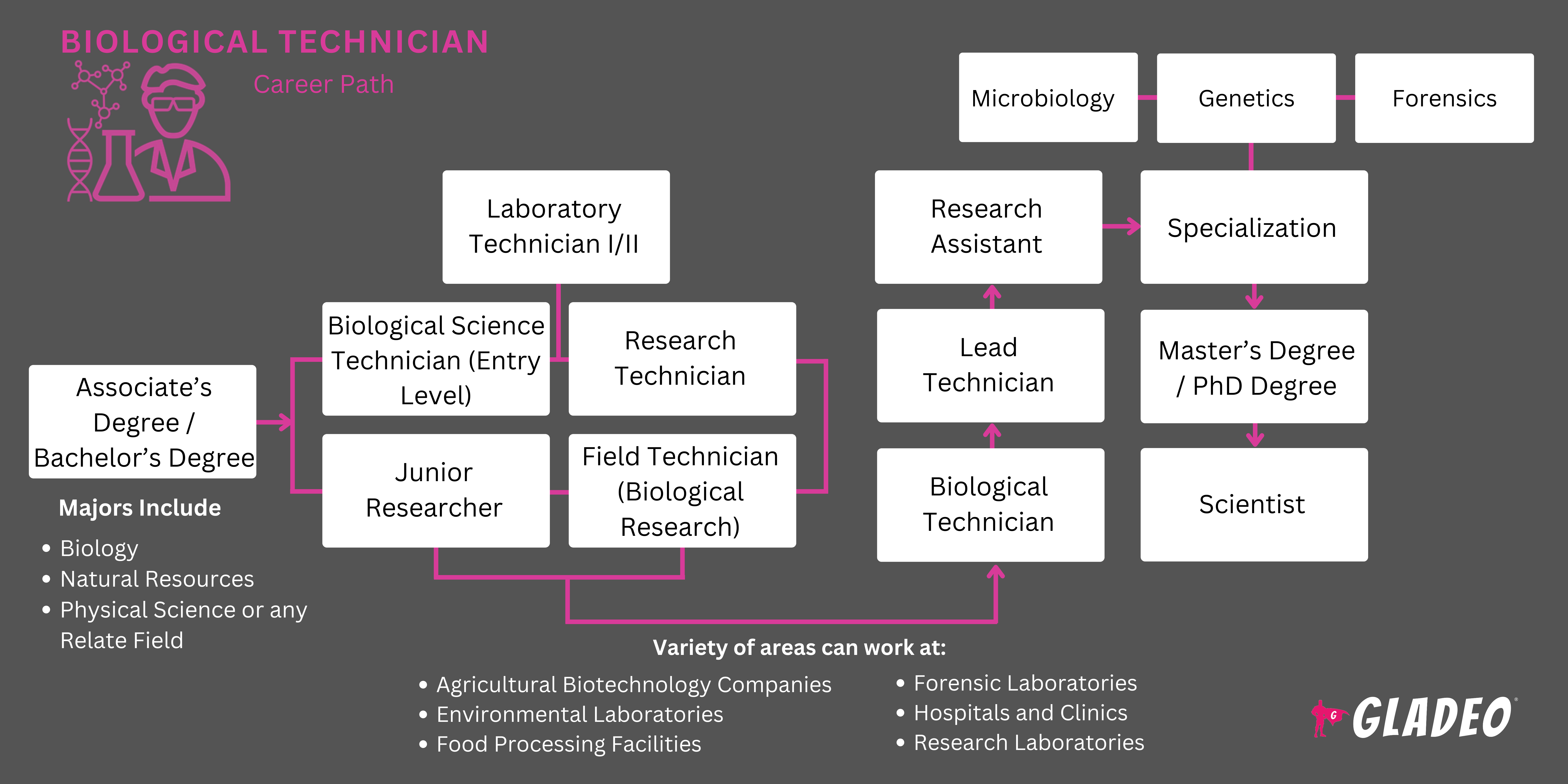
Biological Technicians typically need a bachelor's degree in biology or a related field, although some entry-level positions may accept an associate degree combined with relevant laboratory experience. Employers generally look for candidates who understand biological sciences, can follow detailed laboratory procedures, and are comfortable working with scientific equipment. Students gain valuable experience through laboratory classes, internships, and research projects.
Students can take courses in relevant subjects such as:
- General Biology
- Cell Biology
- Molecular Biology
- Microbiology
- Genetics
- Chemistry
- Biochemistry
- Ecology
- Biotechnology
- Statistics
- Laboratory Techniques
- Scientific Research Methods
Hands-on laboratory training is especially important. Students should learn how to prepare samples, use microscopes and laboratory instruments, maintain sterile conditions, follow safety procedures, and accurately record experimental results. Some Biological Technicians receive additional on-the-job training to learn specialized equipment, testing methods, and laboratory procedures used by their employers. Depending on the workplace, training in laboratory safety, biosafety, quality control, or specialized testing techniques may also be required.
- Take courses in biology, chemistry, physics, and mathematics to build a strong foundation in the sciences.
- Learn how to use microscopes and other basic laboratory equipment through science classes and school laboratory activities.
- Participate in science fairs, biology competitions, or research projects that involve observing, testing, and analyzing living things.
- Practice collecting and recording data carefully, following instructions, and explaining scientific findings.
- Join science clubs, environmental clubs, or other organizations that offer opportunities to explore biology and scientific research.
- Volunteer or seek job-shadowing opportunities at hospitals, universities, environmental organizations, or research laboratories.
- In college, choose a major such as biology, microbiology, molecular biology, biotechnology, or a related life science.
- Take laboratory courses that provide experience with cell cultures, DNA analysis, microscopy, sample preparation, and other research techniques.
- Apply for internships or undergraduate research positions with professors, laboratories, pharmaceutical companies, or government research agencies.
- Learn how to use spreadsheets, statistical software, and scientific databases to organize and analyze research results.
- Develop careful observation, problem-solving, teamwork, and written communication skills by working on laboratory reports and group research projects.
- A curriculum that covers biology, microbiology, genetics, cell biology, molecular biology, and other relevant life sciences.
- Well-equipped laboratories with microscopes, centrifuges, pipettes, incubators, and other scientific instruments.
- Hands-on training in laboratory procedures, sample preparation, testing methods, and scientific data collection.
- Opportunities to learn molecular biology techniques such as DNA extraction, PCR, electrophoresis, and genetic analysis.
- Instruction in laboratory safety, biosafety, contamination prevention, and proper handling of biological materials.
- Courses in chemistry, statistics, and data analysis to help students understand and interpret experimental results.
- Access to research projects where students can work with faculty members and gain experience conducting scientific experiments.
- Internship or work-placement opportunities with universities, hospitals, biotechnology companies, pharmaceutical laboratories, or government research facilities.
- Training in laboratory documentation, quality control, scientific reporting, and the use of research databases and software.
- Instructors with professional experience in biological research, laboratory science, biotechnology, or related fields.
- Scan job portals like Indeed.com, Glassdoor, ZipRecruiter, and other sites.
- Review job ads and look for keywords to list on your resume, such as:
- Cell culture
- Data analysis
- DNA extraction
- Environmental sampling
- Gel electrophoresis
- Laboratory safety protocols
- Microscopy
- Molecular biology
- PCR (Polymerase Chain Reaction)
- Protein purification
- Quality control
- Scientific instrumentation
- Specimen preparation
- Statistical software (e.g., R, SPSS)
- Check out Biological Technician resume templates for ideas.
- Read sample interview questions such as “How do you ensure accuracy and reliability in your data collection and analysis during laboratory experiments?” or “Can you describe how you would handle unexpected results in a research experiment, and what steps you would take to troubleshoot the issue?”
- Practice your replies via mock interviews.
- Reach out to your professional network to ask for tips about job openings.
- Ask former professors and supervisors to write recommendation letters or request their consent to list them as references.
- Make a profile on LinkedIn and other networking platforms to advertise your availability.
- Keep up with current developments related to the industry. Be familiar with the terminology before going into interviews.
- When you get called for an interview, research the employer to learn more about them.
- Dress appropriately for job interviews!
- Talk with your supervisor about additional certifications and specialized training you could complete to qualify for advancement.
- Participate in workshops or webinars. Attend industry conferences and network with scientists and researchers.
- Join professional organizations like the American Society for Microbiology.
- Take on new lab responsibilities and specialize in a niche (e.g., genetics, environmental biology, forensics, etc.).
- Learn how to use more advanced laboratory software and data analysis tools, including AI tools.
- Seek out advanced research roles or consider earning a master’s degree.
- Practice diligent sanitation procedures. Ensure instruments and equipment are cleaned as appropriate.
- Read equipment manuals and become a subject matter expert on the machines you use.
- Keep supplies stocked and equipment well maintained.
- Anticipate problems and be proactive in preventing them.
- Stay informed on trends and advancements in the biological sciences, as well as regulatory changes.
- Volunteer to mentor or train new hires to demonstrate leadership skills.
- Publish research findings in industry journals to build credibility and recognition.
- Participate in cross-disciplinary projects to broaden your skill set. Collaborate with external organizations or agencies on joint projects.
- Volunteer for fieldwork or off-site research projects to gain diverse experiences.
- Build relationships with senior staff and seek their guidance for advancement opportunities.
- Gain proficiency in grant writing to support research funding efforts.
- Create a professional portfolio that highlights your skills, certifications, and contributions.
- Consider relocating or switching employers if necessary to achieve career goals. States with the highest employment levels for Biological Technicians include California, Massachusetts, New York, Texas, and Maryland.
Websites
- American Academy of Forensic Sciences
- American Association for Laboratory Animal Science
- American Chemical Society
- American Fisheries Society
- American Institute of Biological Sciences
- American Society for Cell Biology
- American Society for Clinical Pathology
- American Society for Microbiology
- American Society of Plant Biologists
- Association for Biology Laboratory Education
- Association for Diagnostics and Laboratory Medicine
- Association of Genetic Technologists
- Bio-Link
- Biophysical Society
- Botanical Society of America
- DIYbio
- Ecological Society of America
- Entomological Society of America
- Federation of American Societies for Experimental Biology
- Genetics Society of America
- Institute of Food Technologists
- International Society for Computational Biology
- Marine Biological Laboratory
- National Association of Biology Teachers
- National Center for Biotechnology Information
- National Institute of Environmental Health Sciences
- National Institutes of Health
- Society for Conservation Biology
- Society for Freshwater Science
- Society for In Vitro Biology
- Society of Environmental Toxicology and Chemistry
- Society of Integrative and Comparative Biology
- Society of Toxicology
- The ISME Journal
- The Paleontological Society
- Wildlife Society
Books
- Biology Laboratory Manual, by Darrell Vodopich and Randy Moore
- Medical Laboratory Science Review, by Robert R. Harr MS MLS (ASCP)
- Molecular Biology of the Cell, by Bruce Alberts, et. al.
Biological Technicians are important front-line members of the medical research community, but there are plenty of other professions to consider if this career isn’t resonating with you. Check out our list below for some ideas!
- Agricultural Scientist
- Biochemist
- Bioinformatics Specialist
- Biological Scientist
- Biomedical Engineer
- Bioprocessing Technician
- Botanist
- Calibration Technologist
- Chemical Technician
- Conservation Scientist
- Cytogenetic Technologist
- Ecologist
- Environmental Science Technician
- Environmental Scientist
- Epidemiologist
- Food Safety Specialist
- Food Science Technician
- Forensic Science Technician
- Geneticist
- Histotechnologist
- Marine Biologist
- Medical Laboratory Technician
- Microbiologist
- Molecular Biologist
- Nanotechnology Engineering Technologist
- Pharmacologist
- Plant Science Technician
- Toxicologist
- Veterinary Technician
- Wildlife Biologist
- Zoologist
Newsfeed

Featured Jobs
Online Courses and Tools
Annual Salary Expectations
New workers start around $67K. Median pay is $67K per year. Highly experienced workers can earn around $67K.
Annual Salary Expectations
New workers start around $57K. Median pay is $76K per year. Highly experienced workers can earn around $88K.
Annual Salary Expectations
New workers start around $49K. Median pay is $62K per year. Highly experienced workers can earn around $71K.
Annual Salary Expectations
New workers start around $33K. Median pay is $44K per year. Highly experienced workers can earn around $64K.
Annual Salary Expectations
New workers start around $38K. Median pay is $48K per year. Highly experienced workers can earn around $67K.