






Spotlights
Welding Process Engineer, Materials Joining Engineer, Manufacturing Welding Engineer, Weld Engineer, Welding Metallurgist, Fabrication Engineer, Joining Technology Engineer, Welding Quality Engineer, Structural Welding Engineer, Welding Design Engineer, Welding Research Engineer, Weld Process Development Engineer
Every bridge that holds up rush-hour traffic, every ship that crosses an ocean, every pipeline that carries fuel safely underground, and every skyscraper frame that sways slightly in the wind depends on welds engineered to never fail. Welding Engineers are the people who make sure those invisible seams hold, no matter how much heat, pressure, or decades of stress they face.
Rather than running the torch themselves, Welding Engineers design the process behind the weld. They select the right materials and joint methods for a project, write detailed procedures that certified welders follow step by step, and work closely with metallurgists, welders, quality inspectors, and project managers to make sure every structural weld meets strict codes before it is ever trusted with real weight or pressure. When a weld fails somewhere in the world, it is often a welding engineer who investigates exactly why, down to the microscopic structure of the metal.
Using weld procedure specifications, destructive and non-destructive testing, CAD software, and simulation tools, Welding Engineers turn welding from a skilled craft into a rigorously engineered science. Their work is what allows bridges, ships, pipelines, and factories to be built with confidence, because somewhere behind every safe structure is an engineer who calculated exactly how strong that seam needed to be, and made sure it was.
- Designing the invisible seams that keep bridges, ships, and pipelines safe for millions of people
- Solving tough materials puzzles: figuring out how to join metals that do not want to cooperate
- Working across huge industries, from construction and shipbuilding to aerospace and energy
- Seeing your weld procedures put to work on massive, real-world structures
Working Schedule
Most Welding Engineers work full-time, typically around 40 hours a week, split between an office where they write procedures and review data, and a manufacturing plant, fabrication shop, or job site where they oversee welding in person. Deadlines tied to project milestones, code inspections, or production schedules can occasionally stretch hours longer, and some roles require travel to shipyards, pipelines, or construction sites. Most Welding Engineers are employed by manufacturers, construction firms, energy companies, or engineering consulting firms.
Typical Duties
- Designing and documenting welding procedure specifications and procedure qualification records
- Selecting appropriate welding processes, filler metals, and joint designs for a project
- Reviewing engineering drawings and specifications to determine welding requirements
- Ensuring welds meet applicable codes and standards such as AWS D1.1 or ASME Section IX
- Investigating weld failures and defects through root cause analysis
- Overseeing destructive and non-destructive testing of welds
- Training and certifying welders on new procedures
- Selecting and evaluating welding equipment and automation systems
- Estimating welding costs, labor, and material requirements for projects
- Collaborating with metallurgists and materials engineers on material compatibility
- Auditing welding quality control processes on the shop floor
- Writing technical reports and documentation for regulatory compliance
Additional Responsibilities
- Supporting new product development with weldability assessments
- Evaluating new welding technologies such as robotic and laser welding
- Coordinating with inspectors and third-party certification bodies
- Managing welding-related budgets and vendor relationships
- Mentoring welding technicians and junior engineers
- Participating in safety reviews and hazard assessments
- Keeping current with evolving codes and industry standards
- Supporting field repairs and emergency structural assessments
A Welding Engineer's morning often starts by reviewing overnight production data or inspection reports from the shop floor, checking whether any welds flagged for rework or further testing. They might spend the first part of the day writing or revising a welding procedure specification for a new project, working through which process, filler metal, and joint design will meet both the engineering requirements and the applicable code.
Midday is often spent out on the shop floor or at a job site, watching a welder run a qualification test, reviewing X-ray or ultrasonic test results on a critical weld, or walking a fabrication line to check that procedures are being followed correctly. If a weld fails inspection, the engineer digs into why: was it the process, the material, the technique, or something else entirely.
In the afternoon, the Welding Engineer often meets with project managers, metallurgists, or quality teams to review test data, sign off on procedures, or troubleshoot a production issue. They document findings, update procedures as needed, and may spend time training welders on a new technique or preparing for an upcoming code inspection.
Soft Skills
- Strong analytical thinking
- Attention to detail
- Clear communication between engineering and the shop floor
- Problem-solving under real-world constraints
- Leadership and project management
- Patience with iterative testing and troubleshooting
- Teamwork with welders, metallurgists, and inspectors
- Adaptability to new materials and technologies
- Strong ethics, since safety is always on the line
- Curiosity about materials and failure analysis
- Decisiveness under time pressure
- Confidence presenting technical findings
Technical Skills
- Welding processes including SMAW, GMAW, GTAW, FCAW, and SAW
- Metallurgy and materials science
- Welding codes and standards such as AWS D1.1, ASME Section IX, and API 1104
- Destructive and non-destructive testing methods
- CAD and welding simulation software
- Weld procedure development and qualification
- Failure analysis and root cause investigation
- Statistics and quality control methods
- Robotic and automated welding systems
- Blueprint reading and geometric dimensioning and tolerancing
- Structural Welding Engineer: Focuses on buildings, bridges, and infrastructure
- Pipeline Welding Engineer: Designs weld procedures for oil, gas, and water pipelines
- Shipbuilding Welding Engineer: Works on marine and naval vessel construction
- Aerospace Welding Engineer: Develops precision welds for aircraft and spacecraft components
- Automation and Robotic Welding Engineer: Designs and programs automated welding systems
- Research and Development Welding Engineer: Develops new welding materials and techniques
- Quality and Compliance Welding Engineer: Ensures welds meet codes and standards
- Field Welding Engineer: Supports on-site welding for construction or repair projects
- Heavy manufacturing companies
- Shipbuilders and marine fabricators
- Bridge and infrastructure construction firms
- Oil, gas, and pipeline companies
- Aerospace and defense manufacturers
- Structural steel fabricators
- Power generation and energy companies
- Automotive manufacturers
- Engineering consulting firms
- Government agencies such as departments of transportation and the Navy
- Welding equipment manufacturers
- Third-party inspection and certification agencies
Welding Engineers work in a field where the stakes are genuinely high. A weld that fails on a bridge, pipeline, or pressure vessel is not just a costly mistake, it can be a matter of public safety, which means rigorous documentation and honest reporting are always non-negotiable, even under deadline pressure.
The role sometimes requires travel to remote job sites, shipyards, or fabrication plants, occasionally in tough physical conditions like extreme heat, cold, or confined spaces during site visits. Balancing office-based procedure writing with hands-on shop floor oversight requires flexibility and stamina.
The field also demands continuous learning. Codes and standards are updated regularly, new alloys and materials keep emerging, and Welding Engineers who want to stay sharp pursue ongoing certifications, like the AWS Certified Welding Engineer or Certified Welding Inspector credentials, throughout their careers.
- Growth of robotic and automated welding on production lines
- Rise of metal additive manufacturing as an alternative to traditional welding
- Use of AI and machine vision for automated weld defect detection
- Adoption of hybrid laser-arc welding for faster, cleaner welds
- Increased infrastructure investment driving demand for structural welding
- Welding of new lightweight alloys for electric vehicle manufacturing
- Remote welding monitoring and digital procedure documentation
- Growing shortage of skilled welders increasing demand for automation engineering
- Sustainability efforts pushing more energy-efficient welding processes
- Expanded use of simulation software to predict weld distortion before fabrication
Many Welding Engineers grew up tinkering with metal projects, building model kits, or taking apart machines just to understand how they were put together. Shop class, especially any introduction to welding, was often a turning point where they discovered they loved both the physical craft and the science behind it.
Others found their spark in chemistry and physics classes, fascinated by why materials behave the way they do under heat and stress, or in staring up at bridges, ships, and big machines and wondering how they were built to hold together. Robotics clubs and hands-on engineering competitions were common favorites, combining building with problem-solving.
Most Welding Engineers earn a bachelor's degree in welding engineering, materials science and engineering, or mechanical engineering with a focus on materials joining. A small number of universities, including Ohio State and LeTourneau University, offer dedicated welding engineering programs that combine metallurgy, mechanical design, and hands-on welding lab work. After graduation, many pursue credentials like the American Welding Society's Certified Welding Engineer or Certified Welding Inspector designation to strengthen their qualifications.
Students can take courses in relevant subjects such as:
- Welding Processes and Metallurgy
- Materials Science and Engineering
- Statics and Strength of Materials
- Thermodynamics and Heat Transfer
- Welding Codes and Standards
- Non-Destructive Testing Methods
- CAD and Engineering Drawing
- Fluid Mechanics
- Quality Control and Statistics
- Manufacturing Processes
Hands-on welding lab experience is just as important as classroom theory, since understanding how a weld actually behaves under a torch informs every procedure an engineer later writes. Internships at fabrication shops, shipyards, or pipeline companies give students real exposure to production environments. Continuing education and certification through the American Welding Society help engineers stay current as codes and materials evolve throughout their careers.
- Take physics, chemistry, and calculus courses
- Enroll in a shop class or vocational program with a welding component
- Join a robotics team or engineering competition
- Research welding engineering programs like those at Ohio State or LeTourneau University
- Attend a local American Welding Society student chapter meeting or event
- Practice technical drawing or CAD using free student software
- Enter science fairs or engineering competitions involving building and testing
- Visit a fabrication shop, shipyard, or manufacturing plant on a tour
- Learn basic welding skills through a community college or trade program course
- Build strong math skills, especially in geometry and trigonometry
- Apply for internships at fabrication shops or engineering firms
- Talk to a welding engineer or certified welding inspector about their career path
- ABET accreditation for the engineering program
- A dedicated welding lab with modern equipment
- Faculty with real industry welding or metallurgy experience
- Coursework covering both welding codes and materials science
- An active American Welding Society student chapter
- Required or strongly encouraged internships with fabrication or manufacturing employers
- A senior capstone project involving real welding procedure development
- Preparation for AWS Certified Welding Inspector or Certified Welding Engineer exams
- Strong relationships with regional manufacturers, shipbuilders, or energy companies
- Small lab sections that guarantee hands-on welding time
- Career services that track job placement rates for graduates
- Transfer agreements if starting at a community college
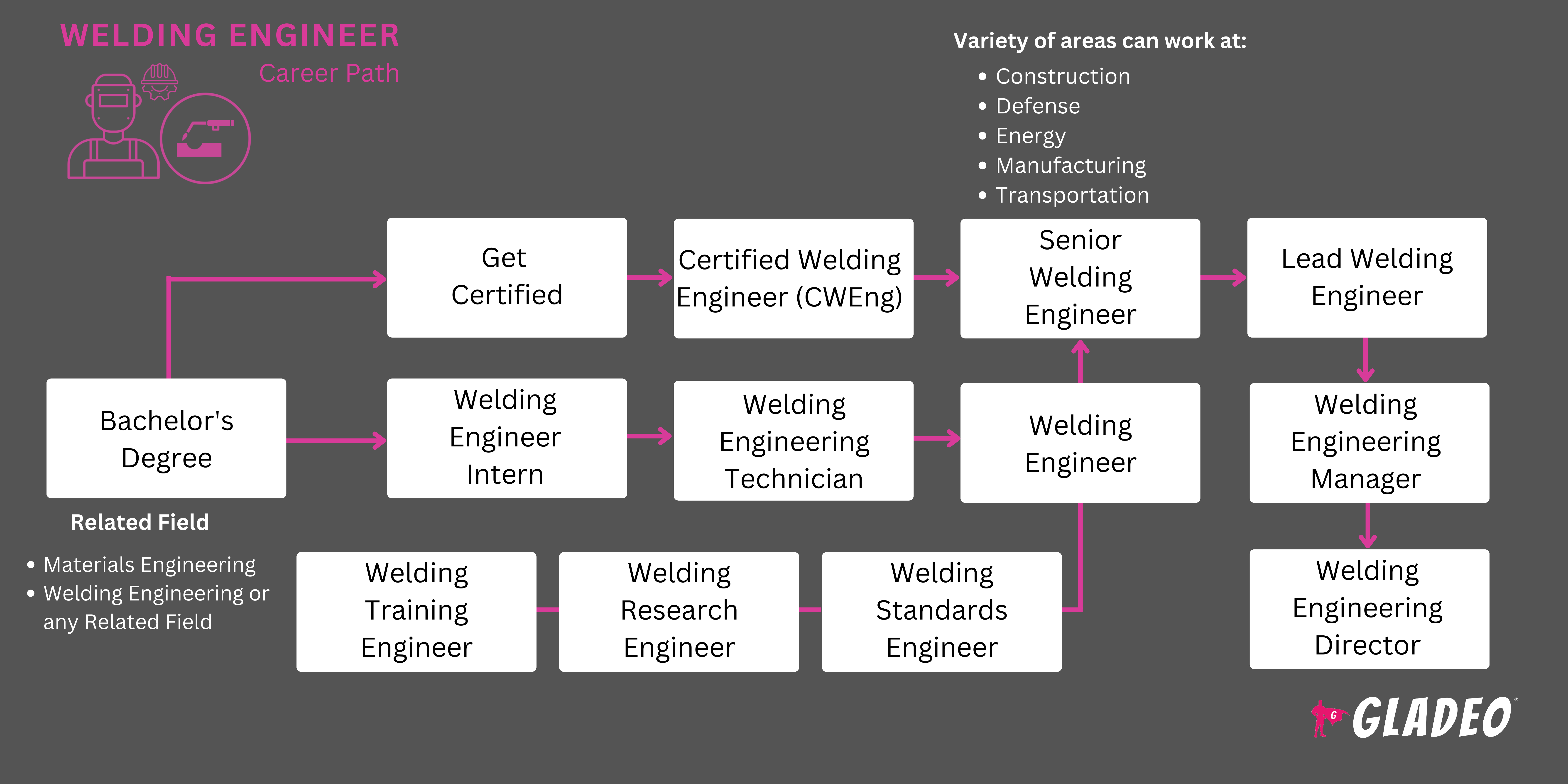
- Complete at least one internship in a fabrication shop, shipyard, or manufacturing plant
- Build a portfolio of school projects involving weld procedure development or testing
- Apply for entry-level titles like Welding Engineer I, Manufacturing Engineer, or Quality Engineer
- Pursue AWS Certified Welding Inspector certification early to stand out
- Attend AWS chapter meetings and the annual FABTECH trade show to network
- Search job boards, company career pages, and AWS's career center
- Highlight hands-on welding lab experience and specific codes you have studied
- Practice explaining a weld failure investigation or procedure project clearly in interviews
- Consider starting as a quality engineer or manufacturing engineer to build experience
- Network with professors, alumni, and AWS members in your region
- Be open to relocating to regions with strong shipbuilding, pipeline, or manufacturing industries
- Show strong safety awareness, since welding engineers work directly around hazardous processes
- Earn advanced certifications like AWS Certified Welding Engineer
- Take on complex, high-visibility projects and failure investigations
- Build a reputation for procedures that pass inspection the first time
- Develop expertise in a specialized area like automation, pipelines, or aerospace welding
- Move into senior welding engineer or engineering manager roles
- Mentor junior engineers and welding technicians
- Get involved with AWS or ASME codes and standards committees
- Explore consulting or expert witness work for weld failure investigations
Websites:
- American Welding Society - aws.org
- AWS Certification - aws.org/certification
- American Society of Mechanical Engineers - asme.org
- American Society for Nondestructive Testing - asnt.org
- Association for Materials Protection and Performance (AMPP) - ampp.org
- Fabricators & Manufacturers Association - fmanet.org
- Welding Journal - aws.org/publications
- The Fabricator - thefabricator.com
- Lincoln Electric Welding Education - lincolnelectric.com
- Miller Welds Education - millerwelds.com
- American Petroleum Institute - api.org
- Society of Naval Architects and Marine Engineers - sname.org
- Ohio State Welding Engineering Program - welding.osu.edu
- FABTECH - fabtechexpo.com
Books:
- Welding Metallurgy by Sindo Kou
- Modern Welding Technology by Howard B. Cary and Scott C. Helzer
- Welding Principles and Applications by Larry Jeffus
- The Procedure Handbook of Arc Welding by Lincoln Electric
- Design of Welded Structures by Omer W. Blodgett
If you find that being a Welding Engineer isn't the right fit, your background in materials, metallurgy, and structural analysis transfers well to many related careers.
- Certified Welder
- Welding Inspector
- Materials Engineer
- Mechanical Engineer
- Manufacturing Engineer
- Metallurgical Engineer
- Quality Engineer
- Structural Engineer
- Robotics Engineer
- Piping Engineer
Newsfeed

Featured Jobs
Online Courses and Tools
Annual Salary Expectations
New workers start around $49K. Median pay is $60K per year. Highly experienced workers can earn around $71K.
Annual Salary Expectations
New workers start around $58K. Median pay is $65K per year. Highly experienced workers can earn around $80K.
Annual Salary Expectations
New workers start around $48K. Median pay is $60K per year. Highly experienced workers can earn around $72K.
Annual Salary Expectations
New workers start around $49K. Median pay is $60K per year. Highly experienced workers can earn around $67K.
Annual Salary Expectations
New workers start around $49K. Median pay is $58K per year. Highly experienced workers can earn around $68K.