





Spotlights
Robotics Maintenance Technician, Automation Technician, Robotic Systems Technician, Industrial Robotics Technician, Robot Field Service Technician, Automated Systems Technician, Robotics Installation Technician, Manufacturing Robotics Technician, Controls and Robotics Technician, Robotics Calibration Technician, Mechatronics Technician, Robotic Equipment Specialist
Somewhere on a factory floor right now, a robotic arm is welding a car frame in seconds flat, a mobile robot is gliding through a warehouse picking orders, or a surgical robot is helping a doctor make an incision more precise than any human hand could manage alone. None of that happens by accident. Behind every robot that shows up to work and does its job flawlessly is a Robotics Technician who built it, installed it, calibrated it, and keeps it running.
Robotics Technicians are the hands-on experts who bring robots to life on the factory floor and keep them there. While robotics engineers design what a robot should do, technicians are the ones who assemble the hardware, wire the electronics, load the programming, and run test after test until the machine performs exactly as intended. Once a robot is up and running, technicians become its first responders, diagnosing why an arm suddenly stopped mid-cycle, replacing a worn sensor, recalibrating a system after a part swap, and working closely with engineers, machine operators, and plant managers to keep production lines moving.
Using multimeters, oscilloscopes, programmable logic controllers (PLCs), robot simulation software, and diagnostic tools built into the machines themselves, Robotics Technicians blend mechanical, electrical, and computer skills into one job. Their work matters because a single robot going down can stop an entire assembly line, cost a company thousands of dollars an hour, and delay products that people are counting on. When a Robotics Technician gets it right, factories run smoothly, products ship on time, and the robots doing dangerous or repetitive work keep human coworkers safer.
- Getting your hands on cutting-edge machines and seeing exactly how they work, inside and out
- Solving mechanical and electrical puzzles that change every day, never the same repair twice
- Playing a critical role in keeping factories, warehouses, and labs running smoothly
- Working at the center of the automation and robotics boom, with skills that translate across industries
Working Schedule
Most Robotics Technicians work full-time, and many factories run production around the clock, so shifts can include evenings, overnight, and weekend work, especially in facilities that operate 24/7. The job splits time between the shop floor, where robots and automated equipment are installed, tested, and repaired, and smaller stretches at a workbench or computer reviewing programming, wiring diagrams, or maintenance logs. Technicians are almost always employed directly by manufacturers, robotics integrators, or equipment makers, though some work as contractors who travel between client sites to install or repair systems. When a robot goes down unexpectedly, technicians may be called in outside their normal hours to get the line running again.
Typical Duties
- Installing new robotic arms, conveyors, and automated equipment on production lines
- Wiring electrical connections and connecting sensors, actuators, and motors
- Loading and adjusting robot programming to match a specific task or product
- Calibrating robots so their movements are precise down to fractions of a millimeter
- Running test cycles to confirm a robot performs safely and correctly before full production
- Diagnosing mechanical, electrical, and software problems when a robot malfunctions
- Replacing worn or broken parts such as motors, belts, sensors, and grippers
- Performing scheduled preventive maintenance to catch problems before they cause downtime
- Reading and interpreting technical manuals, wiring diagrams, and blueprints
- Working with PLCs and human-machine interfaces (HMIs) to troubleshoot control systems
- Documenting repairs, part replacements, and maintenance history for each machine
- Training machine operators on basic robot operation and safety procedures
Additional Responsibilities
- Ordering replacement parts and tracking spare parts inventory
- Collaborating with robotics engineers on upgrades and design improvements
- Enforcing lockout/tagout and other safety procedures around powered equipment
- Updating robot software and firmware as new versions are released
- Assisting with the layout and design of new automated workstations
- Responding to emergency breakdown calls and prioritizing urgent repairs
- Keeping up with new robot models, tools, and industry certifications
- Supporting audits and inspections related to safety and quality standards
A Robotics Technician's day often starts with a walk through the production floor, checking on robots that ran overnight and reviewing any alerts or error codes logged by the system. If a machine flagged a problem, they pull up the maintenance history, grab their tools, and head over to investigate, testing sensors, checking wiring, and running diagnostic software to pinpoint exactly what went wrong.
Midday is often devoted to scheduled maintenance and upgrades. A technician might swap out a worn gripper on a pick-and-place robot, recalibrate an arm after a fixture change, or work with an engineer to install a new sensor package on an existing machine. Testing is constant: after any repair or adjustment, the technician runs the robot through several cycles to confirm it moves exactly as it should before handing it back to the production team.
Afternoons frequently bring new challenges, from an unexpected breakdown that halts a line to a request to help set up a brand-new robotic cell. Technicians document what they fixed, update maintenance logs, and communicate with operators and supervisors about what to expect going forward. Before the shift ends, they check tomorrow's maintenance schedule and make sure parts and tools are ready for whatever comes next.
Soft Skills
- Problem-solving and troubleshooting under pressure
- Attention to detail and precision
- Strong communication with engineers, operators, and managers
- Patience when diagnosing tricky, intermittent problems
- Comfort working independently and making quick decisions
- Teamwork and willingness to help coworkers on the line
- Adaptability to new equipment and changing priorities
- Physical stamina for standing, bending, and lifting
- Safety-first mindset around powered machinery
- Time management to balance planned maintenance with urgent repairs
- Willingness to keep learning as robot technology evolves
- Calm, methodical thinking during high-pressure downtime situations
Technical Skills
- Reading electrical schematics, wiring diagrams, and mechanical blueprints
- Working knowledge of programmable logic controllers (PLCs) and HMIs
- Basic robot programming and teach-pendant operation
- Use of multimeters, oscilloscopes, and other diagnostic instruments
- Mechanical assembly, alignment, and precision calibration
- Understanding of sensors, servo motors, and pneumatic and hydraulic systems
- Preventive maintenance planning and recordkeeping
- Familiarity with major robot platforms such as FANUC, ABB, KUKA, and Universal Robots
- Basic networking knowledge for robots connected to plant control systems
- Safety procedures including lockout/tagout and machine guarding standards
- Field Service Technician: Travels between customer sites to install, repair, and maintain robotic systems
- Maintenance Technician: Handles day-to-day upkeep and repair of robots already running in a facility
- Installation Technician: Specializes in setting up brand-new robotic cells and integrating them into a production line
- Test and Calibration Technician: Focuses on fine-tuning robot accuracy and running validation tests
- Controls Technician: Works primarily with the electrical and software side of robot control systems
- Mechatronics Technician: Blends mechanical, electrical, and software skills across a wide range of automated equipment
- Warehouse Robotics Technician: Maintains mobile robots, automated storage systems, and sortation equipment
- Medical Robotics Technician: Services robotic systems used in surgery, pharmacy automation, or diagnostics labs
- Automotive manufacturers
- Electronics and semiconductor manufacturers
- Food and beverage production plants
- Warehousing and logistics companies
- Robotics integrators and system builders
- Robot manufacturers such as FANUC, ABB, and Universal Robots
- Aerospace and defense contractors
- Pharmaceutical and medical device manufacturers
- Consumer goods and packaging companies
- Research labs and universities
- Agricultural equipment and technology companies
- Third-party maintenance and field service contractors
Robotics Technicians are expected to get things right the first time. A miscalibrated robot or a rushed repair can damage expensive equipment, ruin a batch of product, or even create a safety hazard for coworkers nearby. That pressure to be precise, combined with the reality that production lines lose serious money every minute they are down, means technicians often work fast and carefully at the same time.
Because factories rarely stop running, the schedule can be demanding. Many technicians work rotating shifts, nights, or weekends, and emergency breakdowns do not wait for convenient hours. The work is also physically active, involving standing for long stretches, climbing around large machinery, and sometimes working in loud, hot, or tightly confined spaces.
The field moves quickly, with new robot models, software updates, and safety standards arriving constantly. Technicians who want to stay valuable need to keep learning throughout their careers, whether that means earning new certifications, training on a different robot brand, or picking up skills in vision systems and networking as robots become more connected and intelligent.
- Rapid growth of collaborative robots (cobots) that work safely alongside people
- Expansion of mobile robots and automated guided vehicles in warehouses
- Increasing use of vision systems and AI for robots to detect and adapt to their surroundings
- Growth of robotics-as-a-service models where companies lease rather than buy equipment
- Rising demand for technicians who can support both hardware and software troubleshooting
- Reshoring of manufacturing driving new robotics jobs across the United States
- Predictive maintenance powered by sensors and data analytics catching problems earlier
- Wider adoption of robotics in small and mid-sized manufacturers, not just large plants
- Increased use of remote monitoring so technicians can diagnose issues before arriving on site
- Growing overlap between robotics technicians and electricians as machines become more electronic
Many Robotics Technicians grew up taking apart toys, bikes, and old electronics just to see how the pieces fit together, then figuring out how to put them back in working order. They were drawn to building sets, remote-control cars, robotics kits, and video games that rewarded logical thinking, and they often joined robotics clubs or competitions where they got to design, build, and troubleshoot machines under a deadline.
Others found their spark helping a parent fix a car, wire a light switch, or repair a household appliance, picking up a comfort with tools and electricity along the way. They tended to like math and science best when it connected to something they could touch and test, and they got real satisfaction from fixing something that was broken and watching it work again.
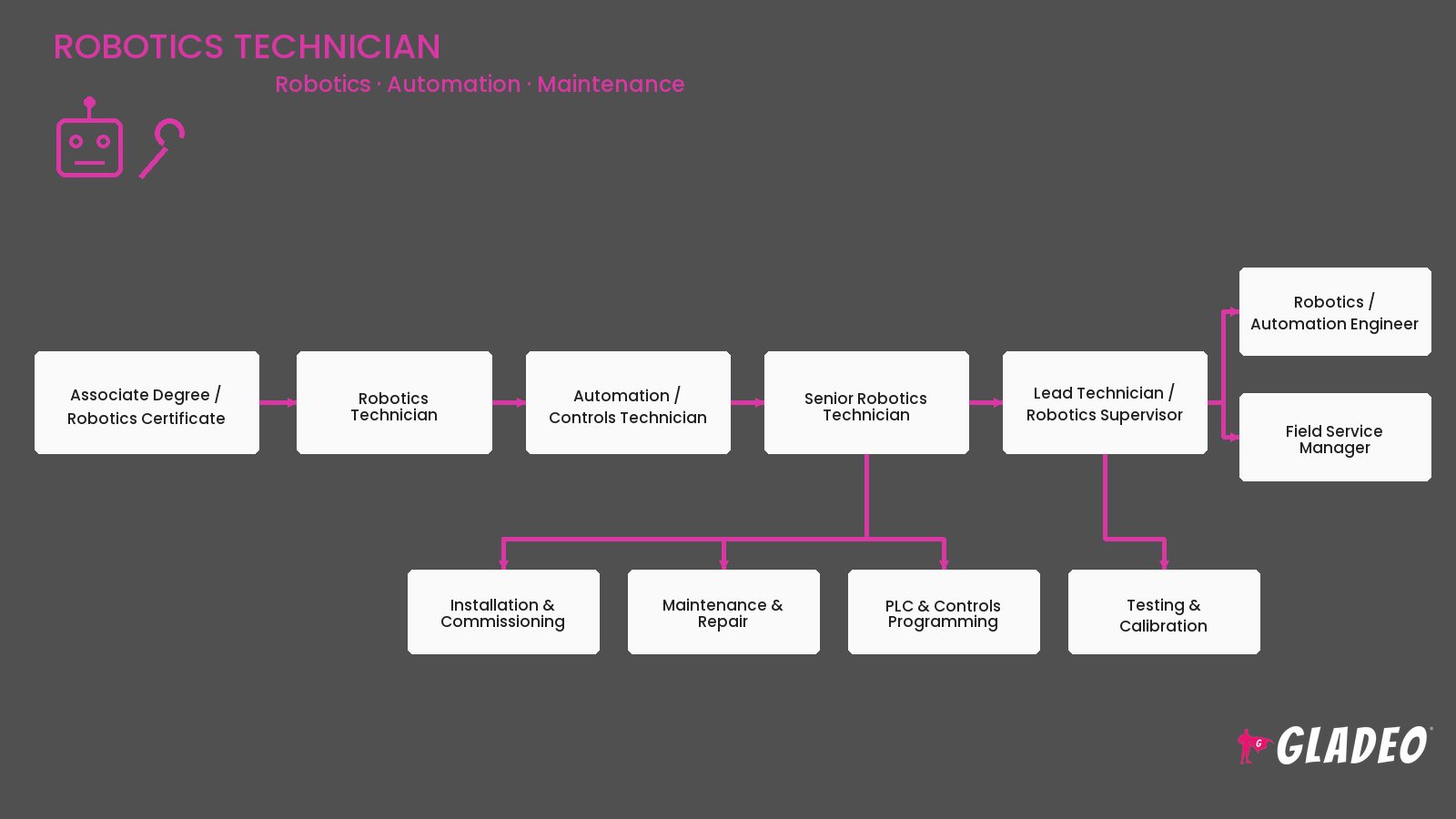
Most Robotics Technicians enter the field with an associate degree in robotics technology, mechatronics, electronics, or a related field from a community or technical college, typically a two-year program. These programs combine classroom instruction in electronics, mechanics, and programming with extensive hands-on lab time working directly with robots and automated equipment. Some technicians instead complete a formal apprenticeship, a military technical program, or transition from a related trade such as electrical or industrial maintenance work.
Students can take courses in relevant subjects such as:
- Robotics and Automation Fundamentals
- Electrical Circuits and Electronics
- Programmable Logic Controllers (PLCs)
- Mechatronics and Motion Control
- Industrial Safety and Lockout/Tagout Procedures
- Blueprint Reading and Technical Drawing
- Hydraulics and Pneumatics
- Introduction to Robot Programming
- Sensors and Instrumentation
- Computer Networking Basics
Hands-on lab experience is essential, since employers want technicians who have actually wired, programmed, and troubleshot real robotic equipment, not just studied it in theory. Internships and co-op placements with manufacturers or robotics integrators give students a head start, and many programs partner directly with local employers who hire graduates on the spot. Manufacturer-specific certifications, such as those offered by FANUC or Universal Robots, add valuable credentials on top of a degree.
- Take algebra, geometry, physics, and any available electronics or engineering classes
- Enroll in shop, drafting, CAD, or industrial technology courses if your school offers them
- Join a robotics team such as FIRST Robotics, VEX Robotics, or a SkillsUSA chapter
- Build and program things at home using kits like LEGO Mindstorms, Arduino, or Raspberry Pi
- Take apart old electronics or appliances (safely) to see how they are built
- Enter science fairs or robotics competitions that involve building working machines
- Tour a local factory or robotics company or arrange a job shadow with a technician
- Learn basic electrical safety and practice using tools like multimeters and screwdrivers
- Look into community college robotics or mechatronics programs early and compare requirements
- Apply for a summer program, internship, or part-time job in a machine shop or factory
- Get comfortable with basic computer skills, including simple programming or scripting
- Talk to working robotics technicians about what a typical day and career path look like
- Programs with dedicated robotics or mechatronics labs stocked with real industrial robots
- Strong internship, co-op, or apprenticeship partnerships with local manufacturers
- Curriculum covering both electrical and mechanical systems, not just one side
- Instructors with hands-on industry experience in robotics or automation
- Opportunities to earn manufacturer certifications such as FANUC or Universal Robots credentials
- Small class and lab sizes so you get real time working with the equipment
- Up-to-date equipment that reflects current robot brands used by local employers
- Career services with strong job placement rates in robotics or manufacturing roles
- Flexible scheduling if you plan to work while completing the program
- Coursework in PLCs, sensors, and industrial networking alongside robotics basics
- Transfer agreements if you might want to pursue a bachelor's degree later
- Clear pathways to industry-recognized certifications beyond the degree itself
- Complete an internship or co-op with a manufacturer or robotics integrator before graduating
- Apply for entry-level titles such as Automation Technician, Maintenance Technician, or Junior Robotics Technician
- Earn a manufacturer certification, such as a FANUC or Universal Robots credential, to stand out
- Build a portfolio or resume that highlights specific robots and equipment you have worked with
- Search job boards like Indeed and LinkedIn along with manufacturing- and robotics-focused sites
- Attend career fairs hosted by your school and by organizations like SME and A3
- Highlight troubleshooting stories in interviews, describing a specific problem and how you solved it
- Consider starting in a related role like electrical technician or maintenance mechanic to gain experience
- Show strong safety habits and a willingness to learn new equipment quickly
- Network with instructors, classmates, and robotics integrators who often hear about openings first
- Be open to shift work and to relocating toward regions with strong manufacturing or logistics industries
- Practice explaining technical problems in plain language, since you will often talk to non-technical coworkers
- Learn multiple robot brands and control systems beyond the one you started on
- Take on the toughest, most unusual repairs to build a reputation as a go-to problem solver
- Pursue advanced certifications in PLCs, vision systems, or specific robot platforms
- Build strong working relationships with the engineers who design the systems you maintain
- Move into senior technician, lead technician, or maintenance supervisor roles
- Consider further education toward an engineering technology or robotics engineering degree
- Mentor new technicians and help train operators on new equipment
- Stay current on emerging technology like AI-enabled robots and predictive maintenance tools
Websites:
- Association for Advancing Automation (A3) - automate.org
- Robotic Industries Association (part of A3) - automate.org/industry-insights
- SME (Society of Manufacturing Engineers) - sme.org
- IEEE Robotics and Automation Society - ieee-ras.org
- RoboticsTomorrow - roboticstomorrow.com
- The Robot Report - therobotreport.com
- FANUC America - fanucamerica.com
- Universal Robots Academy - universal-robots.com/academy
- SkillsUSA - skillsusa.org
- FIRST Robotics - firstinspires.org
- National Institute for Metalworking Skills (NIMS) - nims-skills.org
- RoboDK Blog - robodk.com/blog
- Automation World - automationworld.com
- Control Engineering - controleng.com
Books:
- Robotics, Vision and Control by Peter Corke
- Introduction to Robotics: Mechanics and Control by John J. Craig
- Industrial Robotics: Technology, Programming, and Applications by Mikell P. Groover
- The Robot Builder's Bonanza by Gordon McComb
- Practical Electronics for Inventors by Paul Scherz and Simon Monk
If you find that being a Robotics Technician isn't the right fit, your hands-on skills in electronics, mechanics, and troubleshooting open doors to many related careers.
- Electrical Technician
- Industrial Maintenance Mechanic
- Mechatronics Technician
- Controls Technician
- Robotics Engineer
- Field Service Engineer
- CNC Machinist and Operator
- Electro-Mechanical Technician
- Automation Engineer
- Quality Control Inspector
Click here to download the infographic
Newsfeed

Featured Jobs
Online Courses and Tools