





Spotlights
Plant Scientist, Soil Nutrition Specialist, Agronomist, Crop Nutritionist, Agricultural Scientist, Soil Scientist, Plant Physiologist, Horticulturist, Soil Fertility Expert, Sustainable Agriculture Consultant, Plant Biologist, Agricultural Consultant
Imagine the food on your table, the flowers in a garden, and the green spaces in your community thriving because someone carefully figured out exactly what nutrients plants need to grow strong and healthy. Plant Nutritionists make that possible by ensuring plants get the right balance of minerals and nutrients, affecting everything from food security to environmental health.
Plant Nutritionists analyze soil and plant samples to diagnose nutrient deficiencies or toxicities. They work closely with farmers, agricultural engineers, environmental scientists, and lab technicians to develop nutrient management plans tailored to different crops and ecosystems. Their daily tasks include conducting field tests, interpreting scientific data, advising on fertilizer use, and monitoring plant health to optimize growth and yield.
Using tools like spectrometers, soil testing kits, and data analysis software, Plant Nutritionists apply scientific principles to improve plant nutrition sustainably. Their work is crucial in increasing crop productivity, reducing environmental impact, and supporting sustainable farming practices that feed communities while protecting the planet.
- Helping farmers grow healthier crops that feed communities worldwide.
- Solving complex environmental and agricultural challenges through science.
- Seeing the direct impact of your recommendations in thriving plants and improved ecosystems.
- Contributing to sustainable agriculture practices that protect soil and water resources.
Working Schedule
Plant Nutritionists often work full-time, sometimes spending long hours during planting and growing seasons to monitor crops. Their roles blend indoor lab analysis with outdoor fieldwork, requiring flexibility to adapt to weather conditions and crop cycles. Many work for agricultural firms, universities, or government agencies, and some take on consulting roles that demand travel to farms or research sites.
Typical Duties
- Collect and analyze soil and plant tissue samples to assess nutrient levels.
- Develop customized nutrient management plans for various crops and soils.
- Conduct field trials to test fertilizer effectiveness and plant growth responses.
- Advise farmers and agricultural managers on fertilizer application and soil amendments.
- Monitor crop health throughout growing seasons to detect nutrient deficiencies or toxicities.
- Collaborate with agronomists, soil scientists, and environmental experts on research projects.
- Stay updated on new agricultural technologies and nutrient management strategies.
- Prepare detailed reports and presentations for stakeholders and clients.
- Use laboratory equipment and software to analyze chemical and biological properties of soils and plants.
- Evaluate environmental impacts of nutrient use and recommend sustainable practices.
Additional Responsibilities
- Train farm workers and agricultural staff on proper nutrient application techniques.
- Participate in community outreach programs to promote sustainable farming.
- Assist in grant writing and funding proposals for agricultural research.
- Contribute to scientific publications and present findings at conferences.
- Develop educational materials and workshops for farmers and agriculture students.
- Maintain laboratory equipment and ensure compliance with safety protocols.
- Collaborate with policymakers to develop regulations on fertilizer use and environmental protection.
Morning often begins by reviewing soil and plant sample results from the previous day, analyzing nutrient data to identify any urgent issues affecting crop health. This time includes planning field visits to test soil conditions or observe plant growth in different locations.
Midday typically involves heading out to farms or research plots to collect samples, evaluate plant vigor, and consult with farmers about current challenges. Detailed notes and measurements are taken to inform ongoing nutrient management strategies.
Afternoons are often spent in the lab or office, interpreting data, updating nutrient application plans, and preparing reports for clients or research teams. Collaboration with agronomists, environmental scientists, and extension agents is common to ensure a holistic approach to plant nutrition and sustainability.
Soft Skills
- Analytical thinking to interpret complex nutrient data.
- Strong communication skills for advising farmers and collaborating with teams.
- Problem-solving to address nutrient deficiencies and environmental challenges.
- Attention to detail during sample collection and analysis.
- Patience and persistence in conducting experiments and monitoring crops.
- Adaptability to work outdoors in varying weather conditions.
- Creativity in developing sustainable nutrient management plans.
- Teamwork when partnering with scientists and agricultural workers.
- Organizational skills for managing multiple projects and deadlines.
- Curiosity and passion for plant science and sustainability.
- Teaching and mentoring abilities for educating farmers and students.
- Critical thinking to evaluate research findings and make informed decisions.
Technical Skills
- Soil and plant tissue sampling techniques.
- Operation of laboratory instruments like spectrometers and pH meters.
- Data analysis using statistical software and spreadsheets.
- Knowledge of fertilizer types and nutrient formulations.
- Familiarity with plant physiology and soil chemistry.
- Use of Geographic Information Systems (GIS) for mapping soil data.
- Understanding of environmental regulations related to agriculture.
- Experience with crop monitoring technologies and sensors.
- Ability to design and conduct field experiments.
- Proficiency in preparing scientific reports and presentations.
- Agronomic Plant Nutritionist: Focuses on nutrient management for large-scale crop production.
- Horticultural Plant Nutritionist: Specializes in nutrient needs of fruits, vegetables, and ornamental plants.
- Soil Fertility Specialist: Concentrates on improving soil health and nutrient availability.
- Sustainable Agriculture Consultant: Advises on eco-friendly nutrient practices and organic farming.
- Research Plant Nutritionist: Conducts scientific studies to develop new nutrient solutions.
- Extension Plant Nutritionist: Works with farmers and communities to implement best practices.
- Greenhouse Nutritionist: Manages nutrient regimes in controlled environments.
- Environmental Plant Nutritionist: Studies nutrient cycles and their impact on ecosystems.
- Agricultural research institutes
- Universities and extension services
- Government agriculture departments
- Fertilizer and agrochemical companies
- Environmental consulting firms
- Organic and sustainable farms
- Greenhouse operations
- Food production companies
- Nonprofit agricultural organizations
- Biotechnology firms
- Soil testing laboratories
- Agricultural technology startups
Plant Nutritionists often face pressure to deliver accurate nutrient recommendations that directly affect crop yields and farmer livelihoods. Working during critical planting and growing periods means deadlines can be tight, demanding precision and speed.
The role involves a mix of office, lab, and fieldwork, which can be physically demanding and requires adaptability to weather and outdoor conditions. Extended hours during peak seasons may impact work-life balance.
Because agriculture is subject to environmental variables beyond control, Plant Nutritionists must be patient and resilient, ready to revise plans based on changing conditions and new scientific findings.
- Growing emphasis on sustainable and organic farming nutrient practices.
- Increased use of precision agriculture technologies like drones and sensors.
- Advancements in soil microbiome research affecting nutrient strategies.
- Integration of data analytics and AI for nutrient management optimization.
- Development of eco-friendly and slow-release fertilizers.
- Rising concerns about nutrient runoff and environmental impact.
- Expansion of vertical farming and controlled environment agriculture.
- Greater collaboration between scientists, farmers, and policymakers.
- Use of remote sensing for real-time crop nutrient monitoring.
- Increased public interest in food security and sustainable agriculture.
Many Plant Nutritionists were fascinated by nature and gardening from a young age, enjoying activities like growing plants, exploring soil types, or helping in family gardens and farms. This early connection to plants sparked curiosity about how to help them grow better.
They often excelled in science classes, especially biology and chemistry, and enjoyed experimenting with plant care or soil mixtures. Their passion for understanding living systems and problem-solving set the stage for a career focused on plant health and sustainability.
Becoming a Plant Nutritionist typically involves earning a bachelor's degree in plant science, agronomy, soil science, or a related field. Advanced positions may require a master's or doctorate focusing on plant nutrition or soil fertility.
Students can take courses in relevant subjects such as:
- Plant Biology
- Soil Science
- Chemistry
- Biochemistry
- Agronomy
- Environmental Science
- Statistics and Data Analysis
- Plant Physiology
- Sustainable Agriculture
- Laboratory Techniques
Hands-on experience through internships, lab work, and field research is crucial for building practical skills. Building a strong portfolio of research projects and networking with professionals in agriculture can open doors to entry-level roles and advanced study opportunities.
- Take advanced science courses such as biology, chemistry, and earth science.
- Participate in school or community gardening or farming clubs.
- Volunteer or intern at local farms, botanical gardens, or agricultural labs.
- Develop strong math skills for data analysis and measurement.
- Explore environmental science and sustainability topics.
- Engage in science fairs or research projects related to plants or soil.
- Use software tools for data organization and analysis.
- Attend agricultural workshops, seminars, or summer camps.
- Seek mentorship from agricultural professionals or scientists.
- Stay curious about new farming technologies and environmental issues.
- Look for programs with strong hands-on lab and fieldwork components.
- Choose schools with access to research farms or partnerships with local agriculture.
- Ensure curriculum covers soil chemistry, plant physiology, and sustainable practices.
- Seek programs offering internships or co-op opportunities in agriculture.
- Verify faculty expertise in plant nutrition and related research.
- Consider programs with modern laboratory facilities and technology.
- Check for courses on data analysis and agricultural technology.
- Find schools with active extension services linking students to farmers.
- Look for interdisciplinary opportunities combining biology, chemistry, and environmental science.
- Prioritize programs that support professional certification or continuing education.
- Apply for internships or assistant roles in agricultural research labs or on farms.
- Build a portfolio of sample analyses and nutrient management plans.
- Network with university professors, extension agents, and industry professionals.
- Gain experience using soil testing equipment and data software.
- Volunteer to assist with field trials or community agriculture projects.
- Attend agricultural conferences and workshops to learn industry trends.
- Develop strong communication skills by explaining findings to non-scientists.
- Seek entry-level roles such as Soil Technician, Agronomy Assistant, or Lab Technician.
- Create a resume highlighting science coursework and hands-on experience.
- Prepare for interviews by understanding common agricultural challenges and solutions.
- Join agricultural or environmental clubs to expand your network.
- Stay updated on new research and technologies in plant nutrition.
- Pursue advanced degrees specializing in plant nutrition or soil science.
- Gain certifications related to agronomy or sustainable agriculture.
- Take leadership roles in research projects or farm management.
- Develop expertise in emerging technologies like precision agriculture.
- Publish research or present at industry conferences to build reputation.
- Cultivate professional relationships with farmers, scientists, and policymakers.
- Transition into consulting or advisory roles for agricultural companies.
- Expand skills into related fields like environmental science or biotechnology.
Websites:
- American Society of Agronomy (agronomy.org)
- International Plant Nutrition Institute (ipni.net)
- Soil Science Society of America (soils.org)
- Agricultural Research Service (ars.usda.gov)
- Extension Foundation (extension.org)
- CropLife International (croplife.org)
- Sustainable Agriculture Research and Education (sare.org)
- The Fertilizer Institute (tfi.org)
- Plant Nutrition Today (plantnutritiontoday.com)
- National Sustainable Agriculture Coalition (sustainableagriculture.net)
- Agri-Tech East (agri-tech-e.co.uk)
- The Nature Conservancy Agriculture Program (nature.org/en-us/about-us/where-we-work/united-states/priority-landscapes/agriculture)
- Environmental Protection Agency Agriculture (epa.gov/agriculture)
- World Agroforestry Centre (icraf.org)
Books:
- Plant Nutrition and Soil Fertility Manual by J. Benton Jones Jr.
- Mineral Nutrition of Higher Plants by Horst Marschner
- Soil Fertility and Fertilizers by John L. Havlin
- The Nature and Properties of Soils by Nyle C. Brady and Ray R. Weil
- Agricultural Chemistry by F. J. Stevenson
If a career as a Plant Nutritionist isn’t the right fit, there are many related fields that also focus on plants, agriculture, and environmental science where your skills and interests can shine.
- Agronomist
- Soil Scientist
- Environmental Scientist
- Horticulturist
- Biotechnologist
- Ecologist
- Agricultural Engineer
- Food Scientist
- Forestry Technician
- Landscape Architect
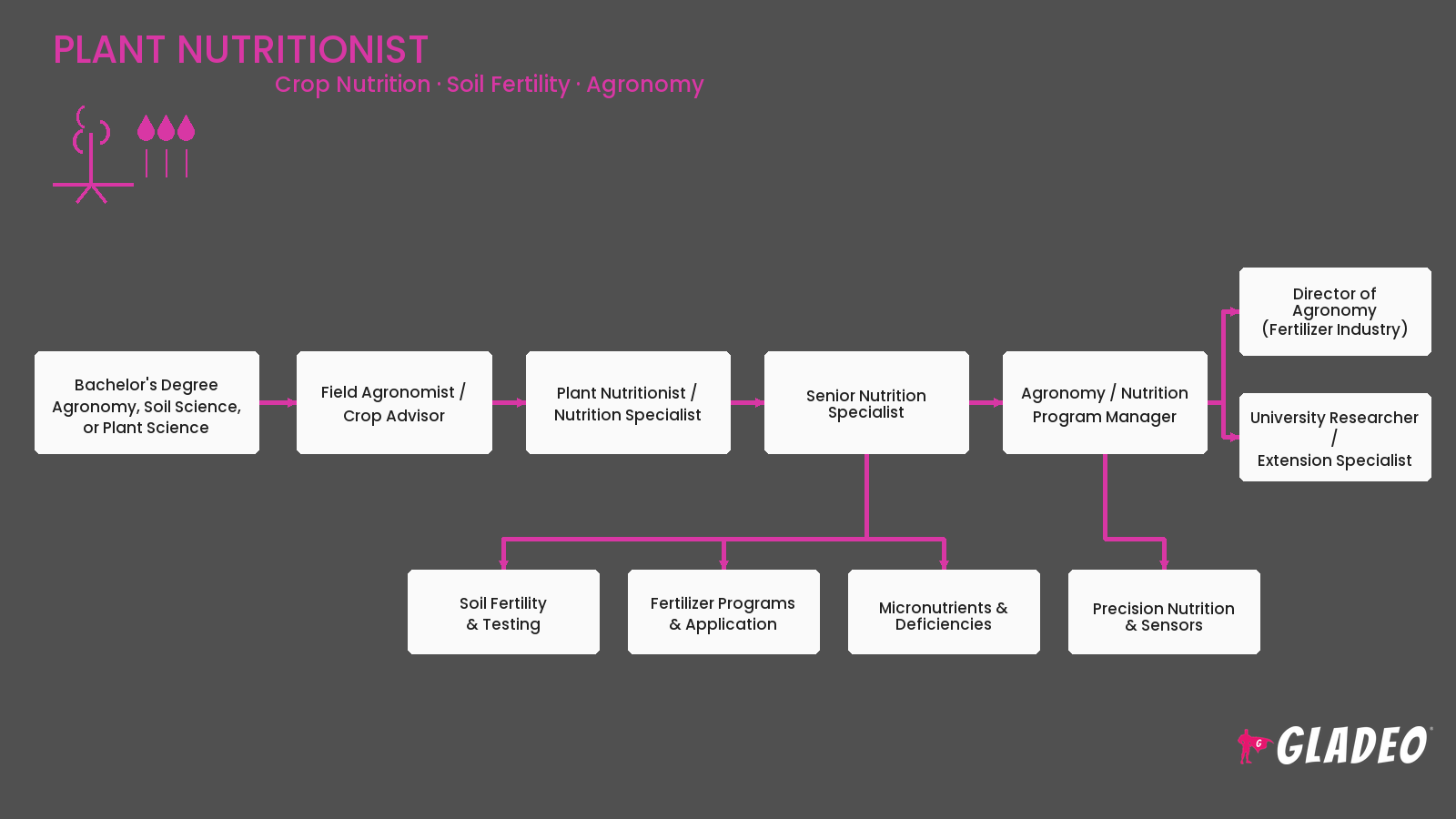
Click here to download the infographic
Newsfeed

Featured Jobs
Online Courses and Tools