






Spotlights
Plant Anatomist, Plant Biologist, Botanical Morphologist, Plant Physiologist, Plant Developmental Biologist, Botanical Scientist, Plant Structure Specialist, Plant Morphology Researcher, Botanical Research Scientist, Plant Taxonomist, Plant Ecologist, Plant Systematist
The shape, structure, and growth of plants influence everything from the food we eat to the natural environments that support life on Earth. Plant Morphologists unlock the mysteries hidden in leaves, stems, roots, and flowers, helping us understand how plants adapt, survive, and thrive in diverse ecosystems.
Plant Morphologists study the form and development of plants at all scales, from microscopic cells to entire plant organs. They work alongside botanists, geneticists, ecologists, and agricultural scientists to observe, document, and analyze plant structures. Through fieldwork, lab experiments, and data analysis, they uncover how plants grow and respond to their surroundings, which can lead to discoveries that improve crop yields, conserve rare species, or restore damaged habitats.
Using microscopes, imaging software, and molecular tools, Plant Morphologists gather detailed anatomical and developmental data. Their work is crucial for breeding hardier crops, understanding plant diseases, and preserving biodiversity. By revealing how plants function and change, they help solve environmental challenges and support sustainable agriculture and conservation efforts.
- Discovering unseen details of plant life that can impact agriculture and environmental health.
- Contributing to scientific knowledge that supports food security and ecosystem restoration.
- Collaborating with diverse teams of scientists and conservationists on meaningful projects.
- Seeing how your research can lead to real-world solutions for plant diseases and climate adaptability.
Working Schedule
Plant Morphologists often divide their time between laboratories, greenhouses, and field sites. Their schedules can vary seasonally — intensive fieldwork during growing seasons may require early mornings and outdoor work in diverse weather conditions, while lab days focus on observation and analysis. Many work full-time with regular hours, but project deadlines and experiments can lead to occasional overtime. Some morphologists work in academic or government research settings, while others may have freelance or consultancy roles that offer flexibility.
Typical Duties
- Collect plant samples from various environments for morphological study.
- Use microscopes to examine plant tissues and cells in detail.
- Record and analyze data on plant structures and developmental stages.
- Conduct experiments to observe plant growth under different conditions.
- Collaborate with geneticists to link morphology with plant genetics.
- Prepare detailed reports and scientific papers on findings.
- Present research to academic, agricultural, or environmental groups.
- Maintain lab and field equipment for accurate measurements.
- Use imaging software to create detailed visualizations of plant anatomy.
- Monitor changes in plant morphology related to environmental factors.
- Assist in teaching or mentoring students in botanical morphology.
- Stay updated on the latest research and techniques in plant science.
Additional Responsibilities
- Apply for research grants and funding to support projects.
- Participate in conferences and workshops to share knowledge.
- Advise farmers or conservationists on plant health and development.
- Help develop educational materials about plant biology.
- Contribute to biodiversity assessments and conservation plans.
- Review scientific articles as peer reviewers.
- Supervise lab assistants or junior researchers.
- Engage with the public through outreach programs about plant science.
Mornings usually begin with reviewing data collected from recent field trips or lab experiments, planning the day's activities, and calibrating microscopes and other instruments. Plant Morphologists check plant samples, ensuring they are properly preserved and ready for detailed analysis.
Midday often involves hands-on work: examining slides under microscopes, recording observations, or conducting controlled growth experiments in greenhouses. They might meet with colleagues to discuss results or adjust research methods based on findings. Some days include field visits to collect fresh specimens or monitor ongoing studies in natural habitats.
Afternoons and evenings are typically dedicated to data analysis, writing research papers, and preparing presentations. Morphologists may attend team meetings or mentor students. Deadlines for grant proposals or journal submissions can bring intense focus and longer hours. The day ends with planning next steps based on results and new questions that arise from the research.
Soft Skills
- Attention to detail
- Curiosity and a passion for discovery
- Critical thinking and problem-solving
- Patience and perseverance
- Effective communication
- Teamwork and collaboration
- Adaptability to changing environments
- Organizational skills
- Time management
- Scientific writing
- Public speaking
- Observation skills
Technical Skills
- Microscopy techniques
- Plant anatomy and physiology knowledge
- Data analysis and statistical software
- Imaging and visualization software
- Molecular biology basics
- Field sampling methods
- Laboratory safety protocols
- Scientific research methods
- Report and paper writing
- Grant writing
- Field Morphologist: Specializes in studying plants in their natural habitats to understand environmental influences on morphology.
- Laboratory Morphologist: Focuses on microscopic and cellular analysis of plant tissues under controlled conditions.
- Developmental Morphologist: Investigates how plant structures develop from seeds through maturity.
- Comparative Morphologist: Compares plant structures across species to study evolution and classification.
- Agricultural Morphologist: Applies knowledge to improve crop varieties and farming techniques.
- Ecological Morphologist: Examines how plant forms adapt to ecological niches and climate.
- Molecular Morphologist: Links genetic information to physical plant traits.
- Conservation Morphologist: Uses morphology to aid in preserving endangered plant species.
- University research departments
- Agricultural research centers
- Botanical gardens and arboretums
- Environmental conservation agencies
- Government agricultural departments
- Biotechnology companies
- Pharmaceutical companies focusing on plant-based products
- Forestry services
- Nonprofit environmental organizations
- Seed and crop development companies
- Museums of natural history
- International agricultural development organizations
Plant Morphologists often work under the pressure of research deadlines, funding cycles, and seasonal fieldwork demands. Experiments may require repeated trials and meticulous attention, which can be mentally demanding. Adapting to unpredictable outdoor conditions during field studies adds physical challenges.
Work hours are generally full-time but can extend during critical project phases or growing seasons. Fieldwork might include early mornings, weekends, or travel to remote locations. Laboratory days are more regular but require intense concentration and precision.
Sacrifices can include long periods away from home during field studies and balancing multiple projects simultaneously. The iterative nature of scientific research means facing setbacks and revisions, but the potential to contribute to important scientific breakthroughs offers strong motivation.
- Increased use of digital imaging and 3D modeling for plant structure visualization.
- Integration of molecular biology with morphological studies to understand genetic influences.
- Growing focus on plant adaptation to climate change and environmental stressors.
- Advances in remote sensing for large-scale plant morphology analysis.
- Use of machine learning to analyze complex morphological data.
- Collaboration across disciplines like ecology, genetics, and agriculture.
- Emphasis on conservation morphology to protect endangered species.
- Development of automated microscopy and high-throughput phenotyping.
- Open-access databases for sharing morphological data worldwide.
- Citizen science projects involving plant observation and data collection.
Many Plant Morphologists were fascinated by nature and plants from a young age, often exploring gardens, forests, or parks to observe different plants. They enjoyed collecting leaves, identifying flowers, and learning the names and uses of plants around them.
They showed curiosity about how plants grow, change, and survive in various environments. Activities like gardening, drawing plants, or participating in science fairs sparked their interest in plant biology and set the foundation for their future careers.
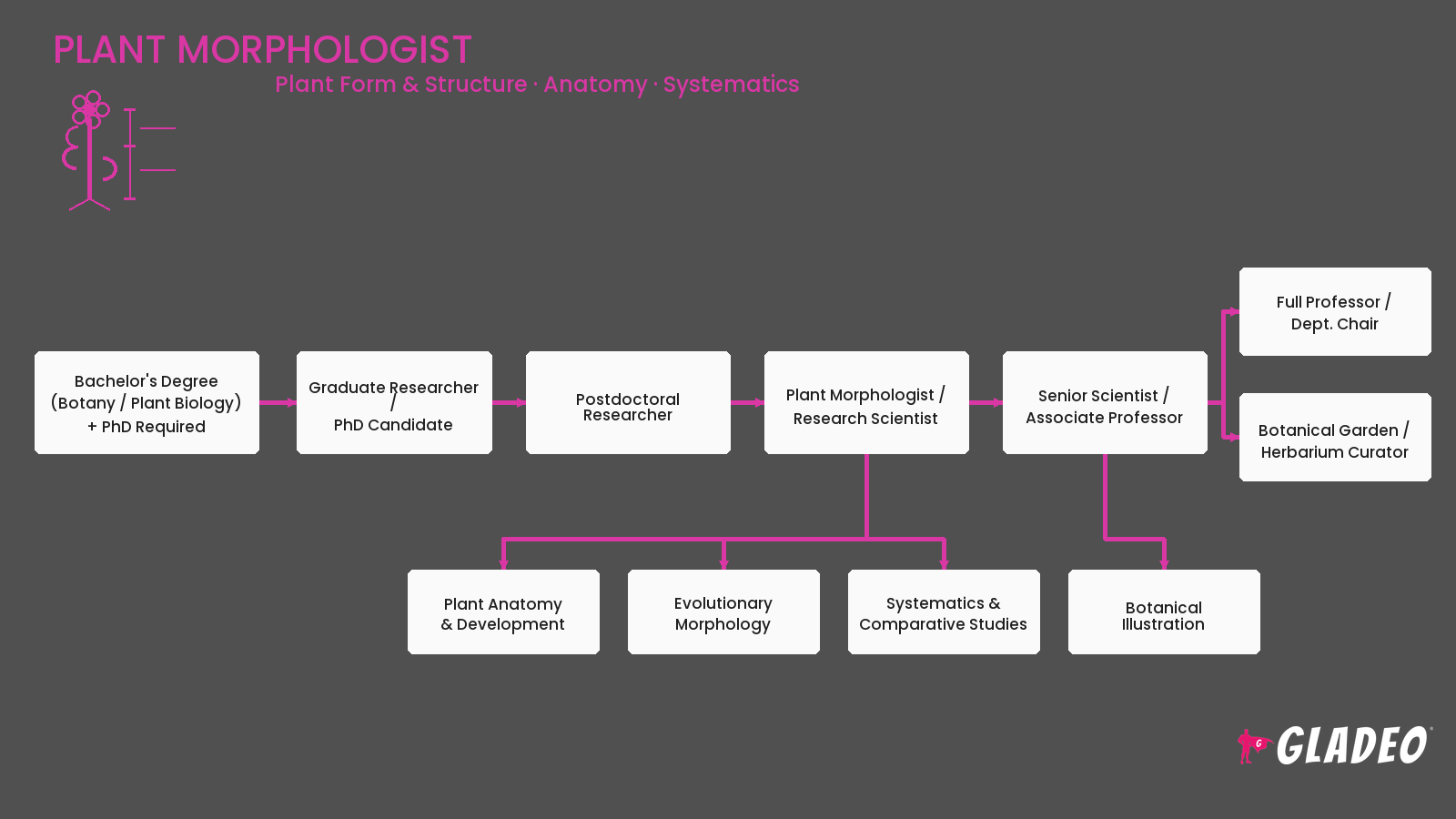
Becoming a Plant Morphologist typically requires a bachelor’s degree in botany, plant biology, or a related field. Advanced research roles often demand a master's or doctoral degree focused on plant morphology, anatomy, or developmental biology. Hands-on experience through internships, lab work, and field research is vital for building expertise.
Students can take courses in relevant subjects such as:
- Biology and Botany
- Plant Physiology
- Plant Anatomy and Morphology
- Ecology and Environmental Science
- Genetics and Molecular Biology
- Microscopy and Imaging Techniques
- Research Methods and Data Analysis
- Soil Science and Plant Nutrition
- Statistics for Biological Sciences
- Scientific Writing and Communication
Practical experience gained through internships, undergraduate research projects, or fieldwork enhances understanding and employability. Building a portfolio of research, including publications or presentations, can open doors to graduate programs or research positions. Continuous learning is important as techniques and technologies evolve.
- Take advanced biology and chemistry courses to build foundational knowledge.
- Participate in science clubs or environmental groups to gain hands-on experience.
- Volunteer in local botanical gardens, farms, or nature reserves.
- Attend workshops or camps focused on plant science or ecology.
- Develop strong skills in math and statistics for data analysis.
- Learn to use microscopes and basic lab equipment through school labs.
- Engage in science fairs or research competitions with plant-related projects.
- Explore computer skills, especially in data analysis and imaging software.
- Connect with college advisors about programs in plant sciences.
- Consider summer programs or internships at universities or research centers.
- Choose programs with strong plant biology or botany departments.
- Look for opportunities involving both lab and field research.
- Check if the program offers courses in microscopy and imaging.
- Seek programs that encourage interdisciplinary studies, including genetics and ecology.
- Ensure access to greenhouses, botanical gardens, or natural habitats for study.
- Investigate faculty research interests to align with your goals.
- Look for programs with active student research groups or clubs.
- Prioritize schools with internship or cooperative education options.
- Consider programs that teach scientific writing and communication skills.
- Explore options that provide training in statistical and data analysis software.
- Find programs offering workshops on grant writing and research funding.
- Check for career services that connect students to botanical or environmental employers.
- Apply for internships in botanical gardens, agricultural research centers, or university labs.
- Volunteer for fieldwork opportunities to gain sample collection experience.
- Assist in lab work such as preparing slides and running experiments.
- Build a portfolio documenting plant samples, observations, and research notes.
- Network with professors and professionals at conferences or seminars.
- Create a resume highlighting biology coursework and relevant skills.
- Develop basic proficiency in microscopy and data analysis software.
- Seek entry-level technician or research assistant roles.
- Practice scientific writing and prepare summaries of your work.
- Attend career fairs focused on science and environmental fields.
- Join plant science or botany clubs to meet peers and mentors.
- Stay curious and ask questions to deepen your understanding of plant morphology.
- Pursue graduate studies (master’s and PhD) to specialize and conduct independent research.
- Publish research findings in scientific journals to establish credibility.
- Gain experience managing projects or leading research teams.
- Build relationships with professionals in academia, industry, and government.
- Attend and present at national and international conferences.
- Develop expertise in emerging technologies like molecular analysis or imaging.
- Seek teaching opportunities to mentor students and expand influence.
- Explore leadership roles in research institutions or environmental organizations.
Websites:
- Botanical Society of America (botany.org)
- American Society of Plant Biologists (aspb.org)
- International Association of Plant Taxonomists (iplant.org)
- Society for Experimental Biology (seb.org)
- Plant Morphology Research Group at universities
- National Arboretum and Botanical Garden websites
- USDA Agricultural Research Service (ars.usda.gov)
- Plant Science Today (plantsciencetoday.org)
- Nature Plants journal (nature.com/nplants)
- Science Careers (sciencecareers.org)
- Plant Conservation Alliance (plantconservation.org)
- Agricultural Research Magazine (ars.usda.gov/magazine)
- Plant Anatomy Online Resources
- Botany in Action (botanyinaction.org)
Books:
- Plant Anatomy by James D. Mauseth
- Plant Systematics by Michael G. Simpson
- The Morphology of Vascular Plants by Ernest M. Gifford and Adriance S. Foster
- Plant Physiology by Lincoln Taiz and Eduardo Zeiger
- Botany: An Introduction to Plant Biology by James D. Mauseth
If a career as a Plant Morphologist doesn’t feel like the perfect fit, there are many related paths where your passion for plants and science can thrive.
- Botanist
- Plant Physiologist
- Ecologist
- Agricultural Scientist
- Environmental Scientist
- Horticulturist
- Plant Geneticist
- Conservation Scientist
- Forester
- Soil Scientist
Click here to download the infographic
Newsfeed

Featured Jobs
Online Courses and Tools