







Spotlights
Agricultural Inspector, Plant Health Inspector, Crop Inspector, Pest Control Inspector, Quality Control Inspector (Agriculture), Phytosanitary Inspector, Nursery Inspector, Food Safety Inspector (Plants), Environmental Compliance Inspector, Agricultural Compliance Officer, Plant Quarantine Officer, Horticultural Inspector
Imagine a world where the fruits, vegetables, and plants you enjoy are safe, healthy, and free from dangerous pests or diseases. Plant Inspectors are the unsung heroes who protect our food supply and natural ecosystems by making sure plants meet strict health and safety standards before they reach your table or the environment.
Every day, Plant Inspectors examine crops, trees, and plant shipments to detect signs of pests, diseases, or contamination. They work closely with farmers, growers, customs agents, and environmental agencies to prevent harmful organisms from spreading. Their inspections help prevent crop loss, protect biodiversity, and support sustainable agriculture.
Using tools like magnifying lenses, microscopes, and specialized testing kits, Plant Inspectors carefully analyze plant samples and documents to verify compliance with regulations. Their work is vital to safeguarding agriculture and natural habitats, ensuring that plants entering markets or crossing borders are healthy and safe for consumers and ecosystems alike.
- Knowing your work protects food supplies and prevents costly outbreaks of plant diseases.
- Helping farmers and communities maintain healthy crops and sustainable practices.
- Playing a key role in environmental conservation by stopping invasive species.
- Working outdoors and combining science with practical problem-solving every day.
Working Schedule
Plant Inspectors often work full-time during regular business hours, but the job can require flexibility to meet seasonal planting and harvesting schedules or respond to urgent inspections. They may work both indoors, examining plant samples in labs or offices, and outdoors in fields, nurseries, or at ports of entry. The role can be government or agency-based, with some inspectors working as contractors or in private industry, and deadlines can be strict, especially when dealing with outbreaks or regulatory compliance.
Typical Duties
- Inspect plants, crops, and plant products for pests, diseases, or other harmful conditions.
- Collect plant samples for laboratory analysis and testing.
- Review import/export documents to verify compliance with phytosanitary regulations.
- Advise farmers and growers on pest management and plant health practices.
- Report and document inspection findings accurately for regulatory agencies.
- Coordinate with customs officials to inspect shipments entering or leaving the country.
- Monitor and enforce quarantine restrictions to prevent spread of invasive species.
- Educate the public and industry personnel about plant health standards and risks.
- Investigate plant health complaints and outbreaks when they arise.
- Maintain detailed records of inspections and follow-up actions.
- Stay updated on new plant diseases, pests, and inspection techniques.
- Use specialized equipment to detect microscopic pests or pathogens.
Additional Responsibilities
- Train new inspectors or agricultural workers on inspection protocols.
- Participate in research projects related to plant health and pest management.
- Develop or update inspection procedures based on latest scientific findings.
- Collaborate with environmental agencies on habitat preservation efforts.
- Support emergency response teams during pest outbreaks or plant disease crises.
- Provide testimony or documentation in regulatory hearings or legal cases.
- Assist in policy development for plant health regulations.
- Engage with local communities to raise awareness about invasive species and plant protection.
Morning usually begins by reviewing inspection schedules and reports from previous days, preparing equipment, and planning field visits or shipment inspections. Inspectors check for any urgent alerts about outbreaks or regulatory changes that may impact their tasks.
Midday involves traveling to farms, nurseries, ports, or markets to conduct physical inspections. Inspectors carefully examine plants for pests or diseases, collect samples, and interview growers or handlers about their practices. Documentation is completed on the spot or shortly after inspections.
Afternoon is often dedicated to analyzing samples in a lab or coordinating with specialists. Inspectors may meet with agricultural officials, provide guidance to growers, or complete detailed reports to submit to regulatory agencies. If urgent issues arise, they may respond immediately to contain potential threats.
Soft Skills
- Attention to detail
- Strong observational skills
- Effective communication
- Problem-solving mindset
- Patience and persistence
- Ability to work independently and in teams
- Adaptability to changing conditions
- Good organizational skills
- Critical thinking
- Customer service orientation
- Integrity and ethical judgment
- Curiosity about natural sciences
Technical Skills
- Knowledge of plant biology and pathology
- Familiarity with pest identification techniques
- Use of microscopes and sampling tools
- Understanding of agricultural regulations
- Data collection and record-keeping
- Basic laboratory testing methods
- Use of GPS and mapping tools
- Report writing and documentation
- Proficiency with inspection software
- Ability to interpret scientific reports
- Phytosanitary Inspector: Focuses on preventing the spread of pests and diseases through international trade and plant shipments.
- Nursery Inspector: Specializes in inspecting plants at nurseries to ensure they meet health standards before sale or distribution.
- Crop Inspector: Concentrates on field inspections of crops during growing seasons to monitor health and compliance.
- Pest Control Inspector: Primarily inspects for the presence of harmful pests affecting plants and advises on control measures.
- Organic Plant Inspector: Verifies that organic farming standards are met through inspections and certifications.
- Environmental Compliance Inspector: Ensures that agricultural practices meet environmental protection laws related to plant health.
- Quarantine Inspector: Responsible for enforcing quarantine regulations to isolate and manage plant disease outbreaks.
- Food Safety Plant Inspector: Checks plant-based food products for contamination and safety before reaching consumers.
- Government agricultural departments and agencies
- State and federal plant health services
- Customs and border protection agencies
- Environmental protection organizations
- Agricultural extension services
- Research institutions and universities
- Private agricultural consulting firms
- Nurseries and greenhouse operations
- •Food safety and inspection services
- International trade and quarantine authorities
- Nonprofit environmental advocacy groups
- Farm cooperatives and associations
Plant Inspectors often face pressure to identify and respond quickly to potential threats that can affect entire regions or countries. The job requires vigilance, as missing a pest or disease outbreak can lead to severe economic and environmental damage.
Work hours are generally full-time with occasional overtime during peak planting seasons or emergency situations. Inspectors may need to travel frequently to farms, ports, or remote areas, requiring physical stamina and flexibility.
The role can be mentally demanding due to the need for constant attention to detail, thorough documentation, and the responsibility of enforcing regulations that impact livelihoods. Continuous learning to keep up with emerging plant health issues is essential.
- Increasing use of digital inspection tools and mobile apps for real-time data collection.
- Adoption of drone technology for aerial crop monitoring and pest detection.
- Greater focus on sustainable agriculture and integrated pest management.
- Improved laboratory testing methods for faster disease identification.
- Rising importance of international phytosanitary standards and trade compliance.
- Expansion of remote sensing and AI to predict and prevent plant health threats.
- Growing public awareness of invasive species and environmental impacts.
- Development of climate-resilient crop inspection protocols.
- Collaboration across agencies for rapid response to outbreaks.
- Use of blockchain for traceability in agricultural supply chains.
Many Plant Inspectors enjoyed spending time outdoors, exploring nature, and observing plants and insects as kids. They often showed curiosity about how plants grow and how different organisms interact in ecosystems.
Early interests might include gardening, collecting bugs, reading about science, or helping in family farms or community gardens. These experiences sparked their passion for protecting plant health and the environment.
Becoming a Plant Inspector typically requires a combination of formal education and hands-on training. Most positions expect at least a high school diploma with additional coursework or degrees in agriculture, biology, horticulture, or environmental science. Specialized training in plant pathology and pest identification is highly valuable.
Students can take courses in relevant subjects such as:
- Biology: Plant Biology and Ecology
- Agricultural Science
- Environmental Science
- Plant Pathology
- Entomology (study of insects)
- Chemistry
- Soil Science
- Food Safety and Quality Control
- Geography and GIS (Geographic Information Systems)
- Data Analysis and Statistics
Hands-on experience is critical for success as a Plant Inspector. Many students gain practical skills through internships, cooperative education programs, or working on farms and nurseries. Building a portfolio of inspection or laboratory work and seeking certification from recognized agricultural or environmental bodies can improve job prospects.
- Take science courses like biology, chemistry, and environmental science.
- Participate in agricultural clubs or 4-H programs to gain practical experience.
- Volunteer or intern at local farms, botanical gardens, or inspection agencies.
- Develop strong communication and report-writing skills.
- Learn about local and global agricultural issues.
- Explore GIS and data management tools.
- Attend workshops or seminars on plant health and pest management.
- Practice critical thinking through science projects or competitions.
- Build a network with agricultural professionals and teachers.
- Consider summer jobs related to farming or environmental work.
- Look for programs with hands-on training in plant health and inspection methods.
- Choose schools offering courses in plant pathology and entomology.
- Seek internships or cooperative education opportunities within agricultural agencies.
- Check for certification preparation in phytosanitary standards or organic inspection.
- Prioritize programs with strong science curricula and laboratory access.
- Find programs that teach regulatory compliance and documentation skills.
- Consider schools with connections to government or industry employers.
- Look for programs that include GIS and data analysis training.
- Ensure faculty have experience in agricultural inspection fields.
- Explore continuing education options for career advancement.
- Apply for internships or seasonal assistant roles with agricultural or environmental agencies.
- Volunteer for local plant health surveys or community garden projects.
- Build a detailed resume highlighting relevant coursework and hands-on experience.
- Create a portfolio documenting sample inspections or lab analyses.
- Network with professionals through agricultural fairs or seminars.
- Prepare for interviews by practicing questions on plant biology and inspection protocols.
- Seek entry-level titles like Agricultural Technician or Inspection Assistant.
- Stay informed about current plant health issues and regulations.
- Demonstrate reliability, attention to detail, and communication skills in applications.
- Consider temporary or contract positions to gain experience.
- Join professional organizations to access job postings and mentorship.
- Ask for feedback after interviews to improve future applications.
- Master advanced plant identification and diagnostic techniques.
- Obtain certifications in phytosanitary inspection or organic agriculture.
- Build strong relationships with regulatory agencies and growers.
- Develop leadership and training skills to mentor junior inspectors.
- Stay current on emerging pests, diseases, and inspection technologies.
- Expand expertise into related areas like food safety or environmental compliance.
- Pursue higher education in agricultural sciences or plant pathology.
- Seek roles with increased responsibility or management duties.
Websites:
- United States Department of Agriculture (USDA) - Plant Health Inspection Service
- International Plant Protection Convention (IPPC)
- American Society for Horticultural Science
- National Plant Board
- Association of Official Seed Certifying Agencies (AOSCA)
- CropLife America
- Plant Health Australia
- Agricultural and Environmental Inspectors Association
- Food and Agriculture Organization of the United Nations (FAO)
- Environmental Protection Agency (EPA) - Agriculture
- National Association of State Departments of Agriculture
- Society of American Foresters
- National Sustainable Agriculture Coalition
- International Federation of Organic Agriculture Movements (IFOAM)
Books:
- Plant Pathology by George N. Agrios
- Introduction to Plant Biology by Kingsley R. Stern
- Insect Pests of Plants and Their Management by James R. McDonald
- The Nature and Properties of Soils by Nyle C. Brady
- Pest Management and Phytosanitary Measures by Food and Agriculture Organization
If a career as a Plant Inspector doesn't turn out to be the perfect fit, there are plenty of related paths where your knowledge of plants, agriculture, and environmental health can shine.
- Agricultural Technician
- Environmental Scientist
- Food Safety Specialist
- Horticulturist
- Pest Control Technician
- Forestry Technician
- Agricultural Extension Agent
- Plant Pathologist
- Soil Scientist
- Lab Technician in Agricultural Testing
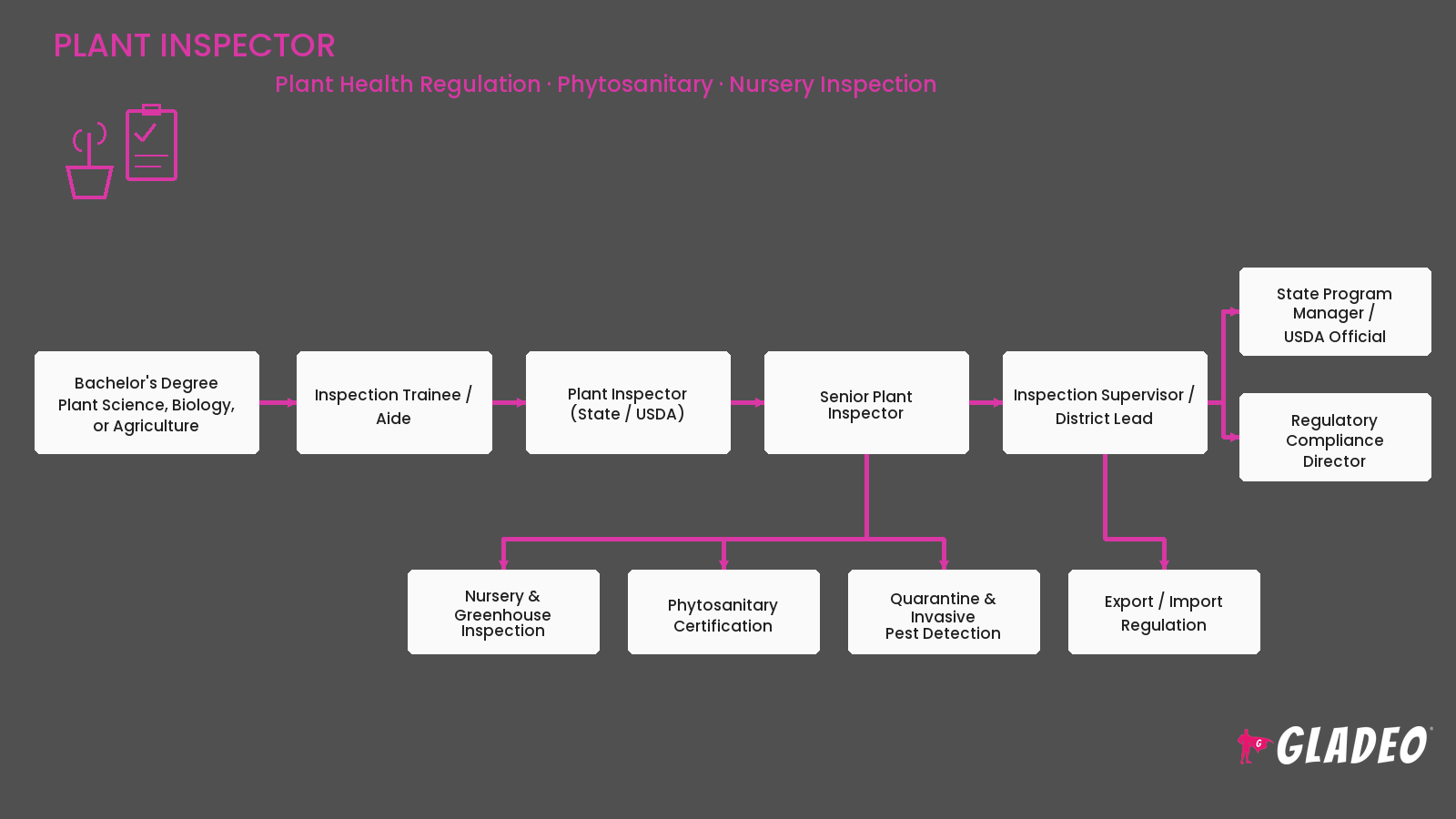
Click here to download the infographic
Newsfeed

Featured Jobs
Online Courses and Tools