





Spotlights
Fungal Biologist, Mushroom Scientist, Mycology Researcher, Fungal Ecologist, Medical Mycologist, Industrial Mycologist, Environmental Mycologist, Mycological Technician, Mycological Analyst, Fungal Taxonomist, Mycological Consultant
Imagine walking through a forest and noticing how mushrooms, molds, and other fungi quietly support the environment, medicine, and even food production. Mycologists make this hidden world visible and understandable, impacting everything from ecosystem health to human health and industry.
Mycologists study fungi — organisms like mushrooms, molds, and yeasts — to uncover their roles in nature, medicine, and technology. Each day, they might collect samples in the field, identify fungal species under microscopes, run experiments in labs, or analyze data to understand how fungi interact with plants, animals, and humans. They collaborate with botanists, chemists, environmental scientists, farmers, and healthcare professionals to develop new medicines, improve crops, or protect ecosystems.
Using tools like microscopes, DNA sequencers, and specialized software, mycologists decode fungal biology and genetics. Their work is vital because fungi influence soil health, produce antibiotics, help break down waste, and even contribute to sustainable materials. Mycologists help reveal nature’s secrets and find innovative solutions for health, agriculture, and the environment.
- Discovering new species or fungal compounds that can lead to medical breakthroughs.
- Contributing to environmental conservation by understanding fungi’s role in ecosystems.
- Helping farmers improve crop health through natural fungal partnerships.
- Working both outdoors in nature and indoors in high-tech labs, combining exploration with science.
Working Schedule
Mycologists typically work full-time in laboratories, offices, or outdoors collecting samples. Their schedules can be flexible but may include long hours when conducting experiments or field research during specific seasons. Many are employed by universities, government agencies, or private companies, but some work as consultants or freelancers. Deadlines often depend on research projects or grant timelines, which can create periods of intense focus and collaboration.
Typical Duties
- Collect and identify fungal specimens from forests, farms, or urban areas.
- Examine fungi under microscopes to classify species and study their structures.
- Conduct experiments to understand fungal genetics, growth, and interactions.
- Analyze soil and plant samples to study fungal impact on agriculture and environments.
- Develop fungal-based products like medicines, enzymes, or biofuels.
- Collaborate with scientists from other fields to apply fungal research in medicine, farming, or industry.
- Write research papers, reports, and grant proposals to share findings and secure funding.
- Maintain lab equipment and ensure safe handling of fungal samples.
- Use molecular biology techniques to study fungal DNA and genetics.
- Monitor fungal diseases affecting crops or human health and develop control strategies.
- Educate students or community members about fungi and their importance.
- Stay updated on scientific literature and advancements in mycology.
Additional Responsibilities
- Present research findings at scientific conferences or public events.
- Train and mentor interns, students, or junior researchers.
- Manage research budgets and lab resources effectively.
- Comply with environmental and safety regulations when handling fungi.
- Work with policymakers to inform regulations related to fungi and public health.
- Develop educational materials or workshops about fungal biology and conservation.
- Participate in interdisciplinary projects combining fungal science with technology or business.
- Seek funding through grants and partnerships for ongoing research projects.
Morning often starts with reviewing research goals and planning field trips or lab work. Mycologists might check data from previous experiments or prepare samples for analysis.
Midday is usually spent conducting experiments, examining fungi under microscopes, or collecting specimens outdoors. Collaboration with team members or discussing findings with other scientists is common during this time.
Afternoons and evenings focus on analyzing data, writing reports, or preparing presentations. Mycologists may also attend meetings, mentor students, or update their knowledge through reading and professional development activities.
Soft Skills
- Curiosity and passion for natural sciences
- Attention to detail for identifying fungi and analyzing data
- Critical thinking to solve complex biological questions
- Patience for long-term research and experimentation
- Good communication for writing reports and presenting findings
- Collaboration skills to work with diverse scientific teams
- Problem-solving to develop new methods or products
- Adaptability to work in labs, fields, and offices
- Organizational skills for managing samples and data
- Creativity to explore innovative uses of fungi
- Perseverance through challenges and failed experiments
- Ethical mindset for environmental and safety compliance
Technical Skills
- Microscopy techniques for fungal identification
- Molecular biology methods such as DNA extraction and sequencing
- Data analysis with statistical and bioinformatics software
- Fungal culturing and laboratory procedures
- Field sampling and specimen collection protocols
- Use of Geographic Information Systems (GIS) for ecological studies
- Laboratory safety and sterilization practices
- Scientific writing and research documentation
- Use of chemical analysis tools like chromatography
- Application of microscopy imaging software
- Medical Mycologist: Focuses on fungi that cause diseases in humans and animals, developing treatments and diagnostics.
- Industrial Mycologist: Applies fungal biology to create products like antibiotics, enzymes, or biofuels.
- Environmental Mycologist: Studies fungi’s role in ecosystems, including decomposition and symbiosis with plants.
- Agricultural Mycologist: Works to protect crops from fungal infections and improve soil health using fungi.
- Fungal Taxonomist: Specializes in classifying and naming fungal species, often discovering new ones.
- Mycological Ecologist: Investigates interactions between fungi and other organisms in their habitats.
- Mycological Technician: Supports research by preparing samples, maintaining equipment, and collecting data.
- Mycological Educator: Teaches students or the public about fungi through outreach and academic programs.
- Universities and Research Institutes
- Agricultural Research Centers
- Pharmaceutical Companies
- Environmental and Conservation Agencies
- Biotechnology Firms
- Food and Beverage Companies
- Forestry Departments
- Government Health Agencies
- Museums and Botanical Gardens
- Nonprofit Environmental Organizations
- Agricultural Extension Services
- Mycological Societies and Clubs
Mycologists often work under pressure to meet research deadlines, publish results, and secure funding. This can involve juggling multiple projects and adapting to unexpected experimental outcomes.
Their work hours are usually standard but can extend into evenings or weekends during field seasons or when experiments require constant monitoring. Travel to remote locations is common for sample collection.
Sacrifices include time spent away from home during fieldwork, repetitive tasks in labs, and the need for continuous learning to keep up with advancing science. Despite challenges, the role offers meaningful contributions to science and society.
- Growing interest in fungi for sustainable agriculture and environmental restoration.
- Advances in DNA sequencing technologies enabling faster fungal identification.
- Increased use of fungi in biotechnology for renewable materials and biofuels.
- Rising awareness of fungal diseases impacting human health and crops.
- Development of software tools for fungal data analysis and ecological modeling.
- Expansion of citizen science projects involving fungal surveys and education.
- Focus on fungal roles in carbon cycling and climate change mitigation.
- Integration of mycology with synthetic biology for novel applications.
- Greater collaboration across disciplines like medicine, agriculture, and environmental science.
- Emerging fungal therapies and natural products in pharmaceuticals.
Many mycologists were fascinated by nature as kids, especially enjoying exploring forests, collecting mushrooms, or observing mold on bread and fruit. They often had a deep curiosity about how living things grow and interact.
Early interests in science projects, biology classes, or gardening helped build their knowledge. Some loved puzzles and experiments, showing patience and attention to detail that suits fungal study well.
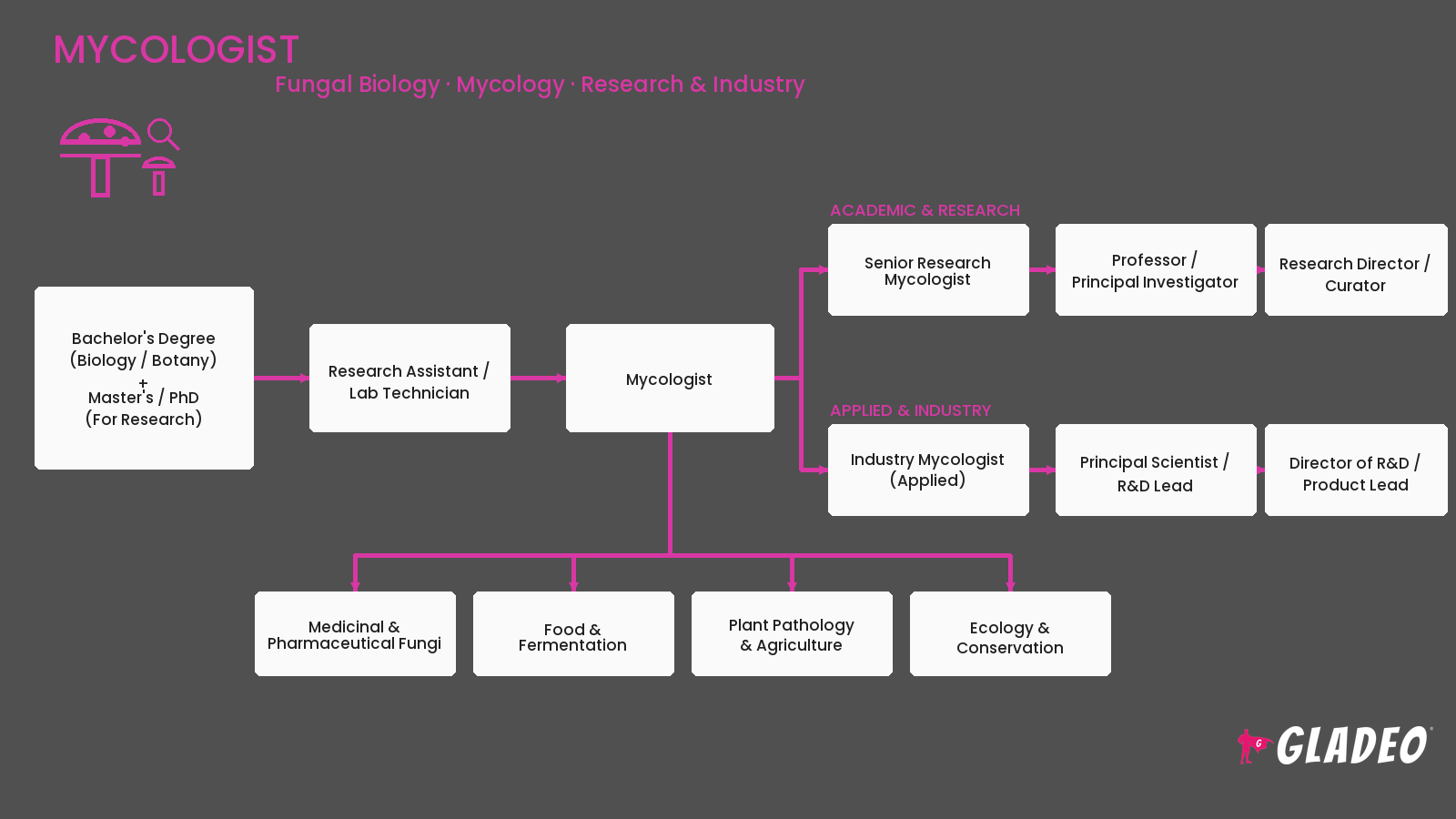
Becoming a mycologist usually starts with a bachelor’s degree in biology, microbiology, botany, or a related field. Many mycologists continue with graduate studies to specialize in fungal biology or applied mycology.
Students can take courses in relevant subjects such as:
- Biology and Microbiology
- Botany and Plant Sciences
- Genetics and Molecular Biology
- Ecology and Environmental Science
- Chemistry
- Soil Science
- Biotechnology
- Statistics and Data Analysis
- Laboratory Techniques
- Scientific Writing
Hands-on experience through internships, lab work, or field research is essential. Building a strong portfolio of projects and research helps prepare for advanced study or employment. Graduate degrees often focus on specific fungal research areas and increase job opportunities.
- Take advanced science courses like biology, chemistry, and environmental science.
- Join science clubs or participate in biology competitions.
- Volunteer or intern at botanical gardens, farms, or research labs.
- Explore local nature by hiking and identifying mushrooms or plants.
- Develop computer skills for data analysis and research presentation.
- Attend science fairs or submit projects related to fungi or ecology.
- Read scientific articles and books about fungi and biology.
- Seek mentorship from biology teachers or local scientists.
- Learn to use microscopes and basic lab equipment.
- Practice writing clear reports and summaries of experiments.
- Choose programs with strong biology, microbiology, or plant science departments.
- Look for schools offering courses or research opportunities in mycology.
- Seek internships or summer programs related to fungi or environmental science.
- Consider programs with access to fieldwork and lab facilities.
- Check for faculty expertise in fungal biology or related research.
- Ensure the program supports hands-on learning and independent research.
- Look for opportunities to join student science organizations or clubs.
- Evaluate the program’s connections to industry or government research.
- Consider schools offering biotechnology or molecular biology courses.
- Choose institutions that encourage interdisciplinary studies combining biology and environmental science.
- Apply for internships or technician roles in research labs or universities.
- Volunteer with environmental organizations or agricultural extension services.
- Build a portfolio documenting research projects or fungal collections.
- Network through mycological societies and science conferences.
- Seek entry-level positions as laboratory assistants or field researchers.
- Develop skills in microscopy, data analysis, and sample processing.
- Attend workshops or training sessions focused on fungal identification and safety.
- Use online job boards and university career centers to find openings.
- Connect with professors or mentors for job recommendations.
- Prepare for interviews by practicing explanations of your research and interests.
- Stay informed about current fungal science through journals and online forums.
- Consider freelance consulting or educational outreach to build experience.
- Pursue graduate degrees like a master’s or PhD in mycology or related fields.
- Publish research in scientific journals to build reputation.
- Develop expertise in specialized areas such as fungal genetics or industrial applications.
- Build strong professional networks through conferences and societies.
- Seek leadership roles in research projects or academic departments.
- Expand skills into biotechnology, bioinformatics, or environmental policy.
- Collaborate on interdisciplinary projects to increase impact and visibility.
- Consider teaching or public outreach roles to share knowledge and grow influence.
Websites:
- • International Mycological Association (imafungus.org)
- • Mycological Society of America (msafungi.org)
- • Fungal Diversity Survey (fungi.org)
- • American Phytopathological Society (apsnet.org)
- • Society for Industrial Microbiology and Biotechnology (sim.org)
- • Environmental Protection Agency - Fungi Resources (epa.gov)
- • National Center for Biotechnology Information
(ncbi.nlm.nih.gov) - • Mushroom Observer (mushroomobserver.org)
- • Fungi Magazine (fungimag.com
- • Biotechnology Innovation Organization (bio.org)
- • Scientific American - Mycology Articles (scientificamerican.com)
- • ResearchGate - Mycology Community (researchgate.net)
- • Nature - Mycology Research (nature.com/subjects/mycology)
- • Coursera - Mycology Courses (coursera.org)
Books:
- Mycelium Running by Paul Stamets
- The Kingdom Fungi by Steven L. Stephenson
- Mushrooms Demystified by David Arora
- Introduction to Fungi by John Webster and Roland Weber
- Fungal Biology by J.W. Deacon
If becoming a mycologist isn't the perfect fit, many related careers let you explore biology, environment, or biotechnology in different ways.
- Microbiologist
- Botanist
- Environmental Scientist
- Agricultural Scientist
- Biotechnologist
- Pharmacologist
- Soil Scientist
- Ecologist
- Wildlife Biologist
- Science Educator
Click here to download the infographic
Newsfeed

Featured Jobs
Online Courses and Tools