






Spotlights
Research Biologist, Molecular Geneticist, Cellular Biologist, Biochemist, Microbiologist, Molecular Biotechnologist, Biomedical Scientist, Geneticist, Molecular Pharmacologist, Molecular Pathologist, Molecular Life Scientist, Molecular Science Researcher
Every breakthrough in medicine, agriculture, and environmental science starts at the microscopic level of molecules and cells. Molecular Biologists uncover the secrets of life by studying DNA, RNA, proteins, and cellular processes that shape how organisms grow, develop, and respond to their surroundings.
On a typical day, Molecular Biologists design and carry out experiments to explore genetic material and cellular functions. They work closely with lab technicians, bioinformaticians, chemists, and healthcare professionals to analyze samples, interpret data, and develop new techniques that can lead to advances in disease treatment, genetic engineering, or drug development. Their work often results in published research, patents, or practical applications in medicine and biotechnology.
Using advanced tools like PCR machines, microscopes, gene sequencers, and computer modeling software, Molecular Biologists manipulate and examine molecules to understand complex biological systems. Their discoveries help improve health outcomes, create sustainable crops, and solve biological puzzles, making their role crucial in science and society.
- Contributing to life-saving medical discoveries that improve patient care and treatment options.
- Unraveling the mysteries of genetics and molecular mechanisms that explain how life works.
- Collaborating with a diverse team of scientists and healthcare experts to push the boundaries of knowledge.
- Seeing research progress from experiments to real-world applications in healthcare, agriculture, and biotechnology.
Working Schedule
Molecular Biologists typically work full-time in laboratory settings within universities, private companies, or government research centers. Their schedule often follows standard business hours but can extend to evenings or weekends when experiments require continuous monitoring or when deadlines approach. Many work as part of research teams, blending independent study with collaborative meetings and presentations.
Typical Duties
- Design and conduct experiments to study molecular and cellular processes.
- Extract and analyze DNA, RNA, and proteins from biological samples.
- Use microscopy and imaging techniques to observe cellular structures.
- Maintain laboratory equipment and ensure safety protocols are followed.
- Analyze experimental data using statistical methods and bioinformatics tools.
- Write research reports, scientific papers, and grant proposals.
- Collaborate with interdisciplinary teams including chemists, clinicians, and engineers.
- Develop new laboratory techniques and protocols to improve research quality.
- Present findings at scientific conferences and seminars.
- Stay updated on current scientific literature and emerging technologies.
- Assist in training and mentoring junior researchers and students.
- Manage laboratory inventories and order supplies.
Additional Responsibilities
- Ensure compliance with ethical standards and regulatory guidelines for research.
- Participate in peer review processes for scientific publications.
- Secure funding by applying for research grants and fellowships.
- Contribute to patent applications and technology transfer initiatives.
- Engage with the public or media to communicate scientific discoveries.
- Support quality control in biotechnological product development.
- Assist in the development of educational materials or workshops.
- Lead or contribute to interdisciplinary research projects.
Mornings often begin with reviewing experimental results from previous days and planning new tests based on those findings. Molecular Biologists might attend lab meetings to discuss progress, troubleshoot issues, and coordinate with team members.
Midday is usually devoted to hands-on laboratory work—preparing samples, running assays like PCR or gel electrophoresis, and documenting procedures meticulously. They analyze data on computers using specialized software and adjust experiment parameters accordingly.
Afternoons and evenings involve writing reports, reading recent scientific papers, and preparing presentations for upcoming conferences. Molecular Biologists often collaborate remotely or in person with other scientists to brainstorm ideas and refine research goals, especially when deadlines for publications or grants loom.
Soft Skills
- Curiosity and passion for scientific discovery
- Attention to detail and precision
- Critical thinking and problem-solving
- Patience and persistence during lengthy experiments
- Clear communication for writing and presentations
- Teamwork and collaboration
- Adaptability to evolving research challenges
- Time management to balance experiments and analysis
- Ethical judgment and responsibility
- Creativity in designing experiments
- Organizational skills for lab management
- Ability to learn new technologies quickly
Technical Skills
- Molecular biology techniques (PCR, gel electrophoresis, cloning)
- Microscopy and imaging methods
- Bioinformatics and computational biology
- Data analysis and statistical software
- Laboratory safety and compliance
- Experimental design and troubleshooting
- Genetic sequencing and editing tools (CRISPR)
- Protein analysis and purification
- Cell culture and manipulation
- Scientific writing and grant applications
- Academic Molecular Biologist: Conducts fundamental research in universities and publishes findings to advance scientific knowledge.
- Industrial Molecular Biologist: Works in biotech or pharmaceutical companies developing products like drugs or diagnostics.
- Clinical Molecular Biologist: Focuses on molecular diagnostics and genetic testing to support patient care in hospitals or labs.
- Environmental Molecular Biologist: Studies molecular processes in ecosystems to address environmental challenges.
- Agricultural Molecular Biologist: Develops genetically improved crops and studies plant molecular biology.
- Computational Molecular Biologist: Uses computer models and bioinformatics to analyze molecular data.
- Regulatory Molecular Biologist: Ensures products and research comply with government regulations.
- Biotech Entrepreneur: Starts companies to commercialize molecular biology innovations.
- Universities and research institutes
- Pharmaceutical companies
- Biotechnology firms
- Healthcare and diagnostic laboratories
- Government research agencies
- Agricultural research centers
- Environmental organizations
- Hospitals and clinical labs
- Nonprofit scientific foundations
- Academic medical centers
- Contract research organizations (CROs)
- Technology startups
Molecular Biologists face pressure to produce accurate, reproducible results, often under tight deadlines for grant submissions or product development timelines. Experiments can be complex and unpredictable, requiring resilience when results don’t match expectations.
Work hours are generally standard but can extend due to the nature of experiments needing continuous attention or when preparing for presentations and publications. Balancing lab work with writing and collaboration demands good time management.
The job requires standing or sitting for long hours, careful handling of chemicals and biological materials, and maintaining focus through repetitive or detailed tasks. Ethical considerations and regulatory compliance add responsibility to their role, ensuring research integrity.
- Increasing use of CRISPR and gene editing technologies.
- Growing integration of artificial intelligence and machine learning for data analysis.
- Expansion of personalized medicine based on molecular diagnostics.
- Development of lab automation to speed up experimental workflows.
- Emphasis on interdisciplinary collaboration across biology, chemistry, and computer science.
- Advancements in single-cell sequencing and molecular imaging.
- Rising importance of biotechnology startups and entrepreneurial ventures.
- Greater focus on sustainability and environmental molecular research.
- Improved techniques for synthetic biology and biomolecular engineering.
- Increased access to open-source scientific databases and tools.
Many Molecular Biologists were fascinated by nature, living organisms, or puzzles from a young age. They enjoyed science experiments, building models, or exploring microscopes to see the tiny details of plants, animals, or everyday objects.
They often displayed curiosity about how life works on a fundamental level and liked subjects such as biology, chemistry, and computer science. Early engagement in science fairs, clubs, or coding helped build their problem-solving and analytical skills.
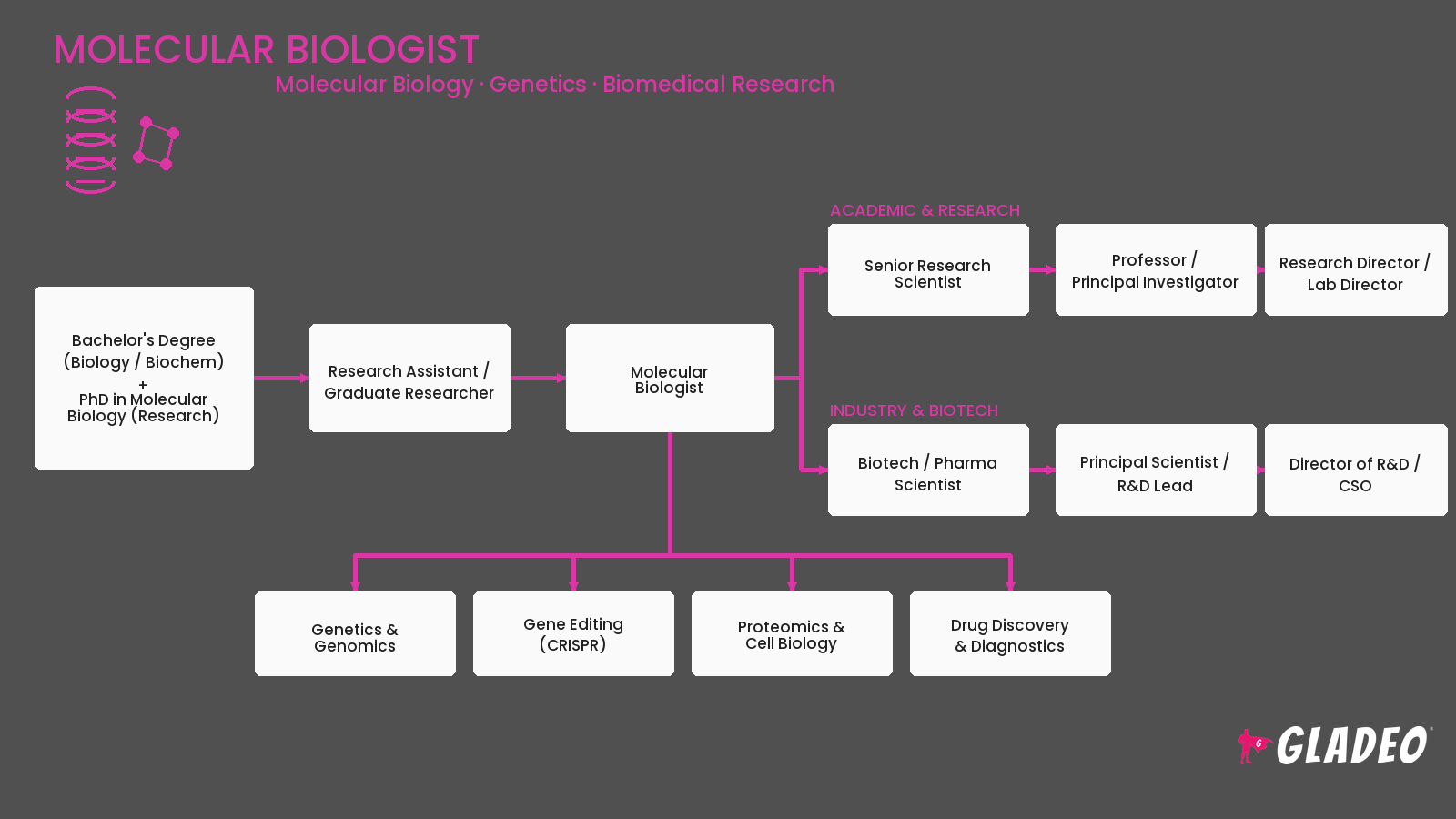
Molecular Biologists typically earn a bachelor’s degree in biology, biochemistry, molecular biology, or a related field. Many continue their education with a master's or doctoral degree to specialize in research and increase job opportunities.
Students can take courses in relevant subjects such as:
- Molecular Biology
- Genetics
- Biochemistry
- Cell Biology
- Microbiology
- Organic Chemistry
- Statistics and Data Analysis
- Bioinformatics
- Laboratory Techniques
- Biotechnology
Hands-on laboratory experience is essential, so internships and undergraduate research projects are highly recommended. Building a strong portfolio of research and publications can open doors to graduate programs and competitive positions in academia or industry.
- Take advanced science courses in biology, chemistry, and physics.
- Participate in science clubs and competitions to develop research skills.
- Learn computer programming and data analysis basics.
- Volunteer or intern in laboratories or research programs.
- Attend science camps or workshops focused on molecular biology.
- Develop strong math skills to support statistical analysis.
- Read scientific journals and stay curious about new discoveries.
- Join mentorship programs with professionals in science fields.
- Practice scientific writing and communication.
- Explore summer research opportunities at universities.
- Choose programs with strong laboratory facilities and research opportunities.
- Look for faculty actively publishing in molecular biology fields.
- Seek programs offering interdisciplinary coursework combining biology and computational methods.
- Consider institutions with partnerships in biotech or healthcare industries.
- Evaluate availability of internships, co-ops, or lab assistantships.
- Check for courses in emerging technologies like CRISPR and bioinformatics.
- Ensure programs provide training in scientific writing and grant applications.
- Find schools with supportive mentorship and career services.
- Look for diversity and inclusion initiatives in STEM programs.
- Assess opportunities for presenting research at conferences.
- Apply for laboratory technician or research assistant positions to gain hands-on experience.
- Build a strong resume highlighting coursework, internships, and lab skills.
- Develop a portfolio of research projects and any publications or presentations.
- Network with professors, peers, and professionals at conferences and seminars.
- Volunteer for extra lab duties to learn new techniques and demonstrate initiative.
- Practice scientific communication by writing summaries and giving presentations.
- Seek mentorship from experienced Molecular Biologists.
- Use job platforms focused on science and research careers.
- Prepare for interviews by reviewing common research scenarios and lab safety practices.
- Stay organized and detail-oriented to manage multiple experiments and data sets.
- Be open to internships or temporary contracts to gain relevant experience.
- Stay informed about new technologies and research trends in molecular biology.
- Pursue advanced degrees (master’s or PhD) to qualify for independent research roles.
- Publish research findings in respected scientific journals.
- Develop expertise in specialized techniques or emerging fields like synthetic biology.
- Expand professional network through conferences, workshops, and collaborations.
- Seek leadership roles such as project lead or lab manager.
- Gain experience in grant writing and managing research funding.
- Collaborate with industry partners to transition research into products.
- Consider teaching or mentoring roles to build reputation and influence.
Websites:
- American Society for Biochemistry and Molecular Biology (ASBMB) - asbmb.org
- The Molecular Biology Society - molbio.org
- National Institutes of Health (NIH) - nih.gov
- Society for Molecular Biology and Evolution (SMBE) - smbe.org
- Biotechnology Innovation Organization (BIO) - bio.org
- Nature Molecular Biology Journal - nature.com/subjects/molecular-biology
- GenomeWeb - genomeweb.com
- Science Careers - careers.sciencemag.org
- PubMed - pubmed.ncbi.nlm.nih.gov
- ResearchGate - researchgate.net
- LabRoots - labroots.com
- European Molecular Biology Organization (EMBO) - embo.org
- Genetics Society of America (GSA) - genetics-gsa.org
- Science News - sciencenews.org
Books:
- Molecular Biology of the Cell by Bruce Alberts
- Essential Cell Biology by Bruce Alberts
- Molecular Biology: Principles and Practice by Michael M. Cox
- Genomes by T.A. Brown
- The Machinery of Life by David S. Goodsell
If a career as a Molecular Biologist isn’t the perfect fit, many related paths build on similar scientific knowledge and skills, offering diverse opportunities to make an impact.
- • Biochemist
- • Microbiologist
- • Genetic Counselor
- • Pharmaceutical Scientist
- • Biomedical Engineer
- • Bioinformatics Specialist
- • Medical Laboratory Technician
- • Environmental Scientist
- • Science Educator
- • Clinical Research Coordinator
Newsfeed

Featured Jobs
Online Courses and Tools