







Spotlights
Design Engineer, Product Design Engineer, HVAC Engineer, Robotics Engineer, Automotive Engineer, Aerospace Mechanical Engineer, Manufacturing Engineer, Thermal Engineer, Systems Engineer, R&D Engineer, Project Engineer, Mechanical Design Engineer
The jet engine that lifts a plane off the runway, the artificial heart valve keeping someone alive, the robotic arm welding a car frame in seconds, the heat pump quietly warming a house in winter, all of it exists because a Mechanical Engineer figured out how to make it work before it was ever built. Mechanical Engineers design the machines, engines, and systems that move, lift, heat, cool, and power the modern world.
Mechanical Engineers take a problem or a product idea and turn it into a working design, calculating forces, stresses, and energy flows to make sure a part or system will actually perform the way it needs to. They model components in CAD software, run simulations to predict how a design will behave under real-world conditions, choose materials that can handle the loads and environments involved, and refine designs through rounds of analysis before anything gets built. They work closely with electrical engineers, manufacturing teams, and technologists who build and test physical prototypes, translating between the theoretical design and the physical reality of production.
Using tools like SolidWorks, ANSYS, MATLAB, and finite element analysis software, Mechanical Engineers predict how designs will perform long before a single part is machined. Their work touches nearly everything: transportation, energy, medicine, robotics, defense, and manufacturing all depend on engineers who can turn physics and math into machines that work safely, efficiently, and reliably.
- Designing systems and machines that solve real problems at scale
- Applying deep math and physics knowledge to build things that actually work
- Working across exciting fields like aerospace, robotics, clean energy, and medical devices
- Seeing a design you calculated on paper become a functioning, tested product
Working Schedule
Most Mechanical Engineers work full-time, typically around 40 hours a week, though project deadlines, product launches, or critical testing phases can mean longer hours for stretches at a time. The work is primarily based in an office or design studio using CAD and simulation software, with periodic visits to manufacturing floors, test labs, or client sites to review how designs are performing in the real world. Most Mechanical Engineers are employed directly by manufacturers, engineering firms, aerospace and defense contractors, or energy companies, while others work as consultants supporting multiple clients and industries.
Typical Duties
- Designing mechanical components, assemblies, and systems using CAD software
- Performing stress, thermal, and fluid dynamics analysis to validate designs
- Running finite element analysis (FEA) and computational fluid dynamics (CFD) simulations
- Selecting materials based on strength, weight, cost, and environmental factors
- Writing engineering specifications, calculations, and technical reports
- Reviewing prototype test results and revising designs based on findings
- Ensuring designs comply with industry codes and standards
- Estimating costs, timelines, and manufacturability of new designs
- Collaborating with electrical, software, and manufacturing engineers on integrated systems
- Overseeing design reviews with technologists, technicians, and project stakeholders
- Investigating mechanical failures and recommending corrective design changes
- Researching new technologies, materials, and methods to improve designs
Additional Responsibilities
- Contributing to patent applications for original designs
- Managing project budgets, schedules, and supplier relationships
- Presenting design proposals to clients, executives, or regulatory bodies
- Mentoring junior engineers and reviewing their design work
- Participating in root cause investigations for field failures
- Staying current with evolving codes from organizations like ASME and ISO
- Supporting sustainability initiatives through energy-efficient design choices
- Leading or contributing to cross-functional product development teams
A Mechanical Engineer's morning often starts by reviewing simulation results that finished running overnight, checking whether a redesigned bracket now meets its stress targets or whether a new heat exchanger layout improves cooling performance. They might join a quick stand-up meeting with the project team to align on priorities and flag any blockers.
Midday is often spent deep in CAD software, refining a 3D model based on yesterday's analysis, or working through hand calculations to double-check a simulation's assumptions. They might meet with a manufacturing engineer to discuss whether a design can realistically be produced at the tolerances specified, adjusting geometry to make fabrication easier without sacrificing performance.
Afternoons frequently involve collaboration: reviewing test data that a technologist collected on a prototype, discussing design trade-offs with electrical engineers on an integrated system, or presenting updated designs to a client or leadership. Before wrapping up, the engineer documents design changes, updates specifications, and plans tomorrow's analysis priorities.
Soft Skills
- Strong analytical and mathematical reasoning
- Attention to detail, since small errors in calculations can have big consequences
- Clear written and verbal communication for technical reports and presentations
- Collaboration across engineering, manufacturing, and business teams
- Problem-solving under real-world constraints like cost and time
- Patience through multiple rounds of design iteration
- Time management across simultaneous projects and deadlines
- Adaptability to new tools, materials, and industry standards
- Leadership in guiding project teams and mentoring junior engineers
- Critical thinking when balancing competing design requirements
- Curiosity to understand how and why systems behave the way they do
- Ethical responsibility, since designs can affect people's safety
Technical Skills
- CAD software such as SolidWorks, Creo, or Siemens NX
- Finite element analysis (FEA) and computational fluid dynamics (CFD) tools like ANSYS
- Thermodynamics, fluid mechanics, and heat transfer principles
- Statics, dynamics, and mechanics of materials
- Geometric dimensioning and tolerancing (GD&T)
- Programming and data analysis using MATLAB or Python
- Knowledge of manufacturing processes and design for manufacturability
- Materials science and selection for strength, weight, and cost
- Understanding of industry codes and standards from ASME, ISO, and SAE
- Project management and systems engineering fundamentals
- Design Engineer: Creates and refines the geometry and function of parts and assemblies
- Thermal and HVAC Engineer: Designs heating, cooling, and climate control systems
- Automotive Engineer: Develops engines, drivetrains, and vehicle systems
- Aerospace Mechanical Engineer: Designs components for aircraft and spacecraft
- Robotics Engineer: Designs mechanical hardware for robots and automated systems
- Manufacturing Engineer: Focuses on how designs are produced efficiently at scale
- Research and Development Engineer: Develops new products and technologies from concept
- Energy Systems Engineer: Designs equipment for power generation and renewable energy
- Aerospace and defense contractors
- Automotive and electric vehicle manufacturers
- Robotics and automation companies
- Consumer products and appliance manufacturers
- HVAC and building systems firms
- Renewable energy companies including wind, solar, and battery makers
- Industrial machinery manufacturers
- Medical device companies
- Engineering consulting firms
- Government research agencies such as NASA and the Department of Energy
- Oil, gas, and energy utility companies
- Semiconductor and electronics manufacturers
Mechanical Engineers carry real responsibility: a miscalculated load, an overlooked failure mode, or a rushed analysis can lead to costly recalls or, in the worst cases, safety incidents. That weight means engineers are expected to be rigorous, double-check their work, and speak up when a deadline threatens quality.
Design work often comes with pressure to balance performance, cost, manufacturability, and schedule all at once, which can mean stressful trade-off decisions and pushback from other teams. Product launches, certification deadlines, or urgent field failures can push hours well beyond a standard workweek for stretches at a time.
The field also demands continuous learning. New simulation tools, materials, manufacturing methods like additive manufacturing, and evolving industry standards mean engineers who stop learning fall behind quickly. Many pursue a Professional Engineer (PE) license or additional certifications throughout their careers to open doors to leadership and consulting roles.
- Growth of generative design and AI-assisted engineering tools
- Expansion of electric vehicles, batteries, and charging infrastructure design
- Increased use of digital twins to simulate systems before and after production
- Rising adoption of additive manufacturing for functional, end-use parts
- Growth of robotics and automation across manufacturing and logistics
- Sustainability-driven design focused on energy efficiency and circularity
- Expansion of renewable energy and grid-scale energy storage projects
- Adoption of model-based systems engineering (MBSE) for complex products
- Increased cross-training in mechatronics, electronics, and software
- Cloud-based CAD and PLM platforms enabling remote, real-time collaboration
Many Mechanical Engineers grew up curious about how machines worked, taking apart bicycles, engines, or old appliances just to see what was inside. They gravitated toward building sets, model kits, robotics competitions, and science fair projects where they could design something and put a theory to the test.
Others found their spark in math and physics classes when the concepts connected to something real, in video games involving building and physics, or in helping a parent fix a car or a household appliance. A drive to understand not just that something works, but why and how, often pointed toward this path early on.
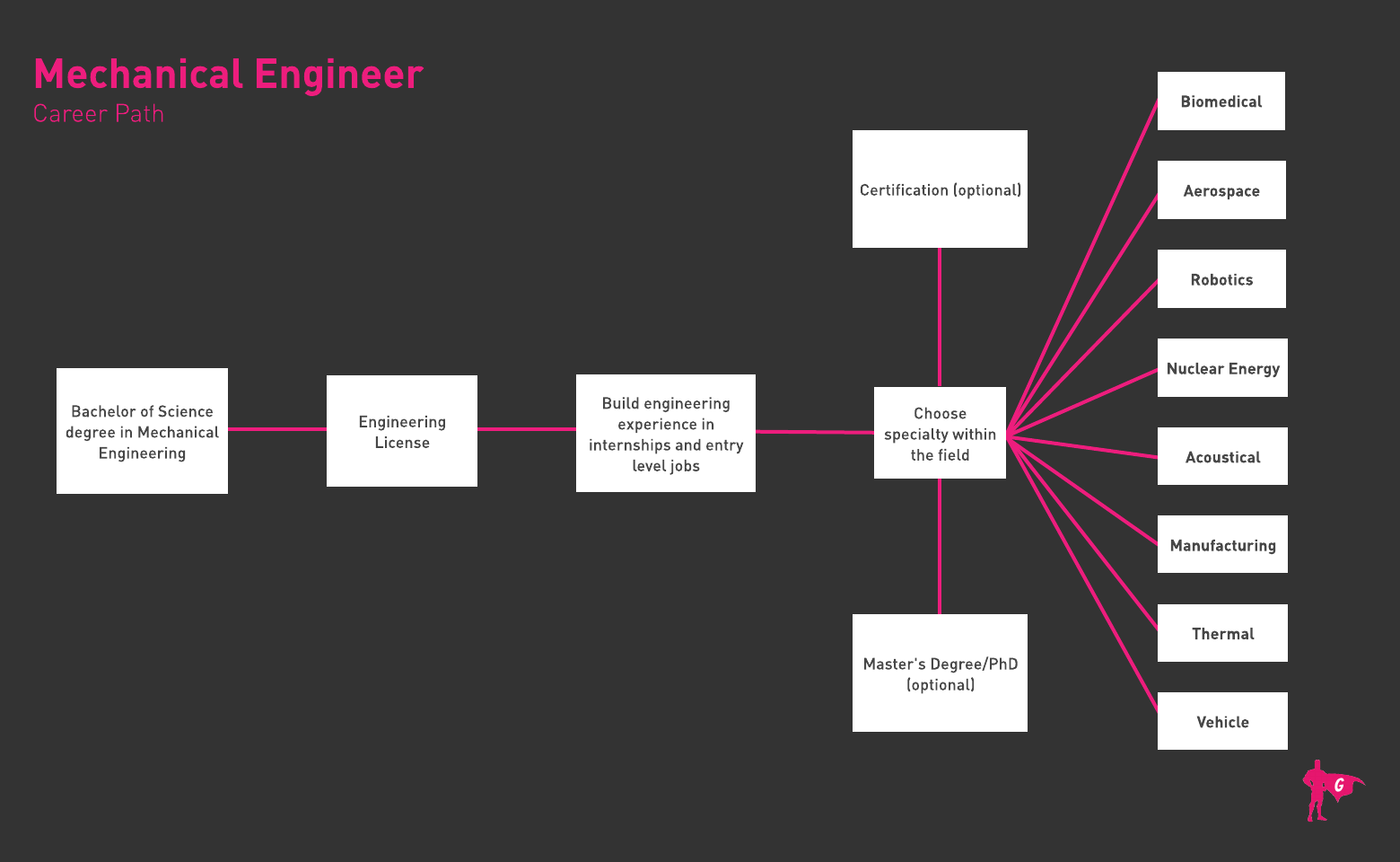
Mechanical Engineers need at least a bachelor's degree in mechanical engineering or a closely related engineering field, typically a four-year program accredited by ABET. The degree covers heavy math and science fundamentals, including calculus, physics, thermodynamics, and mechanics, alongside design projects using CAD and simulation software. Many engineers pursue a Professional Engineer (PE) license, which requires passing exams and gaining supervised work experience, especially for roles involving public safety or independent design sign-off. Some engineers go on to earn a master's degree to specialize in areas like robotics, thermal systems, or aerospace design.
Students can take courses in relevant subjects such as:
- Calculus, Differential Equations, and Linear Algebra
- Statics, Dynamics, and Mechanics of Materials
- Thermodynamics and Heat Transfer
- Fluid Mechanics
- Machine Design and Kinematics
- Computer-Aided Design (CAD) and Finite Element Analysis
- Materials Science and Engineering
- Controls and Systems Engineering
- Manufacturing Processes
- Engineering Ethics and Professional Practice
Hands-on experience through internships, co-op programs, and design competitions like Formula SAE or robotics teams gives students real engineering judgment that classroom theory alone cannot provide. Building a portfolio of design projects, from senior capstone work to personal builds, helps demonstrate both technical depth and creativity to employers. Many engineers continue learning after graduation through specialized software training, professional certifications, and, for many, the path toward a PE license.
- Take calculus, physics, and as much advanced math as your school offers
- Enroll in engineering, drafting, or CAD classes if available
- Join a robotics team such as FIRST Robotics or a SAE Baja or Formula SAE team
- Learn a CAD program like SolidWorks, Fusion 360, or Onshape on your own
- Build and test things at home: model rockets, go-karts, or 3D printed designs
- Enter science fairs or engineering design competitions
- Apply for pre-college engineering summer programs at universities
- Look for internships or job shadowing at engineering firms or manufacturers
- Talk to practicing engineers about what their day-to-day work actually looks like
- Get comfortable with programming basics in Python or MATLAB
- Practice documenting design projects with sketches, calculations, and photos
- Research ABET-accredited mechanical engineering programs early
- ABET accreditation for the mechanical engineering program
- Strong design curriculum paired with rigorous math and physics fundamentals
- Access to modern CAD, FEA, and CFD software for coursework
- Required or strongly encouraged co-op or internship placements
- A senior capstone project where you design, analyze, and often build something real
- Faculty with real industry or research experience
- Opportunities to join competitive design teams like Formula SAE or robotics
- Support for pursuing the Fundamentals of Engineering (FE) exam before graduation
- Strong career services with solid job placement rates for graduates
- Research opportunities in areas like robotics, energy, or aerospace
- Active professional society chapters such as ASME on campus
- Flexible options if you plan to pursue a master's degree afterward
- Complete at least one engineering internship or co-op before graduating
- Build a portfolio of design projects, calculations, and CAD models from school and competitions
- Apply for entry-level titles like Design Engineer, Mechanical Engineer I, or Product Development Engineer
- Pass the Fundamentals of Engineering (FE) exam before or shortly after graduation
- Search job boards like LinkedIn, Indeed, and company career pages, plus engineering-focused sites
- Attend career fairs hosted by your college and by organizations like ASME and SAE
- Highlight specific analysis and design skills on your resume, not just coursework titles
- Practice explaining a design project clearly in interviews, including trade-offs you made
- Network with professors, alumni, and internship supervisors who often hear about openings first
- Consider roles in manufacturing or quality engineering to build broad early experience
- Be open to relocating to regions with strong aerospace, automotive, or energy industries
- Show strong fundamentals in hand calculations, not just simulation software fluency
- Deepen expertise in a specialty like thermal systems, robotics, or structural analysis
- Pursue a Professional Engineer (PE) license to take on higher-stakes design responsibility
- Volunteer for challenging, high-visibility design and analysis projects
- Build a reputation for rigorous, well-documented engineering work
- Move into senior engineer, lead engineer, or engineering manager roles
- Pursue a master's degree for advanced technical or research-focused positions
- Develop project management and cross-functional leadership skills
- Stay active in professional organizations to learn about new methods and opportunities
Websites:
- American Society of Mechanical Engineers (ASME) - asme.org
- National Society of Professional Engineers (NSPE) - nspe.org
- SAE International - sae.org
- National Council of Examiners for Engineering and Surveying (NCEES) - ncees.org
- Engineering.com - engineering.com
- Machine Design - machinedesign.com
- ASHRAE - ashrae.org
- American Institute of Aeronautics and Astronautics (AIAA) - aiaa.org
- Society of Women Engineers (SWE) - swe.org
- National Society of Black Engineers (NSBE) - nsbe.org
- GrabCAD Community - grabcad.com
- NASA STEM Engagement - nasa.gov/stem
- ASME Career Center - careers.asme.org
- IEEE Spectrum Engineering News - spectrum.ieee.org
Books:
- Shigley's Mechanical Engineering Design by Richard G. Budynas and J. Keith Nisbett
- Skunk Works by Ben Rich and Leo Janos
- The Design of Everyday Things by Don Norman
- To Engineer Is Human by Henry Petroski
- Thinking in Systems by Donella Meadows
If you find that being a Mechanical Engineer isn't the right fit, your skills in design, analysis, and problem-solving transfer to many related careers.
- Mechanical Engineering Technologist
- Aerospace Engineer
- Automotive Engineer
- Manufacturing Engineer
- Robotics Engineer
- HVAC Design Engineer
- Product Manager for hardware products
- Patent Engineer or Patent Examiner
- Systems Engineer
- Technical Sales Engineer
Newsfeed

Featured Jobs
Online Courses and Tools
Annual Salary Expectations
New workers start around $79K. Median pay is $104K per year. Highly experienced workers can earn around $124K.
Annual Salary Expectations
New workers start around $122K. Median pay is $158K per year. Highly experienced workers can earn around $185K.
Annual Salary Expectations
New workers start around $102K. Median pay is $130K per year. Highly experienced workers can earn around $172K.
Annual Salary Expectations
New workers start around $85K. Median pay is $112K per year. Highly experienced workers can earn around $140K.
Annual Salary Expectations
New workers start around $83K. Median pay is $105K per year. Highly experienced workers can earn around $141K.