







Spotlights
Medical Malpractice Attorney, Medical Negligence Lawyer, Healthcare Litigation Attorney, Medical Defense Attorney, Plaintiff's Malpractice Counsel, Hospital Liability Attorney, Medical Injury Lawyer, Healthcare Risk Litigation Attorney, Physician Defense Counsel, Nursing Home Litigation Attorney, Medical Liability Litigator, Health Law Litigator
When a routine surgery goes wrong, a diagnosis is missed, or a medication error changes a patient's life forever, someone has to sort through what happened and hold the right people accountable, or defend those who did nothing wrong. Malpractice Lawyers step into the space where medicine and law collide, working to bring justice to patients who were harmed or to protect doctors and hospitals from claims that do not hold up under scrutiny.
Malpractice Lawyers either represent patients who believe they were injured by medical negligence, or they defend physicians, nurses, hospitals, and healthcare systems accused of it. Either way, the job means becoming fluent in medicine: poring over medical records, imaging, and lab results, working closely with medical experts to determine whether a provider deviated from the accepted standard of care, and building a case detailed enough to hold up in a courtroom. They interview patients, doctors, and nurses, depose witnesses, and negotiate settlements, all while translating dense clinical detail into a story a jury can understand.
Using tools like medical record review software, expert witness networks, deposition transcripts, and medical literature databases, Malpractice Lawyers turn complicated clinical facts into clear legal arguments. Their work matters because these cases determine whether injured patients get the compensation and answers they deserve, and whether healthcare providers are fairly protected from claims that lack merit. It is detail-obsessed, high-stakes work where getting the medicine right is just as important as getting the law right.
- Getting justice and financial recovery for patients seriously harmed by medical errors
- Uncovering the truth in complex cases by mastering both medical and legal detail
- Defending skilled healthcare providers against claims that do not hold up to scrutiny
- Working at the fascinating intersection of medicine, science, and the law
Working Schedule
Malpractice Lawyers typically work full-time, and the demands of case preparation, especially reviewing thousands of pages of medical records, often mean long hours as trial dates approach. Much of the work happens in an office reviewing documents and consulting with medical experts, but the job also includes depositions, mediations, and courtroom trials that can run for days or weeks. Plaintiff-side attorneys at smaller firms may have more schedule flexibility but face financial pressure since many cases are handled on contingency, while defense-side attorneys at larger firms or insurance companies tend to have steadier hours and salaries.
Typical Duties
- Reviewing medical records, imaging, and lab results to evaluate potential malpractice claims
- Consulting with medical experts to determine whether care fell below the accepted standard
- Interviewing patients, family members, physicians, and nurses about what occurred
- Filing lawsuits or defending clients against medical negligence claims
- Taking and defending depositions of medical providers and expert witnesses
- Negotiating settlements with opposing counsel or insurance companies
- Preparing and presenting evidence and expert testimony at trial
- Calculating damages, including medical costs, lost wages, and long-term care needs
- Researching medical literature and clinical guidelines relevant to a case
- Drafting complaints, motions, and legal briefs specific to healthcare litigation
- Coordinating with life care planners and economists on damages calculations
- Advising healthcare clients on risk management to prevent future claims
Additional Responsibilities
- Staying current on medical standards of care and evolving healthcare regulations
- Managing relationships with a network of medical expert witnesses across specialties
- Working with insurance adjusters and claims professionals on defense-side cases
- Training or supervising paralegals and legal nurse consultants
- Reviewing hospital policies and procedures for compliance and risk exposure
- Attending continuing legal education focused on medical malpractice and healthcare law
- Managing complex case budgets, since expert witnesses and record review can be costly
- Participating in mediation and alternative dispute resolution to resolve cases efficiently
A Malpractice Lawyer's morning often starts with reviewing a stack of medical records for a new case, looking for the moment where a provider's decision may have deviated from accepted medical practice. They might spend an hour on the phone with a medical expert, walking through imaging results to understand whether a delayed diagnosis caused real harm.
Midday can bring a deposition, questioning a physician under oath about their treatment decisions, or being questioned themselves if representing the defense. Preparation for a deposition or trial testimony is intense, requiring the lawyer to understand the medicine almost as well as the doctors involved. They might also meet with a grieving family to explain, with care and clarity, what the medical evidence shows and what legal options exist.
Afternoons are often spent drafting motions, negotiating a settlement with opposing counsel, or coordinating with a life care planner to calculate the true cost of a client's future medical needs. Malpractice Lawyers frequently juggle several cases at once, each requiring its own deep dive into a different area of medicine, from birth injuries to surgical errors to missed cancer diagnoses.
Soft Skills
- Analytical thinking and attention to detail
- Persistence when reviewing extensive medical documentation
- Strong written and oral advocacy skills
- Empathy when working with injured patients and grieving families
- Composure and precision during depositions and cross-examination
- Skilled negotiation
- Organizational skills to manage complex, document-heavy cases
- Ability to translate complex medicine into plain language for juries
- Objectivity and sound judgment evaluating case merit
- Collaboration with medical experts and other professionals
- Resilience through long, high-stakes litigation
- Ethical rigor and professionalism
Technical Skills
- Deep understanding of medical terminology, procedures, and standards of care
- Legal research and case law analysis in healthcare litigation
- Medical record review and analysis
- Deposition and courtroom litigation skills
- Knowledge of expert witness qualification and testimony rules
- Damages calculation, including future medical costs and lost earning capacity
- Familiarity with hospital risk management and healthcare regulations
- Legal case management and e-discovery software
- Understanding of informed consent and patient rights law
- Negotiation and settlement strategy
- Plaintiff's Malpractice Attorney: Represents patients harmed by medical negligence
- Medical Defense Attorney: Represents doctors, nurses, and hospitals accused of negligence
- Birth Injury Attorney: Focuses on cases involving harm to mother or child during childbirth
- Surgical Error Attorney: Specializes in cases involving mistakes made during operations
- Diagnostic Error Attorney: Handles cases involving missed or delayed diagnoses
- Nursing Home and Long-Term Care Attorney: Focuses on neglect and negligence in care facilities
- Pharmaceutical and Medication Error Attorney: Handles cases involving drug errors or dangerous interactions
- Hospital Risk Management Counsel: Advises healthcare systems on reducing liability exposure
- Plaintiff-side personal injury and malpractice firms
- Defense-side litigation firms representing hospitals and physicians
- Hospital systems and their in-house legal departments
- Medical malpractice insurance companies
- Physician group practices and their legal counsel
- Nursing homes and long-term care facility legal teams
- State medical boards and licensing agencies
- Legal aid organizations serving low-income patients
- Government health agencies
- Academic medical centers and teaching hospitals
- Insurance defense firms
- Solo private practice specializing in healthcare litigation
Malpractice cases demand an almost obsessive level of detail. A single overlooked page in thousands of medical records can be the difference between winning and losing a case, so Malpractice Lawyers spend enormous amounts of time reading, cross-referencing, and consulting experts before ever stepping into a courtroom. The learning curve for each new case is steep, since every case involves a different area of medicine.
Plaintiff-side attorneys often take cases on contingency, meaning they invest significant time and money upfront with no guarantee of payment, and cases can take years to resolve. This creates real financial risk and pressure to choose cases carefully. Defense-side attorneys, meanwhile, face pressure from insurance companies and healthcare systems to manage costs while still providing a vigorous defense.
The emotional weight of this work is real on both sides. Plaintiff's attorneys work closely with patients and families who have suffered serious harm or loss, while defense attorneys often work with skilled healthcare providers whose careers and reputations are on the line. Malpractice Lawyers need the discipline to stay objective and the resilience to handle years-long litigation without losing sight of the human stakes involved.
- Growing use of electronic health records as both evidence and a source of new disputes
- Increased reliance on telemedicine raising new questions about standard of care
- Rising use of artificial intelligence in diagnostics creating new liability questions
- Greater use of litigation funding to support long, expensive malpractice cases
- Expansion of tort reform debates and damage caps affecting case strategy in many states
- Increased focus on nursing home and long-term care negligence litigation
- Growing use of legal nurse consultants to assist with medical record review
- Rising attention to diagnostic error and missed cancer diagnosis cases
- More states requiring pre-suit mediation or expert affidavits before malpractice claims proceed
- Increased use of data analytics to identify patterns of repeated errors across providers
Many Malpractice Lawyers were drawn to science and medicine from a young age, excelling in biology and chemistry classes, but found themselves equally interested in argument, fairness, and the rules that govern how people are treated. Some considered medical school before realizing they wanted to work at the intersection of healthcare and justice rather than practicing medicine directly.
Others grew up with a family member in healthcare or experienced a medical situation firsthand that sparked a deep interest in patient rights and accountability. A combination of scientific curiosity, sharp analytical thinking, and a strong sense of fairness often points students toward this demanding but intellectually rich specialty.
Becoming a Malpractice Lawyer starts with a four-year bachelor's degree. While any major works, degrees in biology, pre-med, health sciences, or nursing give future Malpractice Lawyers a real advantage in understanding the medical side of their cases. Law school follows, a three-year program leading to a Juris Doctor (JD) degree, with electives in health law, torts, and evidence especially useful. After graduation, passing the state bar exam is required to practice, and many Malpractice Lawyers gain early experience through law firm internships or clerkships focused on personal injury or healthcare litigation.
Students can take courses in relevant subjects such as:
- Torts and Personal Injury Law
- Health Law and Policy
- Evidence and Trial Advocacy
- Medical Ethics
- Human Anatomy and Physiology
- Civil Procedure
- Insurance Law
- Legal Writing and Research
- Statistics and Data Analysis
- Negotiation and Alternative Dispute Resolution
Hands-on experience is critical in this field. Internships or clerkships at plaintiff or defense malpractice firms give aspiring lawyers exposure to real medical record review and case strategy. Some Malpractice Lawyers build credibility by earning a nursing or other clinical background before attending law school, and legal nurse consultant training is a valuable complement to legal education. Continuing legal education helps practicing attorneys keep up with evolving medical standards and healthcare regulations.
- Take biology, chemistry, and anatomy and physiology courses
- Join debate team or mock trial to build persuasive speaking and argument skills
- Volunteer or work in a hospital, clinic, or medical office to understand healthcare settings
- Take statistics and data analysis classes to prepare for damages and evidence work
- Shadow a malpractice attorney or observe a civil trial, many of which are open to the public
- Research pre-law or pre-med tracks that combine science and legal studies
- Practice writing and public speaking through school clubs or competitions
- Talk to malpractice attorneys or legal nurse consultants about their day-to-day work
- Consider becoming a certified nursing assistant or EMT for hands-on healthcare exposure
- Study government and civics to understand how the court system works
- Build strong reading comprehension skills for reviewing dense medical and legal documents
- Explore internships at law firms that handle personal injury or medical malpractice cases
- Law schools with a health law concentration or certificate
- Faculty with real medical malpractice litigation experience
- Strong bar passage rates in the state where you plan to practice
- Opportunities for externships with malpractice firms, hospitals, or insurance companies
- Coursework in evidence, trial advocacy, and torts
- Access to mock trial and moot court competitions
- Career services with connections to healthcare litigation firms
- Programs offering joint degrees in law and public health or nursing
- Strong alumni network in medical malpractice and healthcare law
- Opportunities to work with legal nurse consultants during school
- Location near major hospital systems for internship and networking opportunities
- Support for both plaintiff-side and defense-side career paths
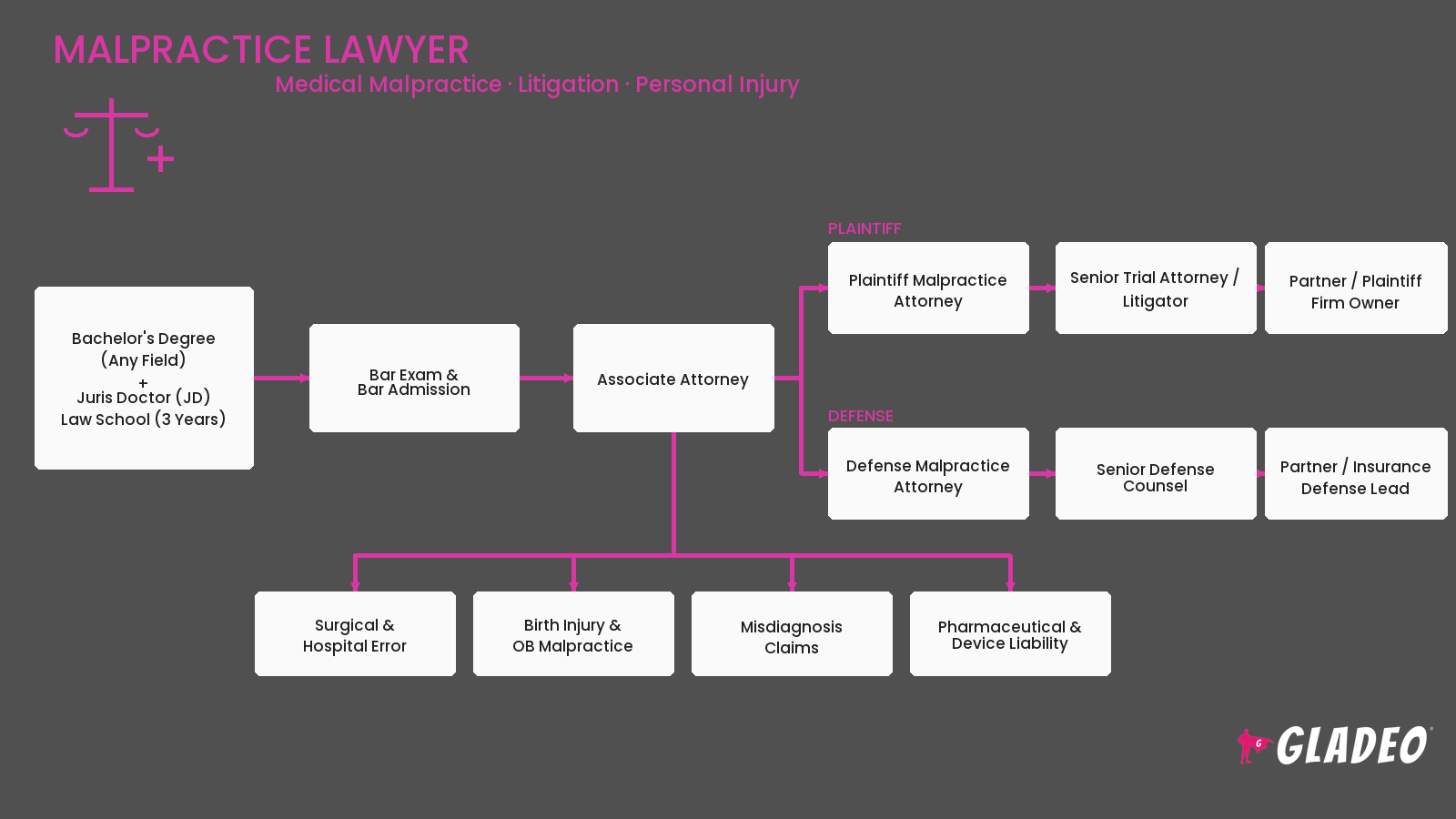
- Complete an internship or clerkship at a plaintiff or defense malpractice law firm
- Seek entry-level roles such as Associate Attorney at a personal injury or healthcare litigation firm
- Build relationships with legal nurse consultants and medical experts during law school
- Volunteer for legal aid clinics that handle healthcare-related cases
- Network through your state bar's health law or trial lawyers section
- Highlight any science, healthcare, or nursing background prominently on your resume
- Pass the bar exam and consider joining the American Association for Justice or Defense Research Institute
- Practice reviewing sample medical records and explaining findings clearly in mock interviews
- Consider starting at an insurance defense firm to build broad litigation experience
- Attend medical malpractice conferences and CLE seminars to meet practicing attorneys
- Offer to assist senior attorneys with medical record review to prove your attention to detail
- Show genuine comfort with scientific and medical detail in interviews
- Take on increasingly complex cases involving specialized areas of medicine
- Build a reputation for thorough medical record analysis and strong trial results
- Pursue board certification in medical malpractice or civil trial law where available
- Develop a trusted network of medical experts across multiple specialties
- Publish articles or speak at CLE events to establish expertise in a subspecialty
- Move from associate to partner, or open your own malpractice litigation practice
- Mentor junior attorneys and legal nurse consultants on case strategy
- Get involved in state or national trial lawyer associations for leadership opportunities
Websites:
- American Association for Justice - justice.org
- Defense Research Institute - dri.org
- American Bar Association Health Law Section - americanbar.org
- American Health Law Association - americanhealthlaw.org
- American Medical Association - ama-assn.org
- National Practitioner Data Bank - npdb.hrsa.gov
- Justia Medical Malpractice Center - justia.com/injury/medical-malpractice
- American Board of Trial Advocates - abota.org
- American Association of Legal Nurse Consultants - aalnc.org
- Federation of State Medical Boards - fsmb.org
- Patient Safety Movement Foundation - patientsafetymovement.org
- Institute for Healthcare Improvement - ihi.org
- Law School Admission Council (LSAC) - lsac.org
- FindLaw Medical Malpractice Center - findlaw.com
Books:
- Medical Malpractice: A Physician's Sourcebook edited by Richard E. Anderson
- The Law of Medical Malpractice in a Nutshell by Barry R. Furrow
- Complications by Atul Gawande
- Wall of Silence by Rosemary Gibson and Janardan Prasad Singh
- Preventing Medical Errors: A Reference by Institute of Medicine
If you find that being a Malpractice Lawyer isn't the right path for you, your skills in medical knowledge, analysis, and advocacy transfer well to related careers.
- Personal Injury Lawyer
- Legal Nurse Consultant
- Healthcare Risk Manager
- Medical Ethics Consultant
- Health Policy Analyst
- Insurance Claims Attorney
- Patient Advocate
- Hospital Compliance Officer
- Paralegal in Healthcare Litigation
- Medical Malpractice Insurance Underwriter
Click here to download the infographic
Newsfeed

Featured Jobs
Online Courses and Tools