







Spotlights
ML Engineer, Machine Learning Systems Engineer, Applied Machine Learning Engineer, MLOps Engineer, AI Engineer, Machine Learning Platform Engineer, Machine Learning Infrastructure Engineer, Production Machine Learning Engineer, Machine Learning Software Engineer, Applied AI Engineer, Machine Learning Operations Engineer, ML Deployment Engineer
Every time your phone finishes your sentence, your streaming app queues up the perfect next show, your bank blocks a stolen card in real time, or a photo app finds every picture of your dog without you searching for it, a machine learning model is working behind the scenes. Someone had to take that model out of a research notebook and turn it into a system that runs flawlessly, for millions of people, every second of every day. That someone is a Machine Learning Engineer.
Machine Learning Engineers build, ship, and maintain the pipelines and systems that let machine learning models work in the real world instead of just in an experiment. They take a model that a data scientist or researcher trained on a laptop and rebuild it into something that can handle massive amounts of live traffic, keep working when a server crashes, and quietly retrain itself as new data rolls in. Along the way they work closely with data scientists, software engineers, product managers, and data engineers to make sure the system does what the business and its users actually need.
Using tools like Python, PyTorch or TensorFlow, Docker, Kubernetes, and cloud platforms such as AWS, Azure, or Google Cloud, Machine Learning Engineers turn fragile prototypes into dependable infrastructure. They build automated pipelines that test and deploy new model versions, dashboards that catch problems before users ever notice, and systems that retrain models as the world changes. Without this behind-the-scenes engineering, even the smartest model would stay stuck in a research paper instead of powering the products people rely on every day.
- Watching a model you built go from a research idea to a system used by millions of real people
- Solving hard engineering puzzles about speed, reliability, and scale that no textbook fully covers
- Working at the exciting intersection of software engineering, data science, and product design
- Seeing your work directly move a real metric, like catching more fraud or getting people better recommendations
Working Schedule
Most Machine Learning Engineers work full-time, typically around 40 hours a week, though launches, outages, or urgent bugs can stretch hours or require being on call. The work is usually a mix of writing code at a desk, reviewing dashboards and metrics, and meeting with data scientists and engineers to plan features or debug issues. Most are employed by technology companies, startups, or the tech divisions of larger companies in finance, retail, healthcare, and other industries, though some work as consultants or contractors on specific projects.
Typical Duties
- Building and maintaining data pipelines that feed models during training and in production
- Training, evaluating, and tuning machine learning models against a target business metric
- Packaging models into containers and deploying them to servers or the cloud
- Building APIs and services that let apps and other systems query a model in real time
- Setting up automated pipelines that test and roll out new model versions safely
- Monitoring live models for accuracy drift, slow response times, and unexpected failures
- Retraining models on fresh data to keep predictions accurate over time
- Optimizing models to run faster and cheaper through techniques like quantization and batching
- Collaborating with data scientists to turn research prototypes into production-ready systems
- Managing cloud infrastructure, storage, and compute resources like GPUs
- Writing automated tests, code reviews, and technical documentation
- Debugging production issues when a model behaves unexpectedly
Additional Responsibilities
- Forecasting compute costs and finding ways to run systems more efficiently
- Versioning datasets and models so results can always be reproduced
- Supporting data privacy and security compliance for systems that use personal data
- Mentoring junior engineers and data scientists on production best practices
- Evaluating new tools and frameworks as the field evolves
- Taking part in on-call rotations to respond to system outages
- Communicating technical tradeoffs clearly to product and business stakeholders
A Machine Learning Engineer's day often starts with a check of overnight dashboards, making sure models are still returning accurate, fast predictions and that no pipeline failed while nobody was watching. If something looks off, the first hour can turn into a debugging session, tracing a problem back through logs, data pipelines, and model code.
Midday is usually spent building. That might mean writing code to retrain a model on new data, improving an API that serves predictions to an app, or working with a data scientist to figure out why a promising model performs worse once it hits real traffic. There are usually meetings woven in, syncing with product managers about what the model needs to do differently, or with data engineers about a change to an upstream data source.
Afternoons often involve testing and shipping. The engineer might run a new model version through an automated pipeline, watch it roll out to a small slice of users, and compare its performance against the old version before releasing it more broadly. Before wrapping up, they document what changed, update tickets, and check that monitoring is in place so tomorrow's dashboards will catch anything unusual.
Soft Skills
- Analytical and logical thinking
- Clear technical communication, especially with non-technical teammates
- Patience when debugging systems with many moving parts
- Collaboration across data science, engineering, and product teams
- Attention to detail, since small bugs can cause big failures at scale
- Time management across multiple ongoing projects
- Comfort with ambiguity and iterative problem solving
- Adaptability as tools, models, and priorities change quickly
- Ownership and accountability for systems once they are live
- Curiosity to keep learning new frameworks and techniques
- Calm decision-making during production incidents
- Willingness to give and receive direct feedback in code reviews
Technical Skills
- Python programming for data processing, modeling, and automation
- Machine learning frameworks such as PyTorch, TensorFlow, or scikit-learn
- SQL and data pipeline tools for moving and transforming large datasets
- Docker and Kubernetes for packaging and running applications reliably
- Cloud platforms such as AWS, Google Cloud, or Microsoft Azure
- CI/CD tools for automated testing and deployment
- Git and collaborative software development workflows
- Distributed computing tools such as Spark for large-scale data processing
- Monitoring and experiment tracking tools like MLflow, Prometheus, or Weights & Biases
- Designing and maintaining REST APIs and microservices
- Platform ML Engineer: Builds the shared infrastructure and tools other teams use to train and deploy models
- Applied ML Engineer: Focuses on building and shipping models for a specific product feature
- MLOps Engineer: Specializes in automation, monitoring, and reliability of ML systems in production
- Recommendation Systems Engineer: Builds the models that suggest content, products, or connections
- Fraud and Risk ML Engineer: Builds real-time models that detect suspicious or fraudulent activity
- Search and Ranking Engineer: Builds models that decide what results appear first and why
- Edge and Embedded ML Engineer: Optimizes models to run directly on phones, sensors, or devices
- Technology companies and software startups
- E-commerce and retail companies
- Financial services and fintech companies
- Healthcare and biotechnology companies
- Streaming, media, and entertainment companies
- Social media and communications platforms
- Cloud computing and infrastructure providers
- Autonomous vehicle and robotics companies
- Government agencies and public sector technology teams
- Consulting and technology services firms
- Manufacturing and logistics companies using predictive analytics
- Research labs and applied AI divisions of large corporations
Machine Learning Engineers are expected to build systems that work not just once, but every time, under real-world conditions that are messier than any test dataset. When a model fails quietly, it can mean lost revenue, an unfair decision, or a broken user experience, so the pressure to catch problems early is constant. Being on call for production systems means outages do not wait for business hours, and a serious incident can mean a late night or a weekend spent debugging.
The pace of the field is intense. New frameworks, model architectures, and best practices appear constantly, and engineers who stop learning quickly fall behind. Balancing the excitement of new techniques against the discipline required to keep existing systems stable and well-documented is a constant tension.
There is also a gap between the glamorous idea of "building AI" and the daily reality of writing pipelines, fixing broken data, and monitoring dashboards. Much of the job is unglamorous plumbing work that makes the exciting parts possible, and engineers who thrive here find real satisfaction in that invisible reliability.
- Growth of LLMOps, applying MLOps discipline to large language model applications
- Wider use of feature stores to share and reuse data features across teams
- Adoption of vector databases to power search and retrieval-based AI features
- Push toward real-time and streaming inference instead of batch predictions
- Expansion of edge AI, running models directly on phones and devices
- Increasing automation of retraining pipelines to keep models fresh without manual work
- Greater focus on responsible AI, including monitoring for bias and fairness in production
- Rising attention to cost optimization as model serving at scale gets expensive
- Growth of low-code and managed ML platforms that lower the barrier to deployment
- Expansion of hybrid teams blending traditional software engineering with ML expertise
Many Machine Learning Engineers grew up enjoying both building things and figuring out why they broke. They liked coding small projects, modding video games, or automating annoying repetitive tasks with a script instead of doing them by hand. Math and computer science classes clicked for them not because of grades, but because they liked seeing an idea turn into something that actually ran.
Others were drawn to puzzles, strategy games, and competitions like math olympiads or hackathons, where the fun was in the debugging and iteration as much as the final answer. A habit of tinkering, whether with a robotics kit, a personal website, or a home server, often carried directly into a career spent building and maintaining real systems.
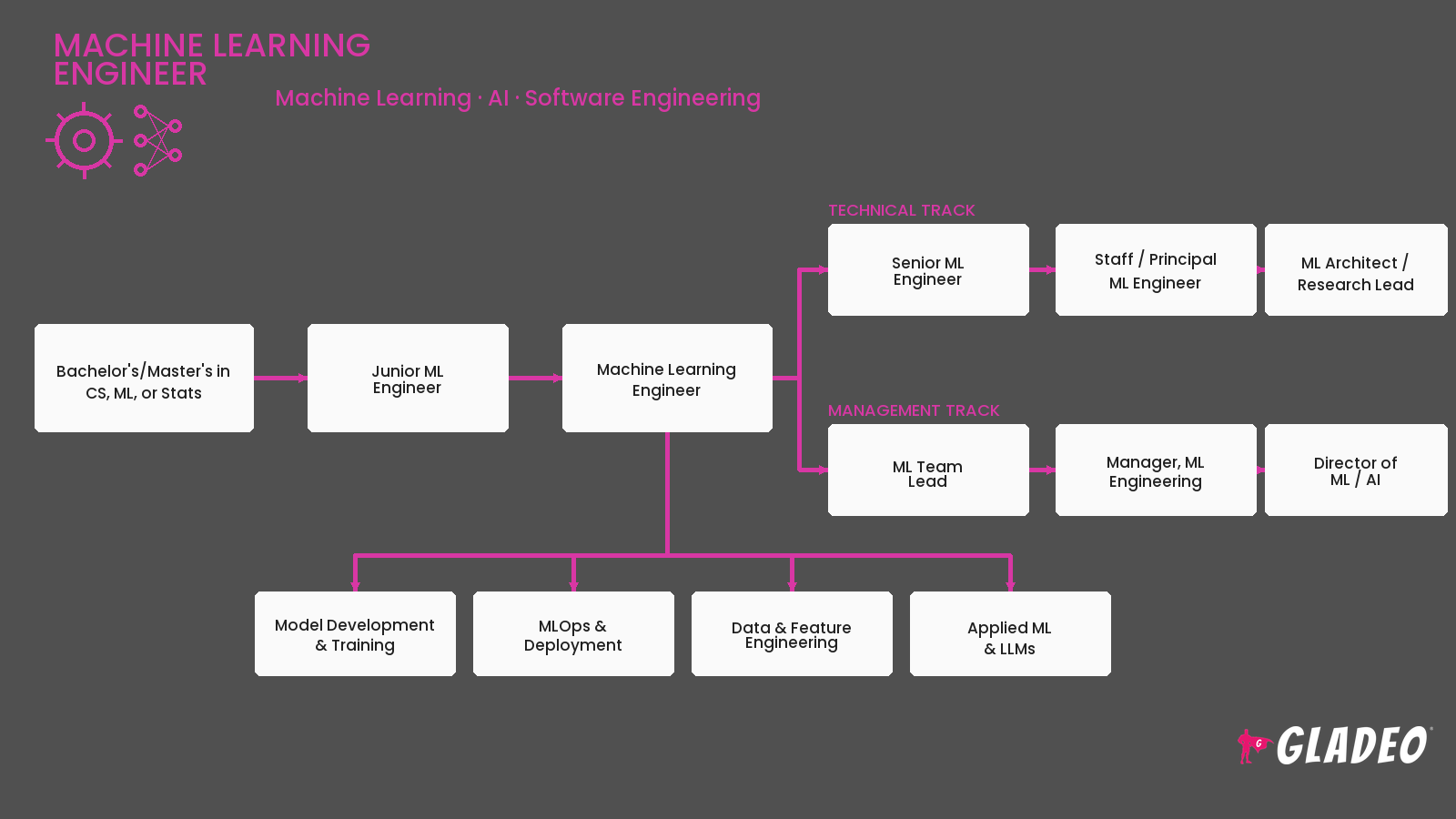
Most Machine Learning Engineers hold a bachelor's degree in computer science, software engineering, data science, or a closely related field, and a growing number pursue a master's degree for more advanced roles. What matters most to employers is a strong foundation in software engineering combined with hands-on machine learning skills, so many engineers supplement formal education with online courses, certifications, and personal projects.
Students can take courses in relevant subjects such as:
- Data Structures and Algorithms
- Python Programming
- Statistics and Probability
- Linear Algebra
- Databases and SQL
- Machine Learning
- Distributed Systems
- Cloud Computing
- Software Engineering Practices
- Computer Networks
Hands-on experience matters as much as coursework in this field. Internships, personal projects deployed to the cloud, and contributions to open-source machine learning tools give students real proof they can build working systems, not just pass exams. Many engineers also build a portfolio on platforms like GitHub and Kaggle to demonstrate practical skills to future employers.
- Take math courses through calculus and statistics, since they underpin machine learning
- Learn to code in Python through online courses, clubs, or independent projects
- Join a coding club, robotics team, or computer science competition
- Build small personal projects and publish the code on GitHub
- Take a free online machine learning course to see if the field excites you
- Enter hackathons or Kaggle competitions to practice building and shipping projects
- Learn basic cloud computing by deploying a simple project to a free-tier cloud account
- Study computer science fundamentals like data structures and algorithms
- Practice writing clearly about technical projects for a resume or portfolio
- Seek internships or part-time jobs involving software development or data
- Talk to working engineers about what their day-to-day work actually looks like
- Contribute to an open-source project to practice real-world collaboration
- Strong core computer science curriculum, not just machine learning theory
- Courses that include hands-on projects deploying real, working systems
- Access to cloud computing resources and modern GPU hardware for coursework
- Faculty or instructors with industry experience in production systems
- Internship placement support with technology companies
- A capstone project where you build and ship an end-to-end system
- Coverage of software engineering practices like testing, version control, and code review
- Opportunities to work on real datasets rather than only simplified textbook examples
- Career services with strong ties to tech employers
- Flexible options to keep learning through online courses and certifications after graduation
- A community of peers working on similar projects, such as a machine learning club
- Up-to-date curriculum that keeps pace with a fast-changing field
- Build a portfolio of deployed projects, not just notebooks that never left your laptop
- Apply for entry-level titles such as Junior Machine Learning Engineer, Data Engineer, or Software Engineer with an ML focus
- Contribute to open-source machine learning projects to build a public track record
- Compete in Kaggle competitions and document your approach and results
- Practice explaining your projects clearly, including what failed and how you fixed it
- Network with engineers and recruiters at meetups, conferences, and online communities
- Search job boards and company career pages, and set alerts for relevant titles
- Consider internships or co-ops, which often convert into full-time offers
- Learn to deploy a project end to end on a cloud platform before your first interview
- Prepare for technical interviews covering coding, systems design, and ML fundamentals
- Highlight any experience with production systems, even from school or personal projects
- Be open to starting as a data engineer or backend engineer to build relevant experience
- Take ownership of larger, more critical systems as you gain experience
- Learn to design systems from scratch, not just implement someone else's plan
- Build a track record of reliable, well-monitored systems that rarely fail
- Mentor newer engineers and review their code and designs
- Develop expertise in a specialized area like MLOps, recommendation systems, or infrastructure
- Contribute to architecture decisions and cross-team technical strategy
- Pursue advanced coursework, certifications, or a master's degree if it fits your goals
- Move into senior engineer, staff engineer, or engineering management roles
Websites:
- Papers with Code - paperswithcode.com
- Hugging Face - huggingface.co
- Kaggle - kaggle.com
- MLflow Documentation - mlflow.org
- Made With ML - madewithml.com
- Full Stack Deep Learning - fullstackdeeplearning.com
- DeepLearning.AI - deeplearning.ai
- Towards Data Science - towardsdatascience.com
- NeurIPS - neurips.cc
- Google AI Blog - ai.googleblog.com
- GitHub - github.com
- Chip Huyen's Blog - huyenchip.com
Books:
- Designing Machine Learning Systems by Chip Huyen
- Machine Learning Engineering by Andriy Burkov
- Building Machine Learning Powered Applications by Emmanuel Ameisen
- Reliable Machine Learning by Cathy Chen, Niall Richard Murphy, Kranti Parisa, D. Sculley, and Todd Underwood
- Deep Learning by Ian Goodfellow, Yoshua Bengio, and Aaron Courville
If you find that being a Machine Learning Engineer isn't the right fit, your skills in coding, systems thinking, and data handling transfer well to many related careers.
- Data Engineer
- Software Engineer
- Data Scientist
- DevOps Engineer
- Data Analyst
- Backend Engineer
- Cloud Solutions Architect
- QA and Test Automation Engineer
- Business Intelligence Analyst
Click here to download the infographic
Newsfeed

Featured Jobs
Online Courses and Tools