





Spotlights
Loan Officer Assistant, Mortgage Loan Processor, Loan Coordinator, Loan Documentation Specialist, Underwriting Assistant, Mortgage Processor, Loan Closer, Loan Interviewer, Credit Processor, Loan Operations Specialist, Consumer Loan Processor
Behind every approved mortgage, car loan, or personal loan sits a mountain of paperwork, and someone whose job is to make sure every document, number, and signature lines up before the money ever moves. That someone is a Loan Processor or Loan Underwriter, the detail-obsessed professional who turns a stack of applications, pay stubs, and bank statements into a loan that actually gets approved.
Loan Processors and Loan Underwriters work behind the scenes at banks, credit unions, and mortgage companies, gathering and verifying borrower documents, checking income and credit history, and making sure an application meets every requirement before it moves forward. They act as the connective tissue between the loan officer who brought in the client, the borrower who is anxiously waiting for an answer, and the underwriter or lender who ultimately signs off. When something is missing, whether it is a tax return, a proof of employment, or an explanation for a strange bank withdrawal, tracking it down and following up with the borrower falls squarely on their shoulders.
Using loan origination software, credit reporting systems, and document verification tools, Loan Processors and Loan Underwriters keep loans moving accurately and on schedule, which matters enormously to a borrower trying to close on a house or replace a broken-down car. Their careful, deadline-driven work protects lenders from unnecessary risk while helping real people get the financing they need for some of the biggest purchases of their lives.
- Helping people cross the finish line on major life purchases like a first home or car
- Solving detailed puzzles by tracking down missing information and inconsistencies
- Building a stable career in banking and financial services with clear advancement paths
- Mastering a process-driven role where accuracy and organization are truly valued
Working Schedule
Loan Processors and Loan Underwriters typically work standard business hours in an office or hybrid remote setting, though the job can get busier around month-end closings or during periods of high loan volume, like when interest rates drop and refinancing surges. The pace is steady but deadline-driven, since loans often have contractual closing dates that cannot slip. Most are employed by banks, credit unions, or mortgage companies, though some work for independent mortgage brokers.
Typical Duties
- Collecting and organizing borrower documents such as pay stubs, tax returns, and bank statements
- Verifying income, employment, assets, and credit history for accuracy
- Reviewing loan applications for completeness before submission to underwriting
- Communicating with borrowers to request missing or clarifying documentation
- Coordinating with loan officers, underwriters, and lenders throughout the loan process
- Entering and updating loan information in loan origination software
- Ordering appraisals, title searches, and other required third-party reports
- Reviewing files for compliance with lender guidelines and regulations
- Tracking loan files against closing deadlines and flagging delays early
- Preparing loan files for underwriting review and final approval
- Explaining loan requirements and next steps clearly to borrowers
- Resolving discrepancies between application information and supporting documents
Additional Responsibilities
- Maintaining organized digital and physical loan files for audits and compliance
- Staying current on lending regulations and investor guidelines
- Assisting with post-closing documentation and file quality checks
- Training new processors or clerks on file procedures
- Communicating loan status updates to real estate agents or referral partners
- Identifying process improvements to speed up loan turnaround times
- Supporting underwriters by clarifying or re-verifying borrower information
- Handling customer service calls from borrowers with questions about their loan
A Loan Processor's day often starts by reviewing a queue of active loan files, checking which ones are closest to their closing dates and which need urgent follow-up. Morning hours are frequently spent calling or emailing borrowers about missing documents, since a single missing pay stub can hold up an entire file.
Midday is typically spent deep in document review: cross-checking income statements against tax returns, verifying that numbers match across multiple forms, and entering updated information into loan origination software. Processors often coordinate with loan officers about tricky files and check in with underwriters on files awaiting a decision.
Afternoons might include submitting completed files for underwriting review, ordering appraisals or title work, and updating borrowers and real estate agents on where a loan stands in the process. Keeping every file moving toward its closing date, while catching any red flag before it becomes a bigger problem, is the constant undercurrent of the job.
Soft Skills
- Extreme attention to detail
- Strong organizational skills
- Clear written and verbal communication
- Patience when following up on missing or unclear documentation
- Time management under firm deadlines
- Problem-solving when discrepancies arise
- Customer service orientation with anxious or frustrated borrowers
- Reliability and consistency handling repetitive tasks
- Ability to juggle multiple loan files simultaneously
- Discretion when handling sensitive financial information
- Collaboration with loan officers, underwriters, and lenders
- Calm demeanor under pressure as deadlines approach
Technical Skills
- Loan origination software such as Encompass or Calyx
- Understanding of credit reports and credit scoring
- Knowledge of income and asset verification methods
- Familiarity with lending regulations and compliance requirements
- Basic understanding of underwriting guidelines
- Document management and file organization systems
- Data entry accuracy and speed
- Math and basic financial calculation skills
- Familiarity with mortgage, auto, or personal loan products
- Communication tools for coordinating across teams
- Mortgage Loan Processor: Handles documentation for home purchase and refinance loans
- Auto Loan Processor: Processes financing applications for vehicle purchases
- Personal Loan Processor: Manages smaller consumer loans for various needs
- Commercial Loan Processor: Handles more complex documentation for business loans
- Junior Underwriter: Reviews files and makes preliminary risk assessments under supervision
- Senior Underwriter: Makes final approval decisions on more complex loan files
- Closing Coordinator: Focuses on the final stages of preparing a loan for closing
- Loan Servicing Specialist: Manages loans after closing, including payments and adjustments
- Banks and credit unions
- Mortgage companies and lenders
- Mortgage brokerages
- Auto financing companies
- Online and fintech lending platforms
- Government housing and lending agencies
- Title and escrow companies
- Credit reporting agencies
- Real estate finance departments
- Consumer finance companies
Loan Processors and Loan Underwriters work under real deadline pressure, since a delayed file can push back a home closing or leave a borrower without the car they were counting on. That pressure means the job requires consistent accuracy even when juggling a heavy caseload of files at different stages.
The work is detail-heavy and can feel repetitive, requiring the same careful verification steps on file after file, day after day. Borrowers are often stressed or anxious during the process, especially with something as significant as a home purchase, so processors need patience and clear communication even when delivering frustrating news about missing paperwork or delays.
Regulatory requirements in lending change regularly, which means staying current on compliance rules is a constant responsibility, not a one-time task. Busy seasons, like when interest rates drop and refinancing spikes, can mean a noticeably heavier workload with the same tight deadlines.
- Growing use of automated underwriting systems to speed up simple loan decisions
- Increased use of digital document upload and e-signature tools for borrowers
- Rising demand for processors skilled in fintech and online lending platforms
- Greater reliance on artificial intelligence to flag document inconsistencies
- Expansion of remote and hybrid work arrangements in loan processing roles
- Increased regulatory focus on fair lending and bias-free underwriting practices
- Growth of instant, algorithm-driven approvals for smaller personal loans
- Rising use of open banking data to verify income and assets faster
- More lenders offering fully digital, paperless mortgage application processes
- Increased demand for cybersecurity awareness in handling sensitive financial data
Many Loan Processors and Loan Underwriters were naturally organized as kids, the ones who kept their school binders color-coded, tracked their own allowance in a notebook, or enjoyed sorting and categorizing things just for the satisfaction of it. A comfort with numbers and detailed tasks often showed up early, whether through math class, budgeting for a personal project, or managing money from a part-time job.
Others were drawn to helping people solve practical problems, enjoying roles like tutoring, customer service jobs, or being the go-to person for figuring out logistics. A mix of patience, precision, and genuine satisfaction from getting every detail right often pointed toward a career built on careful, process-driven work.
Many Loan Processors and Loan Underwriters start with a high school diploma and receive on-the-job training, though a growing number of employers prefer candidates with an associate or bachelor's degree in finance, business, or a related field. Loan Underwriters, who take on more decision-making responsibility, typically need more experience and sometimes additional certification or licensing, especially in mortgage lending. Most people build their expertise gradually, starting as a processor and moving into underwriting as they gain experience.
Students can take courses in relevant subjects such as:
- Business Administration
- Finance
- Accounting
- Economics
- Business Communications
- Statistics
- Business Law
- Computer Applications
- Customer Service
- Office Administration
On-the-job training is central to this field, since much of the work involves learning a specific lender's systems, guidelines, and documentation standards. Internships or entry-level roles at banks or mortgage companies give students a real introduction to how loan files move from application to closing. Pursuing certifications, such as those offered for mortgage loan processing or underwriting, can help with advancement over time.
- Take math, business, and accounting classes to build strong numerical skills
- Practice organization and time management through school projects and part-time jobs
- Learn basic spreadsheet skills like Excel to prepare for data-heavy work
- Look for internships or part-time jobs at banks, credit unions, or mortgage companies
- Study how loans and credit work through personal finance courses or resources
- Join a business or finance club at school
- Practice clear written communication through email and letter-writing exercises
- Build strong customer service skills through part-time retail or service jobs
- Research entry-level roles like bank teller or loan clerk as a starting point
- Attend career fairs and talk with professionals working in lending or banking
- Practice staying organized with deadlines using planners or digital tools
- Explore business or finance certificate programs at local community colleges
- Business or finance programs with courses in lending or consumer credit
- Strong internship placement with local banks, credit unions, or mortgage companies
- Faculty with real industry experience in banking or lending
- Coursework covering financial regulations and compliance basics
- Access to training or certification prep for mortgage processing or underwriting
- Career services with connections to regional banks and lenders
- Programs offering hands-on practice with financial software or spreadsheets
- Flexible scheduling for students balancing part-time work
- Reasonable program costs relative to entry-level industry salaries
- Alumni working successfully in banking, lending, or financial services
- Programs that emphasize attention to detail and organizational skill-building
- Opportunities to learn about both mortgage and consumer loan processes
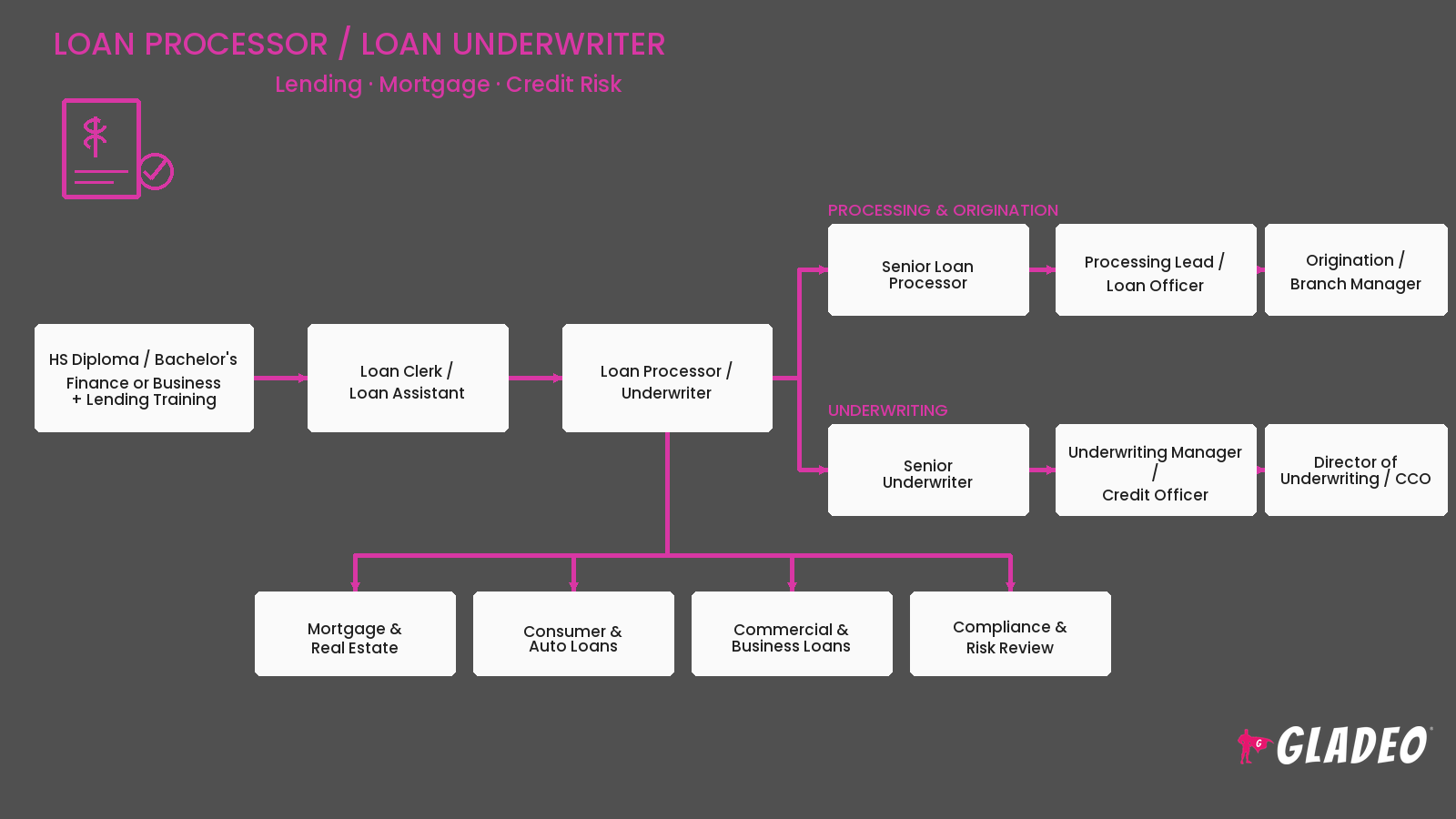
- Apply for entry-level roles like loan clerk, loan assistant, or bank teller to start
- Highlight organizational skills, attention to detail, and reliability on your resume
- Search job boards and bank or credit union career pages for processor openings
- Consider starting at a smaller local bank or credit union to gain broad experience
- Network with professionals in banking through local job fairs or community events
- Practice explaining how you stay organized and handle deadlines in interviews
- Pursue an entry-level certification in loan processing to stand out to employers
- Be prepared to discuss comfort working with numbers and detailed paperwork
- Show enthusiasm for learning a specific lender's systems and procedures
- Follow up professionally and promptly after interviews to show reliability
- Be open to starting in a related role, like customer service, to get in the door
- Research the specific loan products a company handles before interviewing
- Build a reputation for accuracy, speed, and reliable follow-through on files
- Learn the underwriting side of the business to move from processor to underwriter
- Pursue certifications in mortgage underwriting or loan processing
- Take on more complex loan files, like commercial or jumbo mortgages, as experience grows
- Build strong working relationships with loan officers and underwriters
- Mentor new processors and share best practices for staying organized
- Pursue leadership roles such as senior processor, underwriting manager, or operations supervisor
- Stay current on regulatory changes to remain a trusted, go-to expert on the team
Websites:
- Mortgage Bankers Association - mba.org
- National Association of Mortgage Processors - namp.org
- American Bankers Association - aba.com
- Consumer Financial Protection Bureau - consumerfinance.gov
- National Credit Union Administration - ncua.gov
- Mortgage News Daily - mortgagenewsdaily.com
- National Association of Federal Credit Unions - nafcu.org
- HousingWire - housingwire.com
- Scotsman Guide - scotsmanguide.com
- American Financial Services Association - afsaonline.org
- National Association of Realtors - nar.realtor
- Bankrate - bankrate.com
Books:
- Mortgage Processing Simplified by Vincent A. Tuccillo
- The Loan Officer's Practical Guide to Residential Finance by Gibran Nicholas
- How the Mortgage and Real Estate Industry Really Works by Sean R. Young
- Underwriting: The Efficient Frontier of the Insurance Industry by David Sandberg
- The Total Money Makeover by Dave Ramsey
If you find that being a Loan Processor or Loan Underwriter isn't the right fit, your organizational and financial skills can transfer to many related careers.
- Loan Officer
- Insurance Underwriter
- Bank Teller
- Credit Analyst
- Mortgage Broker
- Compliance Specialist
- Escrow Officer
- Financial Services Representative
- Accounts Payable/Receivable Clerk
- Title Examiner
Newsfeed

Featured Jobs
Online Courses and Tools