






Spotlights
Deep Learning Researcher, Neural Network Engineer, Distributed Training Engineer, Deep Learning Scientist, AI Model Architect, Large-Scale Training Engineer, Deep Learning Research Engineer, GPU Computing Engineer, Neural Architecture Engineer, Applied Deep Learning Scientist
The models behind image generators that create art from a sentence, chatbots that hold real conversations, systems that predict how proteins fold, and cars that recognize the road ahead all share something in common: massive neural networks trained on racks of GPUs running for days or weeks at a time. Designing those networks and taming that training process, so it actually finishes and actually works, is the job of the Deep Learning Engineer.
Deep Learning Engineers focus on the architecture and training of neural networks at the largest scale, a different focus from engineers who deploy finished models into products. They design and prototype new network structures, run distributed training jobs spread across dozens or hundreds of GPUs, and debug problems that only show up at scale, like a training run that mysteriously stalls or a loss value that suddenly spikes. They work closely with research scientists who dream up new ideas, infrastructure engineers who manage the hardware, and hardware teams optimizing the chips everything runs on.
Using frameworks like PyTorch, TensorFlow, or JAX, GPU programming with CUDA, and distributed training tools like DeepSpeed, Megatron-LM, and Ray, Deep Learning Engineers turn a promising idea into a model that actually trains successfully and efficiently. Their work determines whether the most ambitious AI models are even possible, and whether training them costs a reasonable amount or an unreasonable fortune, making them essential to nearly every major advance in modern AI.
- Working at the technical frontier that makes the largest, most capable AI models possible
- Solving deep engineering puzzles that combine math, systems, and hardware knowledge
- Being among the first to see a brand new architecture actually work at scale
- Contributing directly to breakthroughs that will shape technology for years to come
Working Schedule
Most Deep Learning Engineers work full-time, though the schedule often bends around long-running training jobs that need to be monitored, sometimes overnight or over a weekend, since a multi-week training run cannot simply pause and resume on a convenient schedule. The work is heavily computer-based, split between writing and reviewing code, analyzing training logs and metrics, and collaborating with research and infrastructure teams. Most Deep Learning Engineers are employed by AI research labs, large technology companies, or well-funded startups building frontier models, since this work requires significant compute resources.
Typical Duties
- Designing and prototyping new neural network architectures
- Running and monitoring large-scale distributed training jobs across many GPUs or TPUs
- Debugging training instabilities like loss spikes, vanishing or exploding gradients, and hardware failures
- Optimizing model code for speed and memory efficiency
- Implementing techniques like mixed precision training and gradient checkpointing
- Benchmarking new architectures against existing baselines
- Tuning hyperparameters at scale across long training runs
- Collaborating with hardware and infrastructure engineers on compute efficiency
- Reading and implementing techniques from recently published research papers
- Writing internal tools and scripts to speed up experimentation
- Documenting experiment results and sharing findings with research teams
Additional Responsibilities
- Managing and forecasting compute budgets across multiple training runs
- Mentoring junior engineers and research interns on training techniques
- Contributing to internal deep learning frameworks and tooling
- Keeping up with a research field that publishes new results almost weekly
- Participating in code and architecture reviews
- Occasionally publishing findings in internal reports or external papers
A Deep Learning Engineer's day often starts with checking on training jobs that ran overnight, reviewing loss curves and metrics to see whether a run is progressing normally or has hit a snag like a stalled process or a spike in error. If something looks wrong, the first hours can turn into a deep debugging session across code, data, and hardware logs.
Midday is usually spent building and experimenting, whether that means implementing a new architectural idea, tuning a training script for better GPU utilization, or working through a subtle bug that only appears when training is spread across many machines. There are often discussions with research scientists about what a new result might mean, or with infrastructure engineers about squeezing more performance out of limited hardware.
Afternoons often involve launching new experiments, reviewing results from earlier runs, and updating documentation so the whole team can learn from what worked and what did not. Since training runs can take days, a lot of the job is about queuing up smart next steps and then patiently, carefully analyzing what comes back rather than expecting instant answers.
Soft Skills
- Deep curiosity about how and why neural networks learn
- Comfort with ambiguity and constant experimentation
- Resilience when experiments fail, which happens often in this field
- Sharp analytical and mathematical thinking
- Patience during long training runs that take days to complete
- Strong collaboration with infrastructure and research teams
- Clear technical writing for documenting experiments and results
- Attention to detail in code that runs at massive scale
- Persistence through repeated rounds of debugging
- Adaptability to new frameworks, hardware, and techniques
- Calm, methodical thinking under pressure, since compute is expensive and mistakes cost real money
Technical Skills
- PyTorch, TensorFlow, or JAX for building and training deep neural networks
- CUDA and GPU programming for performance-critical code
- Distributed training frameworks such as DeepSpeed, Megatron-LM, Horovod, or Ray
- Linear algebra and calculus for understanding optimization and backpropagation
- High-performance computing and cluster scheduling tools like Slurm or Kubernetes
- Profiling and performance debugging tools for identifying bottlenecks
- Mixed-precision and memory-efficient training techniques
- Git for version control and tools like Weights & Biases or MLflow for experiment tracking
- Python and sometimes C++ for performance-critical code
- Statistics and probability for understanding model behavior and evaluation
- Model Architecture Engineer: Designs and prototypes new neural network structures
- Distributed and Systems Training Engineer: Focuses on scaling training across many machines efficiently
- Hardware-Aware ML Engineer: Optimizes models specifically for GPUs, TPUs, or custom AI chips
- Generative Model Engineer: Focuses on training models that create images, text, audio, or video
- Reinforcement Learning Engineer: Trains models that learn through trial, error, and reward
- Scaling Research Engineer: Studies how model performance changes as size and data scale up
- Efficiency and Compression Engineer: Focuses on making large models smaller, faster, and cheaper to run
- AI research labs and frontier model developers
- Large technology companies with dedicated AI research divisions
- Cloud computing providers building AI infrastructure and services
- Well-funded AI startups building large-scale models
- Semiconductor and hardware companies building AI chips
- Autonomous vehicle and robotics companies
- Scientific research institutions using deep learning for discovery
- Government research agencies and national laboratories
- Universities with strong deep learning research programs
- Financial technology companies using large-scale predictive models
- Healthcare and biotechnology companies applying deep learning to research
- Defense and aerospace organizations exploring advanced AI systems
Deep Learning Engineers work with compute resources that are both scarce and expensive, so a failed multi-week training run does not just waste time, it wastes serious money. That reality creates real pressure to plan experiments carefully and to catch problems as early as possible, and mistakes can feel high-stakes in a way that smaller-scale coding projects do not.
The work often involves long, sometimes unpredictable hours, especially when a training run needs monitoring outside of normal working hours or when a launch deadline is approaching. Waiting days for results, only to find a subtle bug that requires starting over, is a normal and sometimes exhausting part of the job.
The field is intensely competitive and moves at a punishing pace, with new papers, techniques, and benchmarks appearing constantly. Staying relevant requires near-constant learning, and the sense that "everyone else is moving faster" is a common and sometimes stressful feeling in this corner of AI.
- Scaling laws continuing to guide the development of ever-larger models
- Growth of mixture-of-experts architectures that activate only parts of a model at a time
- Wider adoption of efficient fine-tuning techniques like LoRA and quantization
- Increasing use of specialized AI hardware, including custom chips and TPUs
- Growing use of synthetic data to supplement or replace scarce real-world training data
- Advances in sparsity and model compression to reduce training and inference costs
- Rapid growth of multimodal foundation models trained on text, images, and audio together
- Rising trend of open-weight model releases reshaping who can do frontier research
- Increasing attention to the energy use and environmental cost of large-scale training
- Growing collaboration between deep learning engineers and hardware chip designers
Many Deep Learning Engineers grew up loving math competitions, coding challenges, and building or upgrading their own computers. They were drawn to systems with a lot of moving parts, whether that meant modding a video game, overclocking a gaming PC, or writing scripts to automate something tedious.
Others found their spark in physics and advanced math classes, enjoying the challenge of problems that took real persistence to solve. A fascination with both the theory behind how things work and the hands-on tinkering required to make them actually run often carried directly into a career spent training the largest neural networks in the world.
Most Deep Learning Engineers hold at least a bachelor's degree in computer science, mathematics, physics, or electrical engineering, and many roles, especially at research-focused labs, favor candidates with a master's degree or PhD. Strong mathematical foundations and hands-on experience training real models, not just studying theory, are what set successful candidates apart.
Students can take courses in relevant subjects such as:
- Linear Algebra
- Multivariable Calculus
- Probability and Statistics
- Deep Learning
- Parallel and Distributed Computing
- Computer Architecture
- Optimization Theory
- Data Structures and Algorithms
- Machine Learning
- Numerical Methods
Because this field is so compute-intensive, hands-on experience training real models, even small ones, on real hardware is essential. Working through open-source deep learning courses, reproducing results from published papers, and experimenting with distributed training on cloud GPUs give students a real edge that a transcript alone cannot show.
- Take math courses through calculus, linear algebra, and statistics, and keep pushing further
- Learn to code in Python and build small projects that train real models
- Join a math team, coding club, or competitive programming group
- Build or upgrade your own computer to understand hardware fundamentals
- Take a free online deep learning course to build a real foundation early
- Enter hackathons or competitions involving machine learning or AI
- Try reproducing the results of a well-known research paper on a small scale
- Study physics, especially topics involving optimization and systems
- Learn the basics of cloud computing by training a model on a cloud GPU
- Read research papers, even if you only understand parts of them at first
- Seek internships or research opportunities involving machine learning
- Talk to deep learning engineers or researchers about what their work really involves
- Strong coursework in advanced math, especially linear algebra and calculus
- Access to modern GPU hardware for hands-on deep learning projects
- Faculty with active research or industry experience in deep learning
- Courses that go beyond using pre-built models to actually training networks from scratch
- A capstone or research project involving real model training and evaluation
- Exposure to distributed computing and large-scale systems, not just single-machine coding
- Strong ties to internships or research positions at AI labs or tech companies
- Opportunities to read and reproduce research papers as part of coursework
- Career services or advisors familiar with deep learning research careers
- A active research community or lab you can join as an undergraduate
- Support for pursuing graduate study if you want to go deeper into research
- Up-to-date curriculum that keeps pace with an extremely fast-moving field
- Build a portfolio of projects that involved actually training models, not just using pretrained ones
- Reproduce results from a published paper and document your process publicly
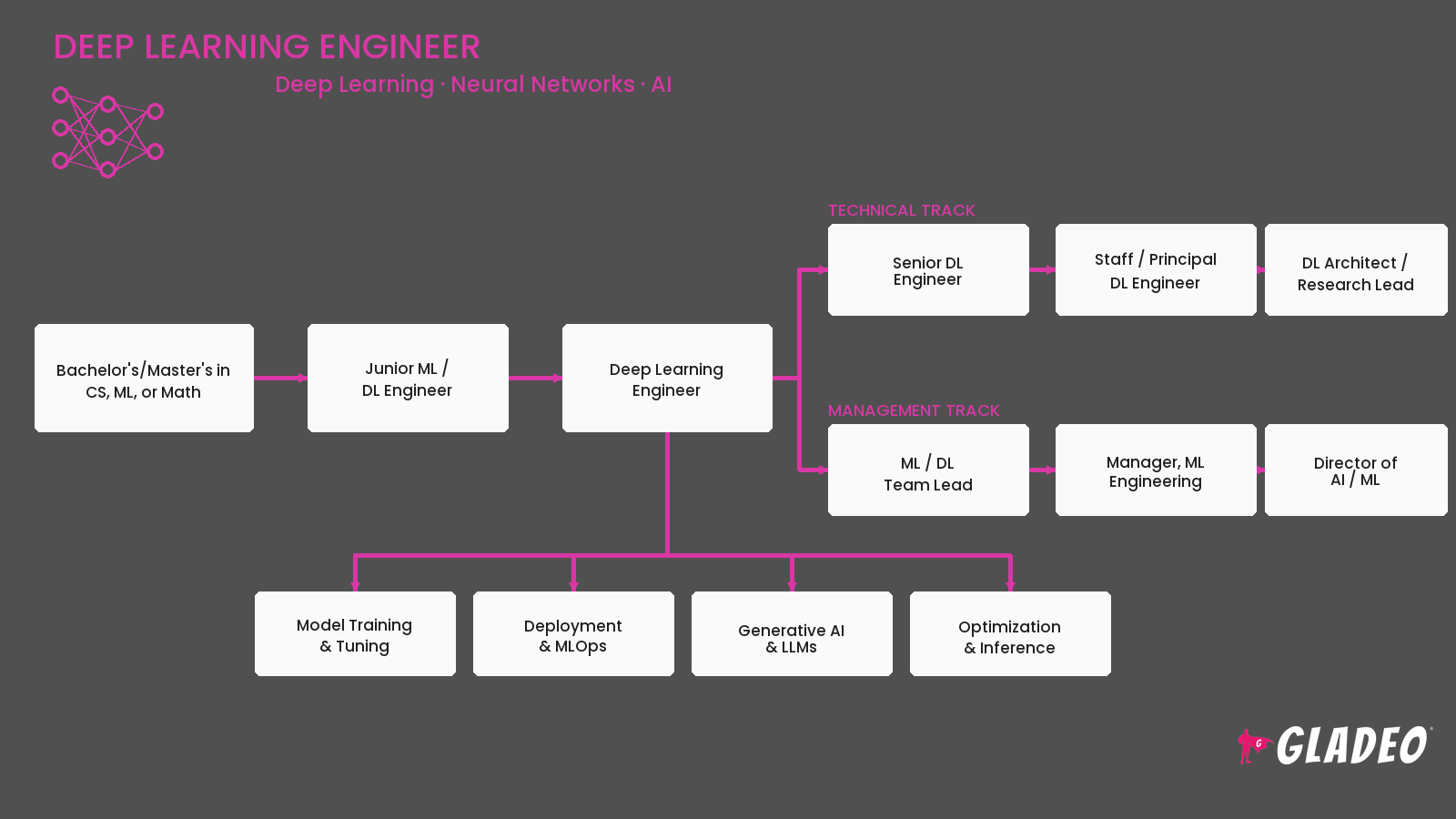
- Apply for entry-level titles such as Machine Learning Engineer, Research Engineer, or Deep Learning Engineer
- Contribute to open-source deep learning frameworks or research code
- Compete in machine learning competitions that involve real model training
- Pursue research internships at AI labs, universities, or tech companies
- Practice explaining a training run you did, including what went wrong and how you diagnosed it
- Network with researchers and engineers at conferences like NeurIPS or ICML
- Prepare for technical interviews covering math, systems, and deep learning fundamentals
- Highlight any experience with distributed computing or large-scale training, even in school projects
- Consider a master's degree or PhD if you want to work at the most research-intensive labs
- Be open to starting on a broader machine learning team to build relevant experience
- Take ownership of larger, more ambitious training projects as you gain experience
- Build a track record of successfully training models that meet difficult performance targets
- Develop deep expertise in a specialized area like distributed systems, efficiency, or architecture design
- Mentor junior engineers and research interns on training techniques
- Contribute to publications, patents, or public research releases
- Build strong relationships with infrastructure and hardware teams
- Stay current with new architectures and techniques as the field evolves weekly
- Move into senior research engineer, principal engineer, or research lead roles
Websites:
- Papers with Code - paperswithcode.com
- arXiv (cs.LG) - arxiv.org/list/cs.LG/recent
- NeurIPS - neurips.cc
- ICML - icml.cc
- Distill.pub - distill.pub
- Hugging Face - huggingface.co
- DeepSpeed Documentation - deepspeed.ai
- PyTorch Tutorials - pytorch.org/tutorials
- Weights & Biases Blog - wandb.ai/fully-connected
- Lil'Log by Lilian Weng - lilianweng.github.io
- Google DeepMind Blog - deepmind.google
- Full Stack Deep Learning - fullstackdeeplearning.com
Books:
- Deep Learning by Ian Goodfellow, Yoshua Bengio, and Aaron Courville
- Dive into Deep Learning by Aston Zhang, Zachary C. Lipton, Mu Li, and Alexander J. Smola
- Deep Learning for Coders with fastai and PyTorch by Jeremy Howard and Sylvain Gugger
- The Principles of Deep Learning Theory by Daniel A. Roberts and Sho Yaida
- • Efficient Deep Learning by Gaurav Menghani and Naresh Singh
If you find that being a Deep Learning Engineer isn't the right fit, your skills in math, systems thinking, and large-scale coding transfer well to many related careers.
- Machine Learning Engineer
- AI Research Scientist
- Data Scientist
- High-Performance Computing Engineer
- Computer Vision Engineer
- Software Engineer
- Robotics Engineer
- Quantitative Researcher
- Systems Engineer
Click here to download the infographic
Newsfeed

Featured Jobs
Online Courses and Tools