







Spotlights
Constitutional Attorney, Civil Rights Attorney, Civil Liberties Lawyer, Appellate Attorney, Public Interest Lawyer, Government Counsel, Constitutional Litigator, First Amendment Attorney, Legal Advocate, Impact Litigation Attorney, Legal Scholar, Supreme Court Advocate
When a school tries to silence a student's speech, when a government agency oversteps its authority, or when a new law raises questions about who gets to vote or worship freely, Constitutional Lawyers step in to defend the rights that the Constitution promises every person. This is a career for people who want their work to shape not just one case, but the rules that govern an entire country.
Constitutional Lawyers focus on legal questions involving the U.S. Constitution: civil liberties, government power, free speech, equal protection, due process, and the balance between individual rights and the authority of federal, state, and local governments. Some spend their careers in courtrooms, filing lawsuits and arguing appeals on behalf of individuals, advocacy organizations, or government agencies. Others work behind the scenes, writing legal briefs, researching precedent, and advising lawmakers, agencies, or nonprofits on whether a proposed policy would survive a constitutional challenge. Many collaborate with law professors, policy researchers, and fellow advocates to build cases that can take years to move through the court system, sometimes all the way to the Supreme Court.
Using deep research into case law, constitutional history, and legal precedent, Constitutional Lawyers build arguments that can protect a single person's rights or reshape the law for millions of people at once. Their work matters because it defines the boundaries of government power and personal freedom, questions that touch nearly every part of American life, from what students can say in school to who gets equal treatment under the law.
- Defending fundamental rights and freedoms for individuals and communities
- Shaping legal precedent that can affect millions of people beyond a single client
- Engaging with big, meaningful questions about government power and personal liberty
- Working alongside passionate advocates, scholars, and organizations fighting for justice
Working Schedule
Constitutional Lawyers generally work full-time, though the pace varies by employer. Those at advocacy nonprofits or government agencies often keep more predictable hours, while lawyers at large firms handling high-profile litigation can face intense stretches before filing deadlines or oral arguments. The work happens across law offices, courtrooms, and increasingly, virtual hearings, with travel sometimes required to argue cases in different jurisdictions or appear before appellate courts. Many constitutional lawyers also balance litigation with writing, research, and public speaking or teaching.
Typical Duties
- Researching constitutional law, case precedent, and legislative history
- Drafting complaints, motions, and appellate briefs
- Representing clients or organizations in court hearings and oral arguments
- Advising government agencies or lawmakers on the constitutionality of proposed policies
- Filing amicus curiae briefs in support of cases with broader legal significance
- Interviewing clients and witnesses to build a case's factual record
- Analyzing how a case might set precedent for future constitutional questions
- Collaborating with civil rights organizations and coalition partners on litigation strategy
- Preparing expert witnesses and reviewing expert testimony
- Monitoring new legislation and court rulings that affect constitutional rights
- Writing legal scholarship, articles, or public commentary on constitutional issues
- Training or educating the public, students, or advocacy groups on constitutional rights
Additional Responsibilities
- Fundraising and grant writing for nonprofit legal organizations
- Mentoring law students and junior attorneys on litigation strategy
- Testifying before legislative committees on proposed laws
- Building relationships with media to communicate a case's public significance
- Coordinating with co-counsel across multiple states on coordinated litigation
- Participating in professional associations focused on civil rights and constitutional law
A Constitutional Lawyer's morning often starts with reading new court opinions and legal news to see whether any recent rulings affect an active case. They might spend the first stretch of the day deep in legal research, tracing how a constitutional principle has been interpreted differently across federal circuits, building the foundation for an argument.
Midday is often filled with writing and strategy. The lawyer might draft or revise a section of an appellate brief, join a call with co-counsel from a partner organization to align on litigation strategy, or prepare questions for an upcoming deposition. If a hearing or oral argument is approaching, much of the day goes toward moot court practice sessions, anticipating tough questions from judges and refining answers.
Afternoons and evenings sometimes involve client meetings, especially with individuals whose personal stories anchor a broader legal challenge, or coordination with advocacy partners planning a public response to a ruling. Constitutional Lawyers also spend real time writing for a public audience, whether that is an op-ed, a policy brief, or a statement explaining what a court decision actually means for the people it affects.
Soft Skills
- Persuasive written and oral communication
- Deep commitment to civil rights and public service
- Strategic, long-term thinking
- Comfort with public speaking and courtroom advocacy
- Patience, since major cases can take years to resolve
- Strong research discipline and intellectual curiosity
- Collaboration with coalition partners and co-counsel
- Resilience in the face of setbacks or unfavorable rulings
- Empathy for clients whose rights are at stake
- Sound ethical judgment
- Clarity when explaining complex legal concepts to the public
- Confidence engaging with judges, legislators, and the media
Technical Skills
- Constitutional law and legal history
- Appellate brief writing and oral argument preparation
- Legal research using tools like Westlaw, Lexis, and court databases
- Case law analysis and precedent tracking
- Litigation strategy and case management
- Understanding of legislative and regulatory processes
- Familiarity with civil procedure and appellate court rules
- Policy analysis and public communication skills
- Knowledge of specific constitutional areas such as free speech or equal protection
- Civil Liberties Attorney: Litigates cases involving free speech, religion, and privacy rights
- Civil Rights Attorney: Focuses on equal protection, discrimination, and voting rights cases
- Appellate Attorney: Specializes in arguing constitutional questions before appeals courts
- Government Constitutional Counsel: Advises agencies on whether policies meet constitutional standards
- Impact Litigation Attorney: Works at nonprofits to bring cases designed to change precedent
- Election and Voting Rights Attorney: Focuses on laws governing elections and ballot access
- Criminal Constitutional Attorney: Litigates Fourth and Fifth Amendment issues in criminal cases
- Constitutional Law Scholar: Teaches and researches constitutional law at a university
- Civil liberties and civil rights nonprofit organizations
- Public interest and impact litigation law firms
- Federal, state, and local government legal offices
- Law schools and university research centers
- Legislative offices and policy advocacy groups
- Appellate and Supreme Court specialty law firms
- International human rights organizations
- Bar associations with constitutional law sections
- Think tanks focused on law and public policy
- Religious liberty and faith-based legal organizations
- Media law and press freedom organizations
- State attorney general offices
Constitutional Lawyers often work on cases that unfold over years, not weeks, which requires patience and the ability to stay motivated through a slow, incremental process without losing sight of the larger goal. Losses can be public and can affect real people and communities, which takes emotional resilience to absorb without becoming discouraged.
Nonprofit and public interest work, where much constitutional litigation happens, often pays significantly less than private firm work, and lawyers in this field frequently accept that trade-off in exchange for mission-driven work. Funding for advocacy organizations can also be unpredictable, adding uncertainty to some roles in this field.
The subject matter itself can be intense, touching on discrimination, government overreach, or deeply divisive social and political issues. Constitutional Lawyers need to stay grounded and professional while working on cases that are often personal, controversial, and closely watched by the public and the media.
- Increased litigation over digital privacy and government surveillance powers
- Growing legal battles over free speech on social media and college campuses
- Rising number of cases addressing voting rights and election administration
- Expanded use of amicus briefs to influence high-profile constitutional cases
- Greater public attention to Supreme Court decisions through media and social platforms
- Increased litigation over the scope of executive branch authority
- Growth of legal organizations focused on reproductive rights and bodily autonomy
- More cases examining constitutional limits on artificial intelligence and government data use
- Expansion of religious liberty litigation across multiple legal issue areas
- Rising demand for constitutional expertise in state-level policy fights
Many Constitutional Lawyers were the students who loved debate, Model Congress, or Model UN, drawn to arguing big ideas about fairness, rights, and how society should be organized. They often gravitated toward history and government classes, fascinated by landmark court cases and the stories behind them.
Others got involved early in student activism, community organizing, or volunteer work with causes they cared about, developing a personal stake in questions of justice and equality. Many future Constitutional Lawyers also read voraciously about historical movements and court battles, drawn to the idea that a well-argued case could genuinely change how the country works.
Becoming a Constitutional Lawyer requires a four-year bachelor's degree followed by three years of law school to earn a Juris Doctor (J.D.). While any undergraduate major can lead to law school, degrees in political science, history, philosophy, or government provide strong preparation for constitutional work. After law school, graduates must pass the bar exam in their state, and many pursue clerkships with federal judges, which are especially valuable for building the research and writing skills central to constitutional litigation. Some go on to earn a Master of Laws (LL.M.) for advanced specialization or academic careers.
Students can take courses in relevant subjects such as:
- Constitutional Law I and II
- Civil Rights Law
- Federal Courts and Jurisdiction
- Legal Research and Appellate Advocacy
- American Government and Political Theory
- Administrative Law
- Legal History
- First Amendment Law
- Civil Procedure
- Legislation and Statutory Interpretation
Practical experience is critical in this field. Law students build real skills through constitutional and civil rights legal clinics, internships with advocacy organizations, and judicial clerkships, especially at the appellate level. Moot court and mock trial competitions also sharpen the oral argument skills central to constitutional litigation.
- Take government, civics, and U.S. history courses seriously
- Join debate, Model UN, or Model Congress to build argumentation skills
- Get involved in student government or a cause-based club or organization
- Read about landmark Supreme Court cases and how they were argued
- Volunteer with civil rights, civic engagement, or legal aid organizations
- Take a pre-law track or major in political science, history, or philosophy in college
- Study for and take the LSAT with plenty of time before applying to law school
- Seek internships with advocacy organizations, legislative offices, or courts
- Practice public speaking and formal debate whenever possible
- Write research papers on historical or current constitutional issues
- Attend a court hearing or oral argument in person if you get the chance
- Network with lawyers, professors, and advocates working in civil rights law
- Law schools with strong constitutional law and civil rights clinics
- Faculty who are active constitutional law scholars or litigators
- Strong moot court and appellate advocacy programs
- Opportunities to work on a law review or constitutional law journal
- Judicial clerkship placement rates, especially at the federal level
- Externship opportunities with advocacy organizations or government agencies
- Strong bar passage rates in the state where you plan to practice
- Career services with connections to public interest and nonprofit legal employers
- Loan repayment assistance programs for graduates entering public interest work
- Active alumni network in civil rights and constitutional law
- Access to visiting scholars or speaker series on constitutional issues
- Programs offering coursework in specific areas like election law or First Amendment law
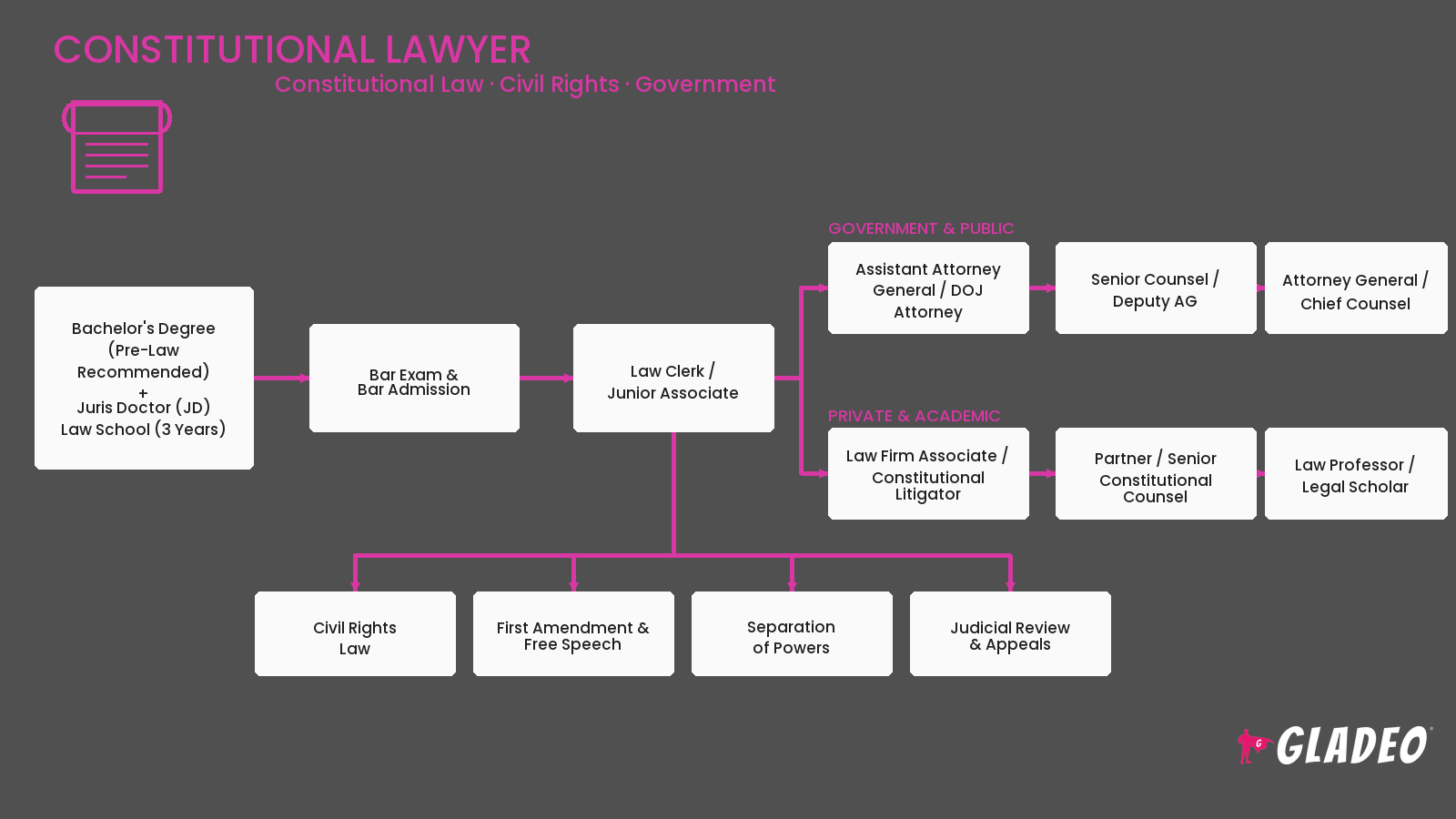
- Pursue a judicial clerkship, especially at the federal appellate level, right after law school
- Apply for fellowships at civil rights and civil liberties organizations
- Search job boards through public interest legal networks and advocacy nonprofits
- Attend recruiting events hosted by government agencies and public interest firms
- Network with professors, clinic supervisors, and practicing constitutional lawyers
- Pass the bar exam and stay current on major constitutional rulings
- Highlight moot court, law review, or clinic experience prominently on your resume
- Consider starting at a state attorney general's office to build litigation experience
- Practice writing clear, persuasive legal arguments and seek feedback often
- Apply to public interest law fellowships that fund early-career advocacy work
- Be open to relocating for positions with the strongest litigation opportunities
- Join student and early-career chapters of civil rights and constitutional law organizations
- Build a track record of well-researched, persuasive briefs and oral arguments
- Take on more complex cases with broader precedent-setting potential
- Develop deep expertise in a specific constitutional area, such as free speech or voting rights
- Publish legal scholarship or commentary to build a public reputation
- Argue cases before appellate courts and, eventually, the Supreme Court
- Move into leadership roles at advocacy organizations or government legal offices
- Mentor law students and junior attorneys entering constitutional law
- Build relationships with coalition partners across the civil rights legal community
Websites:
- American Civil Liberties Union - aclu.org
- American Constitution Society - acslaw.org
- National Constitution Center - constitutioncenter.org
- NAACP Legal Defense and Educational Fund - naacpldf.org
- Institute for Justice - ij.org
- Electronic Frontier Foundation - eff.org
- Brennan Center for Justice - brennancenter.org
- American Bar Association Section of Civil Rights and Social Justice - americanbar.org
- Federalist Society - fedsoc.org
- First Amendment Coalition - firstamendmentcoalition.org
- Supreme Court Historical Society - supremecourthistory.org
- SCOTUSblog - scotusblog.com
- Alliance Defending Freedom - adflegal.org
- National Association for Public Interest Law - napil.org
Books:
- American Constitutional Law by Laurence H. Tribe
- Constitutional Law: Principles and Policies by Erwin Chemerinsky
- Simple Justice by Richard Kluger
- The Nine: Inside the Secret World of the Supreme Court by Jeffrey Toobin
- Gideon's Trumpet by Anthony Lewis
If you find that being a Constitutional Lawyer isn't the right fit, your skills in research, persuasive writing, and advocacy transfer well to many related careers.
- Civil Rights Litigator
- Policy Analyst
- Legislative Aide or Counsel
- Law Professor
- Nonprofit Executive Director
- Journalist covering law and policy
- Government Relations Specialist
- Judicial Clerk
- Human Rights Advocate
- Political Campaign Advisor
Click here to download the infographic
Newsfeed

Featured Jobs
Online Courses and Tools