







Spotlights
AI Architect, Artificial Intelligence Solutions Architect, Machine Learning Solutions Architect, AI Infrastructure Architect, Enterprise AI Architect, AI Systems Architect, AI Platform Architect, AI Integration Architect, AI Technical Architect, AI Implementation Lead, AI Strategy Architect, Applied AI Architect
Every company that wants to "use AI" eventually runs into the same wall: brilliant ideas about automating customer service, predicting equipment failures, or personalizing recommendations, but no clear plan for how those ideas connect to the messy systems already running the business. AI Solutions Architects are the ones who close that gap, turning ambitious AI goals into a blueprint that actually works with the databases, software, and workflows a company already has.
On any given project, an AI Solutions Architect studies a business problem, evaluates which AI tools and platforms fit best, and designs how data will flow from its source into a model and back out into a useful decision or product feature. They work closely with executives to understand budget and goals, with data engineers and machine learning engineers to make sure the technical plan is buildable, and with security and compliance teams to make sure it is safe and legal. Their blueprint becomes the shared map everyone else builds from.
Using cloud platforms like AWS, Microsoft Azure, and Google Cloud, along with architecture diagrams, integration tools, and AI frameworks, AI Solutions Architects turn scattered ambition into a working system. Their decisions about which vendors, tools, and data pipelines to use shape whether an AI project actually launches, scales, and delivers value, or quietly stalls out as an expensive experiment.
- Shaping how a company will use AI for years to come through the choices you make early on
- Translating big-picture business strategy into a technical plan that real teams can build
- Working at the intersection of technology, leadership, and innovation on nearly every project
- Seeing an idea move from a whiteboard sketch to a system that changes how people work
Working Schedule
AI Solutions Architects generally work full-time, standard business hours, since much of the job involves meetings with stakeholders across departments and time zones. The role is a mix of independent design work, spent researching platforms and drafting architecture diagrams, and highly collaborative work, spent in workshops with executives, engineers, and vendors. Most are employed by technology companies, consulting firms, or the internal IT departments of large organizations, though a growing number work as independent consultants advising multiple clients at once.
Typical Duties
- Meeting with business leaders to understand goals, pain points, and budget for an AI initiative
- Evaluating AI platforms, cloud services, and vendor tools to find the best fit for a project
- Designing the overall architecture showing how data, models, and applications connect
- Mapping how data will move from existing systems into an AI pipeline and back out again
- Assessing a company's existing infrastructure for gaps that could block an AI rollout
- Creating technical documentation and diagrams that guide engineering teams during development
- Working with data engineers and machine learning engineers to validate that a design is feasible
- Reviewing security, privacy, and compliance requirements before a system goes live
- Estimating costs, timelines, and resource needs for AI projects
- Presenting architecture plans and recommendations to executives and technical teams
- Troubleshooting integration issues between AI systems and legacy software
- Staying current on new AI models, tools, and platforms to recommend the best options
Additional Responsibilities
- Mentoring engineers and junior architects on AI system design
- Writing proposals and requests for proposal (RFP) responses for new AI initiatives
- Negotiating with software and cloud vendors on licensing and service terms
- Running proof-of-concept projects to test an approach before full-scale investment
- Auditing existing AI systems for performance, cost, and scalability issues
- Building governance frameworks for how AI models are deployed and monitored
- Representing the technical team in cross-departmental strategy meetings
An AI Solutions Architect's morning often starts with checking in on any AI systems currently in development, reviewing overnight test results or messages from engineering teams about a technical blocker. They might spend the first hour reviewing a data flow diagram, updating an architecture document, or reading up on a new model release that could change their recommendation for a client.
Midday is frequently packed with meetings. The architect might walk a client's leadership team through a proposed AI roadmap, explaining in plain language why a particular cloud platform or model type makes sense for their goals and budget. Afterward, they could huddle with data engineers to sort out how a proposed pipeline will actually pull information from an old customer database without breaking anything.
Afternoons often shift toward hands-on evaluation and writing. The architect might test a vendor's AI platform, sketch out a revised architecture diagram after new requirements come in, or draft documentation that a development team will use to start building. Before the day ends, they typically follow up with stakeholders, answer technical questions from engineers, and note open risks that need attention before the next project milestone.
Soft Skills
- Strong communication with both technical and non-technical audiences
- Strategic and big-picture thinking
- Persuasion and the ability to build consensus among stakeholders
- Problem-solving and systems thinking
- Active listening to understand real business needs, not just stated ones
- Leadership and the ability to guide teams without direct authority
- Adaptability as technology and requirements shift quickly
- Negotiation skills for working with vendors and internal teams
- Patience when explaining complex technical tradeoffs
- Attention to detail in documentation and planning
- Comfort with ambiguity and incomplete information
- Collaboration across departments and disciplines
Technical Skills
- Cloud platforms such as AWS, Microsoft Azure, and Google Cloud
- Machine learning and AI frameworks including TensorFlow and PyTorch
- Data architecture, data pipelines, and ETL (extract, transform, load) processes
- API design and system integration
- Enterprise architecture frameworks such as TOGAF
- Security, privacy, and compliance standards for data and AI systems
- Understanding of large language models, MLOps, and model deployment practices
- Database design, including both relational and NoSQL systems
- Cost estimation and cloud infrastructure budgeting
- Diagramming and documentation tools for system architecture
- Enterprise AI Architect: Designs AI strategy and infrastructure across an entire large organization
- Cloud AI Architect: Focuses on deploying AI solutions using a specific cloud provider's tools
- Data Platform Architect: Specializes in the data pipelines and storage that feed AI systems
- MLOps Architect: Designs the systems that deploy, monitor, and maintain machine learning models in production
- Industry-Specific AI Architect: Focuses on AI solutions tailored to healthcare, finance, retail, or another sector
- AI Integration Architect: Focuses on connecting new AI tools with a company's existing legacy software
- AI Security Architect: Specializes in the security, privacy, and governance of AI systems
- AI Consulting Architect: Advises multiple client companies on AI strategy and implementation as an outside expert
- Technology and software companies
- Management and IT consulting firms
- Cloud service providers
- Financial services and banking institutions
- Healthcare systems and health technology companies
- Retail and e-commerce companies
- Manufacturing and logistics companies
- Government agencies and public sector technology offices
- Telecommunications companies
- Insurance companies
- Startups building AI-powered products
- Universities and research institutions
AI Solutions Architects are expected to be right, or close to it, when recommending million-dollar technology investments. Companies rely on their judgment to choose platforms and designs that will still make sense years down the road, so the pressure to research thoroughly and communicate tradeoffs honestly is constant.
The field moves fast. New AI models, tools, and best practices appear every few months, and an architect who falls behind can recommend outdated solutions without realizing it. This means significant time outside of core project work goes toward reading, testing new tools, and earning certifications just to stay current.
The role also requires comfort with being the person in the room who has to say difficult things, like telling an executive that their AI vision is not technically or financially realistic yet. Balancing business optimism with technical honesty, while managing many stakeholders with different priorities, can be mentally demanding and occasionally stressful, especially near major project deadlines.
- Rapid adoption of generative AI and large language models across industries
- Growing use of retrieval-augmented generation (RAG) to connect AI models with company-specific data
- Increased focus on responsible AI governance, bias testing, and explainability
- Rise of AI agents that can take multi-step actions rather than just answer questions
- Greater demand for hybrid architectures that mix cloud and on-premises systems
- Expansion of MLOps practices for monitoring and maintaining models after deployment
- Growing importance of data privacy regulations shaping how AI systems are designed
- Increased use of low-code and no-code AI platforms for faster prototyping
- Rising demand for AI cost optimization as compute expenses climb
- More companies building internal AI centers of excellence led by architects
Many AI Solutions Architects were the kids who loved figuring out how systems fit together, whether that meant organizing a messy closet by category, building elaborate setups in strategy video games, or mapping out how a school project should be divided among a group. They often enjoyed both building things and explaining how they worked to other people.
Many also gravitated toward math, computer science, or business classes at the same time, and enjoyed being the person who could translate a complicated idea into something a friend or teammate could actually use. A natural curiosity about new technology, combined with a knack for planning and persuasion, often pointed toward this kind of career.
Most AI Solutions Architects hold a bachelor's degree in computer science, information technology, data science, or a related field, and many pursue a master's degree in a specialized area like artificial intelligence, machine learning, or enterprise architecture. Because this is a senior role that blends deep technical knowledge with business strategy, most architects spend several years working as software engineers, data engineers, or machine learning engineers before moving into architecture.
Students can take courses in relevant subjects such as:
- Computer Science Fundamentals and Data Structures
- Artificial Intelligence and Machine Learning
- Cloud Computing and Distributed Systems
- Database Design and Data Management
- Enterprise Architecture and Systems Design
- Statistics and Applied Mathematics
- Business Strategy and Project Management
- Cybersecurity and Data Privacy
- Software Engineering and API Design
- Ethics of Artificial Intelligence
Beyond coursework, hands-on experience building and deploying real systems is essential. Internships in software engineering, cloud infrastructure, or data science help future architects understand how systems behave in practice, not just in theory. Many also earn professional certifications from cloud providers, which employers use as proof of platform-specific expertise. Continuing education never really stops in this field, since new AI tools and best practices emerge constantly.
- Take advanced math, computer science, and statistics courses whenever possible
- Learn a programming language like Python, which is widely used in AI and data work
- Join a computer science club, hackathon team, or robotics program
- Build small AI or data projects to learn how models actually work
- Take business or economics classes to understand how companies make technology decisions
- Practice public speaking and writing, since architects must explain technical ideas clearly
- Seek out internships in software engineering, IT, or data analytics
- Learn the basics of a cloud platform like AWS, Azure, or Google Cloud through free tutorials
- Read about real AI case studies to understand how businesses apply the technology
- Participate in case competitions or entrepreneurship programs that mix technology and strategy
- Ask to shadow a technology professional or architect for a day
- Practice diagramming systems and processes, even for simple everyday tasks
- Strong computer science or information systems curriculum with real coding practice
- Courses that cover both machine learning and enterprise systems, not just one or the other
- Opportunities to work on capstone projects with real businesses or organizations
- Access to cloud computing labs or free cloud credits for hands-on practice
- Faculty with industry experience in AI, data, or enterprise architecture
- Strong internship placement support with technology and consulting employers
- Coursework that includes business communication and project management
- Preparation for cloud certification exams from providers like AWS or Microsoft
- Opportunities to study enterprise architecture frameworks such as TOGAF
- Active alumni network in technology and consulting fields
- Flexible programs that allow working professionals to study part-time
- Career services that connect students with technology employers
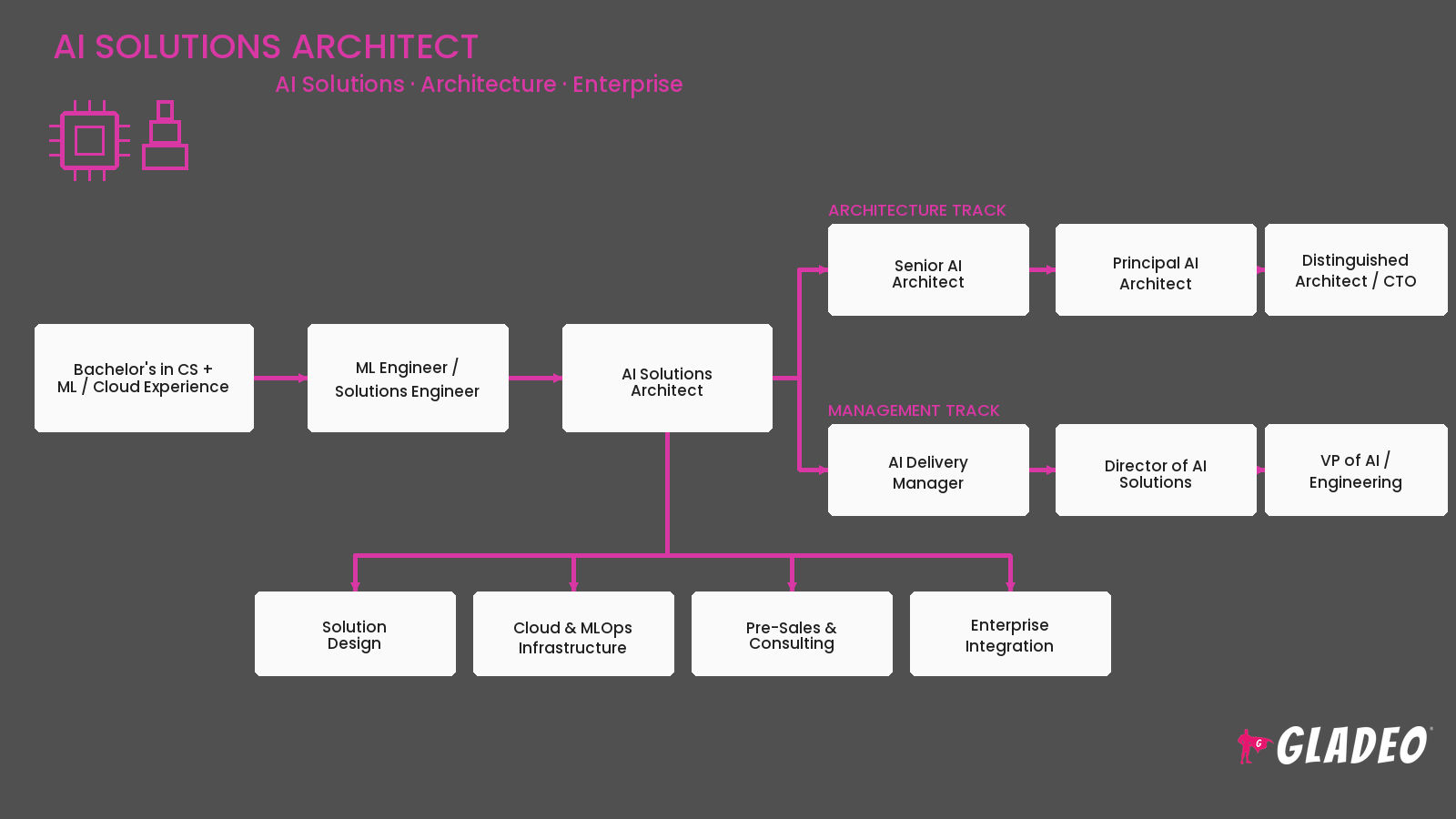
- Build a strong foundation first in software engineering, data engineering, or cloud infrastructure
- Earn a cloud certification such as AWS Certified Solutions Architect or Microsoft Azure Solutions Architect
- Create a portfolio of AI or data projects that show you can design, not just code
- •Apply for roles like Junior AI Engineer, Cloud Engineer, or Data Engineer as stepping stones
- Search job boards such as LinkedIn, Indeed, and company career pages for entry points into AI teams
- Attend AI and cloud computing conferences or local meetups to build your network
- Practice explaining technical projects in plain language for non-technical interviewers
- Contribute to open-source AI or data projects to demonstrate real skills
- Seek mentorship from experienced architects or senior engineers at your company
- Volunteer for cross-functional projects that expose you to business strategy discussions
- Highlight any experience translating business needs into technical solutions on your resume
- Be patient; most AI Solutions Architects spend years building technical depth before earning the title
- Take ownership of increasingly complex system design projects
- Earn advanced certifications in multiple cloud platforms and AI specialties
- Build a track record of AI projects that launched successfully and delivered real value
- Develop strong relationships with business leaders, not just technical teams
- Learn enterprise architecture frameworks to design at a company-wide scale
- Mentor junior engineers and architects to build leadership experience
- Present at conferences or write articles to build a reputation in the field
- Move into roles like Principal Architect, Chief AI Architect, or Head of AI Strategy
Websites:
- Association of Enterprise Architects (AEA) - globalaea.org
- The Open Group (TOGAF) - opengroup.org
- Association for the Advancement of Artificial Intelligence (AAAI) - aaai.org
- IEEE Computer Society - computer.org
- Association for Computing Machinery (ACM) - acm.org
- Partnership on AI - partnershiponai.org
- AWS Training and Certification - aws.amazon.com/training
- Microsoft Learn - learn.microsoft.com
- Google Cloud Skills Boost - cloudskillsboost.google
- MLOps Community - mlops.community
- Towards Data Science - towardsdatascience.com
- KDnuggets - kdnuggets.com
- Gartner Research - gartner.com
- InfoQ AI, ML & Data Engineering - infoq.com/ai-ml-data-eng
Books:
- Prediction Machines: The Simple Economics of Artificial Intelligence by Ajay Agrawal, Joshua Gans, and Avi Goldfarb
- Enterprise Architecture as Strategy by Jeanne W. Ross, Peter Weill, and David C. Robertson
- Designing Data-Intensive Applications by Martin Kleppmann
- Machine Learning Design Patterns by Valliappa Lakshmanan, Sara Robinson, and Michael Munn
- AI Superpowers by Kai-Fu Lee
If you find that being an AI Solutions Architect isn't the right fit, your skills in systems thinking, technology strategy, and translating business needs into technical plans transfer well to many related careers.
- Enterprise Architect
- Cloud Solutions Architect
- Machine Learning Engineer
- Data Engineer
- IT Project Manager
- Technology Consultant
- Data Architect
- Business Systems Analyst
- Product Manager for AI Products
- DevOps or MLOps Engineer
Click here to download the infographic
Newsfeed

Featured Jobs
Online Courses and Tools